


app-store-logo
play-store-logo
February 20, 2026

Marine Fossils Reveal Mount Everest’s Underwater Past
The CSR Journal Magazine

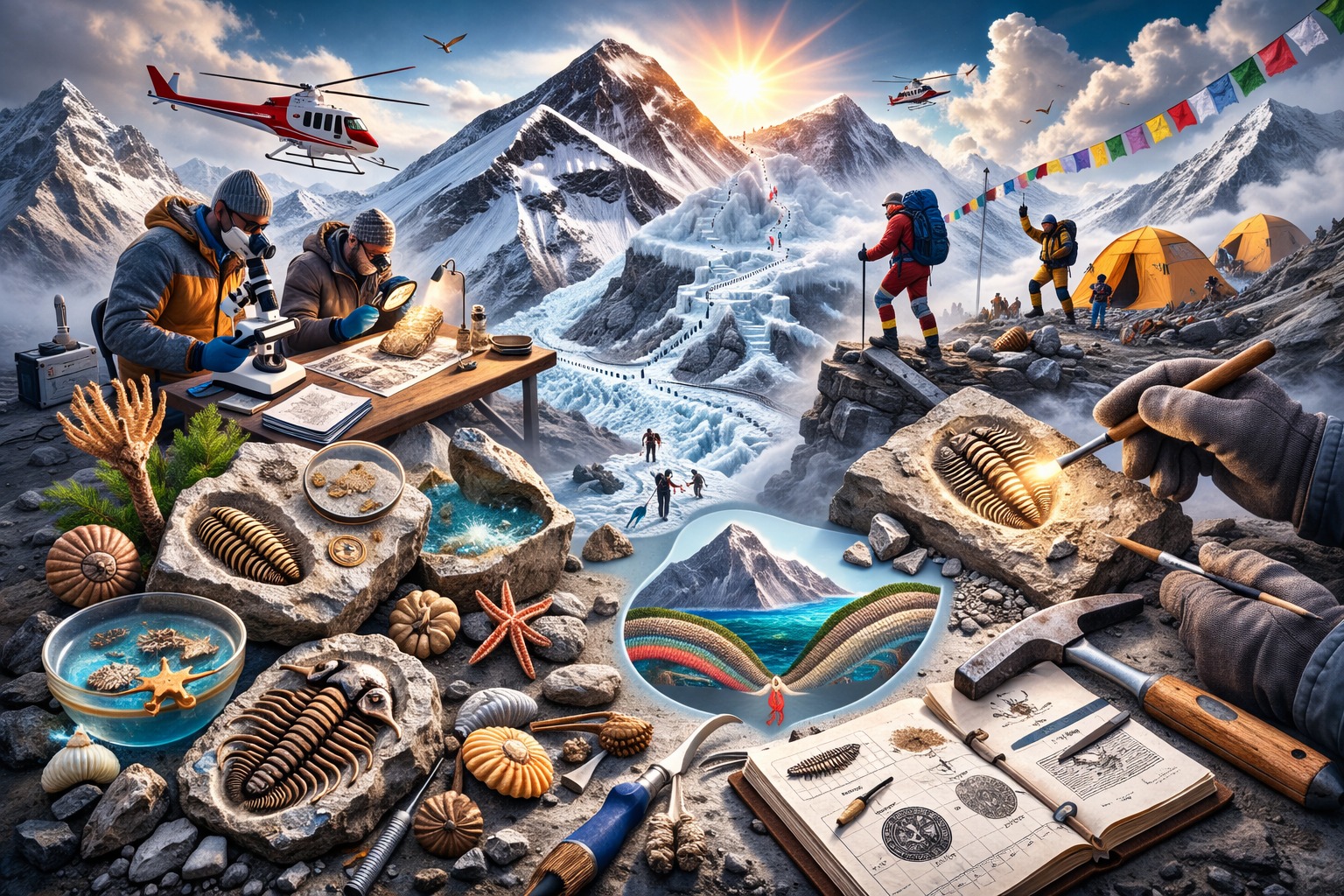
At an elevation of approximately 8,000 meters, scientists and climbers have discovered marine fossils on Mount Everest, highlighting its ancient origins. The presence of fossils from marine life such as trilobites, crinoids, and brachiopods at such altitudes raises significant scientific interest. These fossils were embedded in sedimentary rock formed long before the mountain was uplifted, showcasing extensive geological transformations linked to tectonic activities and the historical closure of an ancient ocean.

Connection to the Tethys Ocean

Research indicates that the current formations atop Everest were once situated beneath the Tethys Ocean, which divided the Indian landmass from the Asian continent. Approximately 225 million years ago, the Indian plate was located far south of Asia, and sediments accumulated along its margins. Over time, organic remains, including shells and other skeletal fragments, settled into layers that eventually solidified into rock. These formations have remained intact even as tectonic forces restructured the region, resulting in the elevation of these marine deposits to extreme heights.

Plate Tectonics and the Shaping of the Himalayas

As the supercontinent Pangaea began to split around 200 million years ago, the Indian plate initiated its northward migration. By 80 million years ago, it was positioned thousands of kilometers south of Asia, progressively moving northward. The oceanic crust of the Tethys Ocean was subjected to subduction under the Eurasian margin, a geological process akin to the current dynamics observed in the Andes mountain range. While some material was pushed into the Earth’s crust, significant marine sediments were aggregated, forming part of the burgeoning mountain belt.

The Collision of Continental Plates

The collision between the Indian and Eurasian continental plates, which occurred between 50 and 40 million years ago, marked a pivotal point in the region’s geological history. Both plates, composed of buoyant continental crust, resisted sinking, leading to the crumpling and thickening of the crust. This collision signifies the beginnings of the Himalayan uplift, resulting in a mountain range stretching approximately 2,900 kilometers from east to west, with Mount Everest standing as the tallest peak at 8,848 meters.

Continual Uplift and Erosion

Current geological assessments reveal that the Himalayas continue to rise at a rate of over one centimeter per year as the Indian plate advances northward. Simultaneously, erosion processes, driven by ice, wind, and water, work to wear down the rock formations. This dynamic interplay between uplift and erosion leads to an ongoing evolution of the landscape. The marine fossils found within these rocky layers serve as silent reminders of a time when parts of the world now recognized as the highest peaks were once submerged under a vast sea.

Long or Short, get news the way you like. No ads. No redirections. Download Newspin and Stay Alert, The CSR Journal Mobile app, for fast, crisp, clean updates!

App Store –  https://apps.apple.com/in/app/newspin/id6746449540 

Google Play Store – https://play.google.com/store/apps/details?id=com.inventifweb.newspin&pcampaignid=web_share

Latest News

Popular Videos
