


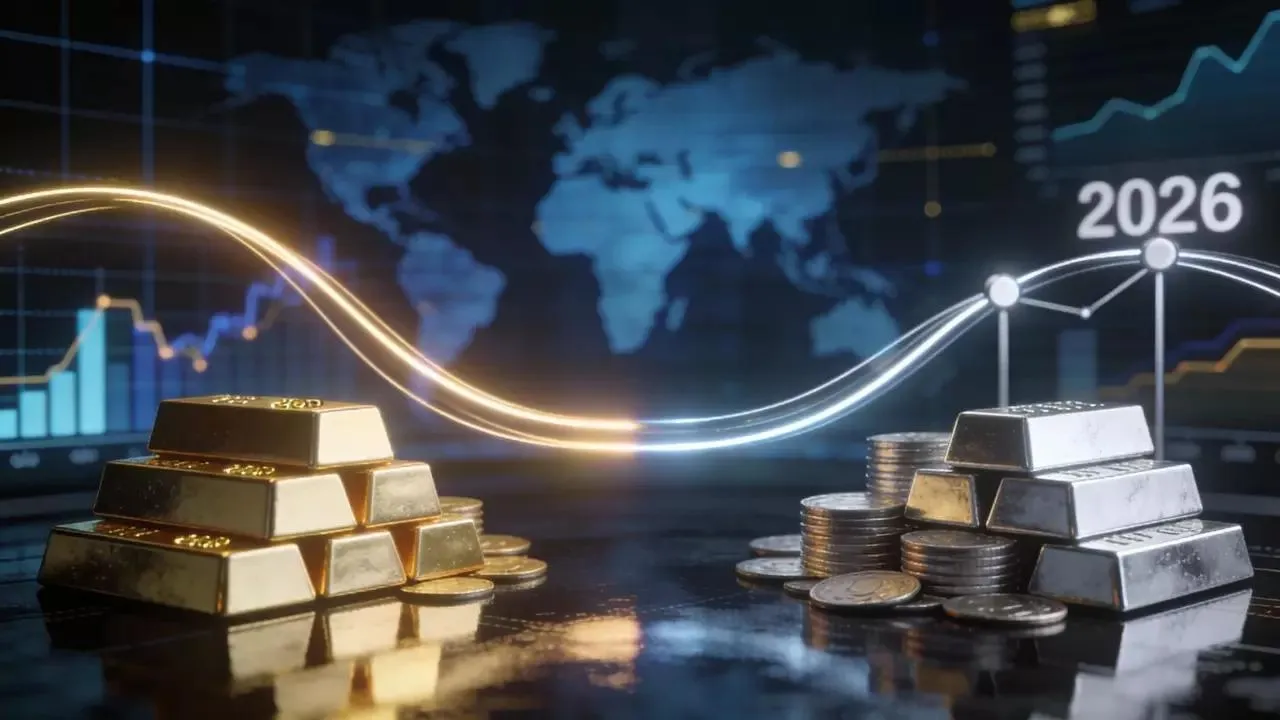

In the early days of 2026, as global markets navigate uncertain waters, 2 timeless assets have emerged as beacons of stability: gold and silver.
As of late January, gold trades around $5,500 per ounce, marking a staggering rise of over 98% from a year ago.
Silver, often called the “people’s metal,” has surged even more dramatically, hovering near $117 per ounce with a year-over-year gain exceeding 270%.
These aren’t just numbers on a screen—they reflect a profound shift in how people and institutions are safeguarding their wealth amid economic turbulence.
As someone who’s spent decades observing financial flows, I see this as more than a trend; it’s a response to deeper forces reshaping our world.
But is this rapid climb sustainable, or are we witnessing the formation of a bubble?
Gold and silver have long been symbols of enduring value. An old proverb reminds us, “All that glitters is not gold,” cautioning against superficial allure. Yet in today’s economy, these metals glitter for good reason: they offer a hedge against uncertainty when paper money and stocks falter.
Over the past year, gold has climbed more than 60% in 2025 alone, building on gains that pushed it past $4,000 for the first time. Silver, meanwhile, doubled in value during 2025 before accelerating further, rising about 50% in January 2026 to hit historic peaks near $118.
This isn’t random speculation; it’s rooted in real-world pressures.
First, global tensions—from ongoing conflicts in the Middle East and Ukraine to trade disputes—have driven investors toward safe havens. When uncertainty looms, people turn to assets that have held value for centuries. Gold, in particular, benefits from this, as it’s seen as a shield against chaos. Silver shares this appeal but adds an industrial edge, used in everything from solar panels to electronics, boosting demand as green technologies expand.
Second, central banks worldwide are stockpiling these metals at record paces. In 2025, they added over 1,000 tons of gold for the third straight year, with countries like China, India, and Turkey leading the charge. This isn’t just hoarding; it’s a strategic move to diversify away from the U.S. dollar amid fears of currency weakening. As one economic saying goes, “Gold is the money of kings,” highlighting its role as a reliable store of value when trust in paper currencies erodes. Silver, too, sees institutional interest, though its rally is amplified by supply shortages—global deficits have persisted for years, pushing prices higher.
Third, economic policies play a big role. With the U.S. Federal Reserve expected to cut interest rates up to 150 basis points through 2026—meaning borrowing gets cheaper—non-yielding assets like gold become more attractive. Lower rates weaken the dollar, making metals cheaper for international buyers and fueling demand. Inflation concerns, sparked by tariffs and rising debts, further propel this trend. As economist Milton Friedman once noted, “Inflation is always and everywhere a monetary phenomenon,” and when money supply grows unchecked, real assets like metals shine.
Who’s Buying and Why?
The buyers span the globe, from powerful institutions to everyday savers. Central banks are the heavy hitters, averaging 60 tons of gold purchases monthly—triple the pre-2022 rate.
China and India alone account for much of this, using gold to bolster reserves and reduce reliance on foreign currencies. This “de-dollarization” trend reflects a broader shift: nations preparing for a multipolar world where the dollar’s dominance wanes.
Investors, both big and small, are piling in too. Exchange-traded funds (ETFs) have added about 500 tons of gold since early 2025, driven by high-net-worth individuals and funds seeking protection from policy risks. Retail buyers, especially in Asia, view silver as an accessible entry point—its lower price per ounce makes it appealing for those hedging against local economic woes. In India, for instance, cultural affinity for gold and silver as jewelry and savings tools sustains demand, though recent policy tweaks have introduced some friction.
India’s approach to this surge warrants a gentle note of caution. While the country has wisely encouraged domestic production and recycling to meet demand, its reactive hikes in import duties—upping costs on gold and silver inflows—may unintentionally dampen access for ordinary citizens at a time when these metals could serve as vital buffers against inflation.
A more proactive strategy, perhaps easing barriers for small investors, could better align with the global momentum and empower more households to participate.
Is This a Bubble?
With such rapid gains, whispers of a bubble are inevitable. Gold’s steady ascent feels orderly, supported by fundamentals like central bank buying and geopolitical risks—hardly the froth of pure speculation. Analysts at J.P. Morgan forecast gold averaging $5,055 by late 2026, potentially reaching $5,400 by 2027, viewing it as a rebasing rather than overinflation. Silver, however, shows more volatility, with some experts warning of bubble territory due to retail frenzy and extreme price swings. Its 60% jump in January alone raises flags, as high prices could curb industrial demand and trigger corrections.
Yet, history suggests these aren’t classic bubbles. As Ron Paul put it, “Gold is honest money,” disliked by those who prefer fiat’s flexibility. Unlike tulips or dot-com stocks, metals have intrinsic uses and limited supply. If uncertainty persists, this could be a structural uptrend, not a pop waiting to happen.
The Future of Metals
Looking ahead, the outlook remains bright but nuanced. Gold could push toward $6,000 by year-end if rate cuts deepen and tensions escalate, per forecasts from Deutsche Bank and others. Silver might climb to $135 or even $309 in extreme scenarios, driven by green tech demand, though averages around $68-115 seem more realistic. Supply constraints—mining output lagging demand—will keep floors high.
But metals’ future extends beyond gold and silver. As an old investing proverb states, “Don’t put all your eggs in one basket.” Copper and aluminum are next in line, fueled by the shift to electric vehicles, renewable energy, and infrastructure. Copper prices have risen to near $13,000 per ton in early 2026, up from recent highs, with forecasts averaging $11,750-12,000 amid supply deficits. Aluminum, trading around $3,267 per ton with a 24% yearly gain, benefits from its lightweight efficiency in EVs and solar setups. These “industrial metals” could outpace precious ones if green initiatives accelerate, offering diversification for savvy investors.

 Dr. Jaimine Vaishnav is a faculty of geopolitics and world economy and other liberal arts subjects, a researcher with publications in SCI and ABDC journals, and an author of 6 books specializing in informal economies, mass media, and street entrepreneurship. With over a decade of experience as an academic and options trader, he is keen on bridging the grassroots business practices with global economic thought. His work emphasizes resilience, innovation, and human action in everyday human life. He can be contacted on jaiminism@hotmail.co.in for further communication.