


app-store-logo
play-store-logo
March 10, 2026

China Announces 7% Increase in Defence Budget Amid Global Tensions
The CSR Journal Magazine

On March 5, 2026, China revealed plans to increase its defence budget by 7%, raising it to approximately RMB 1.91 trillion, or around USD 277 billion. This increment is slightly lower than the average annual increase of 7.2% seen over the past three years. The announcement comes at a time when geopolitical instability is prevalent, particularly in the Middle East, and has not garnered the same level of international attention as in previous years.

Factors Influencing Defence Spending

China’s decision to adjust its military spending appears influenced by various external factors, including recent shifts in its diplomatic relationships, notably with Venezuelan and Iranian leaders. These changes have also impacted the flow of oil, crucial for China’s economy. According to state media outlet Xinhua, Chinese officials emphasized the country’s sovereign right to modify its defence budget to align with national security needs in a rapidly changing global landscape.

Context of the National People’s Congress

This budget announcement was made during the 14th National People’s Congress in Beijing, a significant event involving discussions by over 2,000 delegates from the Chinese People’s Political Consultative Conference. The sessions serve as a key platform for policy discussions within the Chinese Communist Party.

Changes in Military Leadership

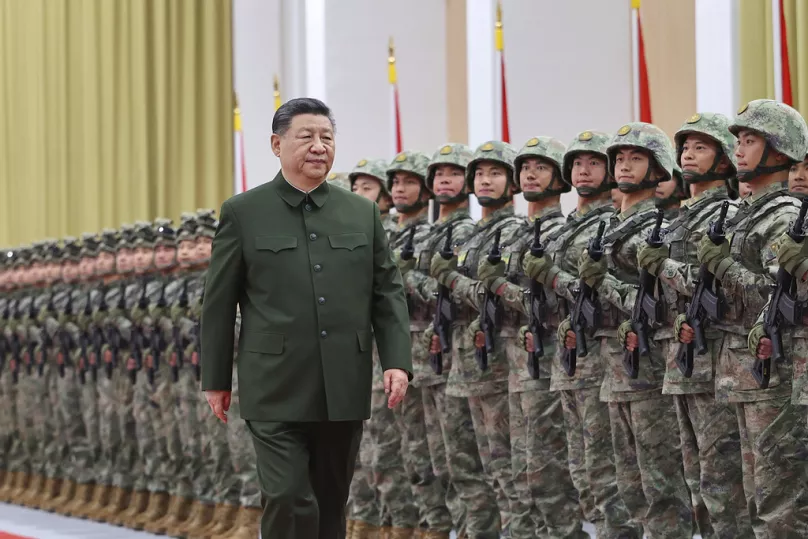
Amidst this backdrop, on the same day, the Central Military Commission (CMC) held a meeting at which members of the People’s Liberation Army (PLA) and People’s Armed Police (PAP) were directed to enhance operational standards. Notably, the CMC now has only two members: Xi Jinping and Vice-Chairman General Zhang Shengmin, following a series of purges targeting senior military leaders. Since 2022, around 101 high-ranking PLA officials have reportedly been removed as part of an anti-corruption campaign led by Xi, including two recent members of the CMC.

Historical Trends in Defence Expenditure

China’s defence budget has now seen single-digit increases for eleven consecutive years, a shift from the double-digit growth earlier in this century. The current increase is the smallest since a 6.8% rise recorded in 2021, the year following the COVID-19 pandemic. Nevertheless, China’s military expenditure continues to outpace that of other regional actors. Reports indicate that China now accounts for almost 44% of total military expenditure in Asia, spending significantly more than Japan and Taiwan.

Concerns Over Actual Defence Spending

Analysts caution that the officially announced figure of RMB 1.91 trillion does not represent the entirety of China’s military spending. The Pentagon has indicated that actual expenditure may be 32% to 63% higher than publicly stated figures, as the total budget often excludes defence-related research and development, internal security expenses, and other military mobilization activities. Authorities have stated that these funds will support improved training, modernisation efforts, and the creation of military strategies for the upcoming five-year period from 2026 to 2030.

2027 Milestone and Strategic Goals

The year 2027 will mark the centennial of the PLA, a target for which the military aims to accomplish several significant goals, integrating mechanisation, informatization, and intelligentisation. This push to modernise is reportedly tied to the necessity of enhancing capabilities against perceived threats, notably in the Taiwan Strait, where tensions have escalated significantly. Last year, PLA aircraft conducted 5,709 sorties in the region.

International Arms Exports and Imports

China’s rankings in global arms exports and imports have evolved, showing a decline in its arms import levels. In recent reports, China accounted for 5.6% of global arms sales between 2021 and 2025. The majority of its arms exports were directed to countries in Asia and Oceania, particularly Pakistan. Despite a decrease in imports, China’s domestic production capabilities have reportedly allowed it to achieve a near-complete independence in military equipment supply.

Response to Geopolitical Developments

As tensions mount globally, particularly regarding conflicts involving Iran and its relationships with Iraq and Hezbollah, China has been selective in deepening ties. Nevertheless, the nation remains focused on its energy requirements, which are vulnerable to international turmoil, particularly in the Strait of Hormuz. Given this dependency, China is likely to pursue diplomatic channels rather than direct military engagement while enhancing its defence budget for 2026.

Long or Short, get news the way you like. No ads. No redirections. Download Newspin and Stay Alert, The CSR Journal Mobile app, for fast, crisp, clean updates!

App Store –  https://apps.apple.com/in/app/newspin/id6746449540 

Google Play Store – https://play.google.com/store/apps/details?id=com.inventifweb.newspin&pcampaignid=web_share

Latest News

Popular Videos
