


app-store-logo
play-store-logo
December 20, 2025

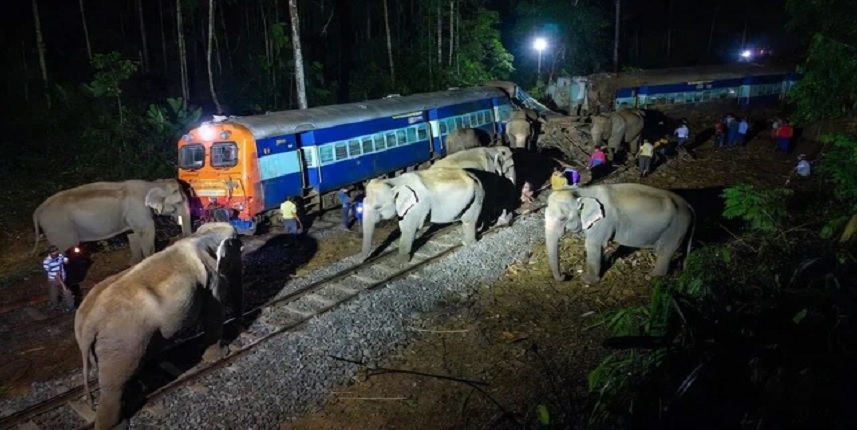
Assam: Rajdhani Express derails after collision with herd, 8 elephants die on track, one critical

The CSR Journal Magazine

Eight elephants were killed in a collision with the Rajdhani Express in Assam. A baby elephant has been severely injured in the accident which occurred at 2:17 AM on Saturday in the Hojai district of Assam. The engine and five coaches of the Rajdhani Express derailed as a result of the accident. However, the Northeast Frontier Railway authorities have stated that all the passengers are safe.

At least eight elephants were killed in a collision between a herd of elephants and the Sairang-New Delhi Rajdhani Express. A baby elephant was seriously injured in the accident and was later rescued by forest department officials. The incident has also caused significant disruption to train services in the region.

The Rajdhani Express was traveling from Sairang (near Aizawl) in Mizoram towards Anand Vihar Terminal in New Delhi. Near Hojai, a herd of elephants suddenly came onto the tracks. The loco pilot applied the emergency brakes upon seeing the elephants, but the collision could not be avoided. The elephants were hit by the train, causing the engine and five coaches to derail.

Forest department officials stated that a total of eight elephants died in the accident. Local residents claim that there were around eight elephants in the herd, and most of them perished in the collision. It has also been reported that the location where the incident occurred is not a designated elephant corridor.

Railway authorities have stated that no passengers were injured in the accident. However, the derailment and the presence of elephant carcasses on the tracks disrupted train services on various routes in Upper Assam and Northeast India. Upon receiving news of the accident, the railway accident response team and senior officials quickly reached the scene.

According to railway sources, passengers from the damaged coaches have been temporarily accommodated in empty berths in other coaches of the train. After the train reaches Guwahati, additional coaches will be added to ensure all passengers reach their destinations.

Human-wildlife conflict in India

This incident has once again raised questions about collisions between trains and wildlife, particularly elephants in India. The fact that this accident occurred outside a designated elephant corridor is strengthening calls for renewed discussions on coordination between the forest and railway departments and the implementation of advance warning systems. Deaths due to train collisions.

India’s rapidly expanding railway network is increasingly becoming a major threat to wildlife—especially elephants. A recent government survey has revealed alarming information. From the 2009-10 financial year to 2024, at least 186 elephants have died in the country due to collisions with trains. Due to this worrying situation, the central government has now identified a total of 77 railway lines in 14 states where preventive measures will be taken on an urgent basis.

The survey was conducted jointly by the Union Ministry of Environment, the Ministry of Railways, and the concerned state forest departments. At least 127 railway lines, with a total length of approximately 3,452 kilometres, were included in the survey. Based on the analysis of past elephant movement and mortality data, 77 of these railway lines have been identified as the ‘riskiest’. Government sources claim that this is the first time such a comprehensive analysis of rail-wildlife collisions has been conducted.

During the survey, expert teams inspected the railway lines on foot and using trolleys. The level of risk was determined by examining various factors such as the height of the tracks, surrounding vegetation, existing infrastructure, and drainage systems.

A total of 705 special structures have been proposed to reduce elephant deaths. These include 503 ramps and level crossings, 72 bridge expansions and modifications, 65 underpasses, 22 overpasses, 39 fences, barricades or trenches and 4 exit ramps.

The goal of all these structures is the same—to provide elephants with safe passage across railway lines or to divert them away from dangerous areas.

States with a higher elephant population have been given priority. It has been decided that 131 level crossings and ramps will be built in Assam, 125 in Maharashtra, and 92 in Uttar Pradesh.

According to the 2017 elephant census, Karnataka has the highest number of wild elephants—6,049. This is followed by Assam (5,719), Kerala (5,706), and Tamil Nadu (2,761). These states have active railway lines running through dense forest areas, resulting in the highest risk of collisions.

Long or Short, get news the way you like. No ads. No redirections. Download Newspin and Stay Alert, The CSR Journal Mobile app, for fast, crisp, clean upda
App Store – https://apps.apple.com/in/app/newspin/id6746449540
Google Play Store – https://play.google.com/store/apps/details?id=com.inventifweb.newspin&pcampaignid=web_share

Latest News

Popular Videos