


Amazon Cargo Jet Crash at Miami Airport Claims Five Lives
The CSR Journal Magazine

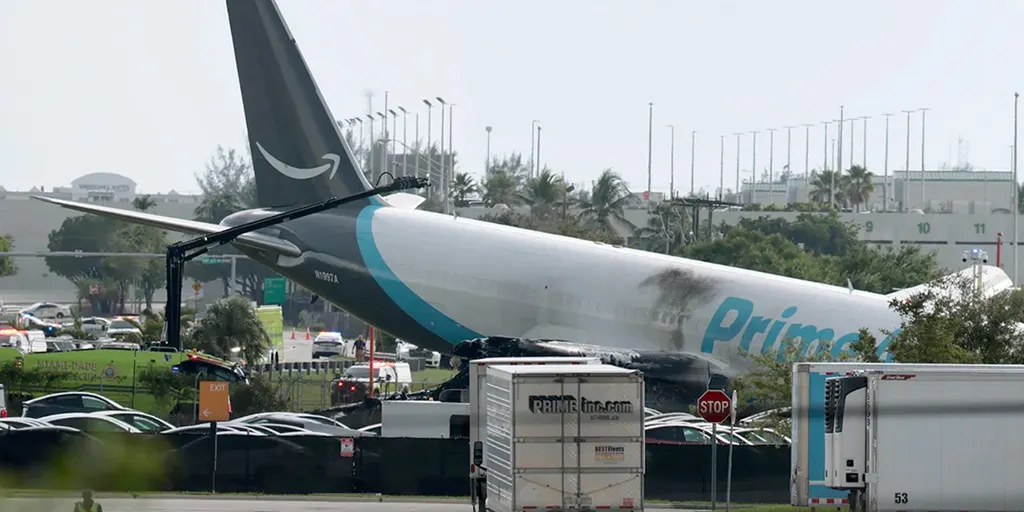
Federal investigators are initiating a detailed examination of the crash involving an Amazon cargo jet at Miami International Airport. The incident occurred at approximately 2 pm on Sunday, when the aircraft, having arrived from San Juan, Puerto Rico, overran the runway, collided with vehicles, and subsequently caught fire.

Tragically, five individuals lost their lives, while another five sustained injuries, three of whom are in critical condition. The complexity of the situation arose as it remains unclear whether the pilots survived the incident or if all casualties were in vehicles struck by the jet. One bystander was also reportedly trapped beneath a vehicle following the crash, which enveloped the area in thick black smoke.

Miami-Dade Rescue Fire Chief Ray Jadallah confirmed that the firefighting crews faced challenges in their rescue efforts, including removing both the pilot and co-pilot from the cockpit amid the flames. A news conference has been scheduled for Monday by Jennifer Homendy, chairwoman of the National Transportation Safety Board (NTSB).

Possible Causes of the Crash Investigated

Experts suggest that investigators will likely analyse whether the aircraft descended too far along the runway before landing. According to aviation safety expert Steve Arroyo, the standard landing zone is typically within the first 3,000 feet, or 914 metres, of a runway, and any touchdown beyond that point may necessitate a go-around for safety.

Mary Schiavo, a former Inspector General of the Transportation Department and an experienced pilot, pointed out that visual evidence from online sources seemed to indicate that the Amazon flight remained airborne longer than expected.

Despite the absence of rain, dark storm clouds and robust winds in the vicinity may have contributed to the aircraft’s landing dynamics. Schiavo further noted that a tail wind could exacerbate challenges during landing if sufficient runway space is not available. The importance of executing a timely landing becomes critical under such circumstances.

Impact on Airport Operations

The crash significantly disrupted flight operations at Miami International Airport, resulting in the cancellation of over 160 flights and delays for nearly 325 others, as reported by FlightAware. The incident also saw some flights diverted to Orlando International Airport, located over 200 miles, or 320 km, north of Miami.

Emergency response to the fire involved about 200 personnel, who worked amidst heavy flames and dense smoke emerging from an engine compartment fire. Firefighters employed specialised foam to extinguish the fire, while crews managed a fuel leak that persisted for several hours after the incident.

Images from the scene depicted the Boeing 767 Prime Air plane resting beside a roadway, having come to a stop largely intact despite extensive fire damage. Operated by 21 Air, a cargo carrier based in North Carolina, the company originally built it as a passenger jet, with over two decades of service before its conversion into a cargo plane in 2015.

Schiavo mentioned that investigators would meticulously scrutinise the aircraft’s maintenance history, particularly due to its past ownerships by foreign entities, including a firm from Russia. As the investigation unfolds, the focus will include the aircraft’s landing procedures, weather influences, safety features of the runway, and its maintenance record to ascertain the cause of this tragic incident.

Long or Short, get news the way you like. No ads. No redirections. Download Newspin and Stay Alert, The CSR Journal Mobile app, for fast, crisp, clean updates!

App Store –  https://apps.apple.com/in/app/newspin/id6746449540 

Google Play Store – https://play.google.com/store/apps/details?id=com.inventifweb.newspin&pcampaignid=web_share

Latest News

Popular Videos
