Why married people cheat, and why we’ve been lying to ourselves about why they shouldn’t
The CSR Journal Magazine

We built a moral cage around desire, called it civilization, handed out wedding rings, and then acted genuinely surprised when people kept picking the lock. The data is in. The apps are booming. And the conversation we’ve been avoiding is long overdue.

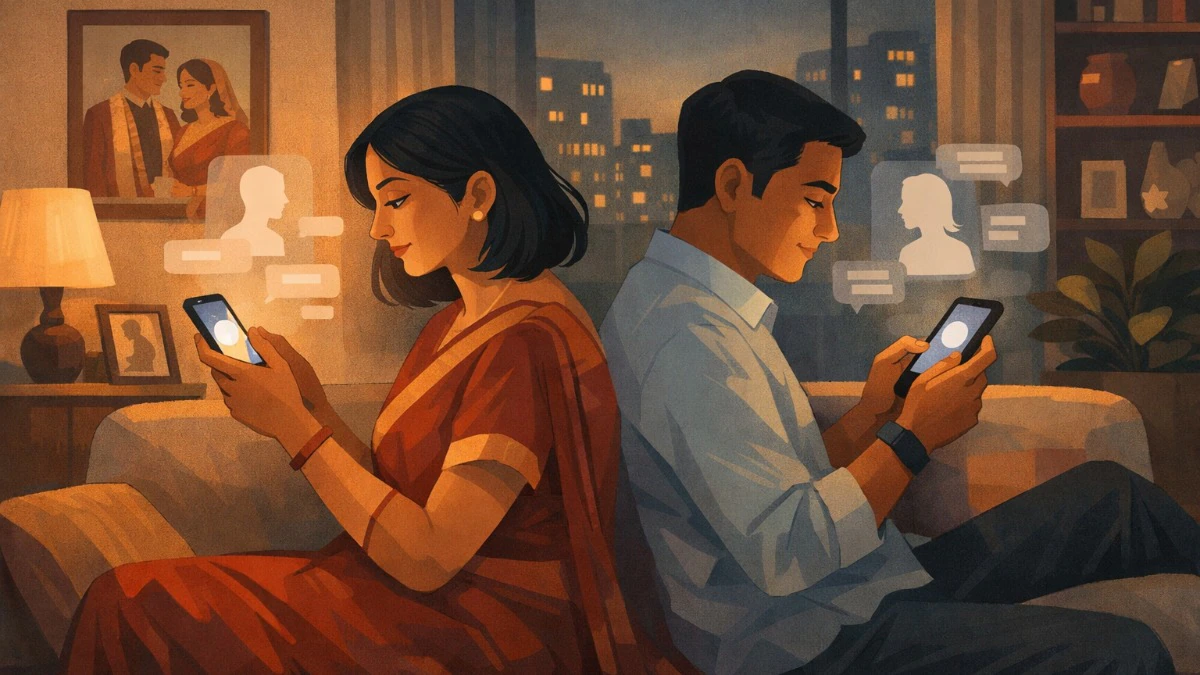
Somewhere in Bengaluru tonight — between the startup pitch decks and the arranged marriage photographs on the living room wall — a 37-year-old woman is opening an app on her phone at 11:47 PM. She isn’t ordering food. She’s on Gleeden, the extramarital dating platform, in a city that currently leads India in users seeking connections outside their marriages. She is not an anomaly. She is a data point in one of the most quietly staggering social shifts of our time.

We have spent centuries constructing an elaborate mythology around marriage: that it is natural, that fidelity is instinctive, that the desire to stray is a character flaw rather than a human condition. What if that mythology was always built on sand — and the tide is finally coming in?

Gleeden, the world’s largest extramarital dating platform, reached 3 million users in India alone — representing a 270% surge in 2024. That’s not a rounding error. That’s a city the size of Ahmedabad quietly signing up to cheat.

Women now make up 58% of Gleeden’s user base, with female registrations rising 128% in just the past year. The majority of new users fall between ages 30 and 50. The app they’re using was, by design, built for them — free for women, pay-to-play for men, with women controlling who sees their profiles and who can message them.

Female participation has risen 148% in the last 2 years. This isn’t a footnote. This is a structural shift in who cheats and why.

In the United Kingdom, the dating app Illicit Encounters saw a 50% uptick of women registering in 2023 alone. In France, the share of women who have been unfaithful has climbed from 10% in 1970 to nearly 38% today — a near-quadrupling in two generations.

Meanwhile, Ashley Madison — the pioneer of discreet affairs — reports a global footprint of millions, with over 3.5 million Indian users across its platform, and Gleeden adding 270% growth alongside it. In a global league table of infidelity, the United States tops the charts with 71% of people surveyed admitting to some form of cheating.

The anonymity problem: These numbers are almost certainly underestimates. One study found respondents were six times more likely to admit to an affair under conditions of complete anonymity. The shame gap between what people do and what they’ll admit to is enormous — which means every statistic you read about infidelity is a floor, not a ceiling.

The real question isn’t whether this is happening. It’s why we’re so shocked that it is.

Here is a biological fact that tends to make dinner parties uncomfortable: there is little doubt that the “natural” mating system for human beings is polygamy, encompassing both polygyny — one man with multiple women — and polyandry — one woman with multiple men.

The evidence isn’t fringe. It comes from mainstream evolutionary biology. Institutionalized monogamy, which largely follows from modern monotheistic religions in connection with urbanization, seems to have been very much the exception rather than the rule during the lion’s share of human evolutionary history. Before agriculture, before gods with commandments, before notarized wedding certificates — 80% of early human societies were polygamous.

Our bodies carry the receipts. In nature, species with the strongest polygynous inclinations — those whose males build the biggest harems — also tend to have the most exaggerated sexual dimorphism. Human males are moderately taller, heavier, and more muscular than females — a signal, in evolutionary terms, of moderate competition for multiple mates.

Evolutionary biologist David Barash, whose work on human mating is considered foundational, described us with a memorable metaphor: we are essentially a tortoise and a hare tied together to run a race — the tortoise being our polygamous nature and the hare being our monogamous culture, which can move much faster than genetic evolution does.

“The iconic image of the happy, naturally monogamous, heterosexual twosome has always been a fiction.” — David P. Barash, Evolutionary Biologist

This doesn’t mean monogamy is impossible or undesirable — Barash himself argues it can be a worthy and even ennobling pursuit, precisely because it is difficult. Just because monogamy isn’t “natural” to the human species doesn’t mean it isn’t possible or even desirable. In fact, we often do those things best that don’t come easily to us — like playing the violin.

But there is a crucial difference between a violin and a moral commandment. One says: “This is hard but beautiful.” The other says: “Failing to do this makes you a bad person.” The first is an aspiration. The second is a trap.

Social monogamy and sexual monogamy can exist in conjunction or independently. Social monogamy without sexual monogamy is common, as reflected in the rates of affairs and consensual non-monogamous committed relationships. Put simply: people pair off publicly all the time while doing something else privately. We even have a word for the birds who do it — we call them “socially monogamous.” For humans, we call it cheating. The difference is mostly the paperwork.

The dominant moral narrative around infidelity goes like this: someone is unhappy in their marriage, so they cheat. Fix the marriage, end the cheating. It’s a tidy story. It’s also largely false.

Statistics show that 56% of men and 34% of women who commit infidelity rate their marriages as happy or very happy. More than half of cheating husbands aren’t running from a bad marriage. They’re just… running. This makes the entire moral framework — “if you loved your partner enough, you wouldn’t cheat” — structurally incoherent.

Psychology offers something more useful: the concept of desire discordance. Humans are simultaneously capable of deep love and restless curiosity. These are not mutually exclusive states. A person can cherish their partner completely and still feel the gravitational pull of novelty — not because their partner is lacking, but because novelty is its own reward, entirely separate from love.

The psychological literature calls this the Coolidge Effect — a well-documented phenomenon in mammals where sexual interest wanes with a familiar partner and revives with a new one. It is not a character defect. It is a feature of mammalian neurochemistry. Dopamine, the brain’s reward chemical, spikes in response to novelty. A long-term partner, however wonderful, cannot indefinitely replicate the dopaminergic hit of the new. Marriage, in neurochemical terms, is a bit like eating your favorite meal every single day. Eventually, your brain stops calling it a reward.

Emotional disconnect in marriages often drives extramarital affairs. Over time, couples grow apart when they face stress, stop communicating effectively, fall into routine, or leave conflicts unresolved. When one partner fails to provide affection, appreciation, intimacy, or understanding, the other often starts to feel lonely — even within the relationship.

This is particularly illuminating when it comes to women. Most women say they cheat due to not getting emotional satisfaction or stimuli from sex with their spouse. They aren’t looking for a replacement husband. They’re looking for someone to actually see them. Gleeden’s country manager says emotional dissatisfaction is the main factor driving married individuals to join the platform — many are seeking emotional rather than physical companionship.

This reframes the entire conversation. The question is not “why are these women betraying their husbands?” It becomes: “why were these women so emotionally starved within their marriages that a discreet app became their best available option for connection?”

The Emotional Affair Paradox: One study found that 78.6% of men and 91.6% of women admitted to having an emotional affair. Women are more likely than men to have emotional affairs — and yet women are more devastated by them when discovered. The thing women are more prone to doing is also the thing they find most intolerable. We don’t have a cheating crisis. We have a connection crisis. Cheating is the symptom.

Economists don’t usually write about infidelity, but they probably should. Because when you strip away the moral language, an affair is, at its core, a cost-benefit calculation — one that millions of people make and, increasingly, find tilts in favor of straying.

Consider the basic economic model. Marriage involves what economists call sunk costs (years, children, finances, shared identity) and opportunity costs (all the other lives you didn’t live). As the sunk costs accumulate, so does the weight of the opportunity costs. The longer the marriage, the more the unlived life accumulates, quietly, like interest on an emotional debt.

The average married woman has her first affair seven years into marriage. Seven years is not arbitrary. It’s roughly when the dopamine honeymoon has ended, the children are no longer infants, and the scaffolding of routine has fully calcified around what was once a love story. The romantic economists have a term for this: the domesticity trap.

Meanwhile, the transaction costs of cheating have collapsed. What once required elaborate logistics — secret hotel bookings, coded phone calls, physical geography — now requires only a smartphone and a discreet app. People use messaging platforms to communicate privately, allowing emotional or physical affairs to grow unnoticed. Many now rely on disappearing messages, secret folders, and privacy apps. The friction cost of an affair has never been lower in human history.

India’s adultery was decriminalized in 2018, removing even the legal deterrent. When you reduce the moral shame (through cultural normalization), lower the logistical barrier (through technology), and eliminate the legal risk (through decriminalization), the economic model predicts exactly what we’re seeing: a surge in supply and demand for extramarital connection.

There is one economic factor above all others driving the surge in female infidelity: women’s financial independence. Some women may feel more financially secure in their later years, giving them more freedom to pursue extramarital affairs. When women couldn’t leave, they stayed. When women couldn’t pay for privacy, they couldn’t afford to stray. Both of those conditions are dissolving simultaneously.

Financially dependent men are actually 15% more likely to cheat their spouses — power imbalance creates its own risk profile. But for women, financial independence hasn’t just increased their options after a marriage fails. It’s increased their options within a marriage that continues. This is not moral failure. This is economic agency, expressing itself through the only channel left unsealed.

Philosophers have always been somewhat more honest about desire than the rest of us. Plato saw love as inherently expansive — tending toward the beautiful and the good wherever it was found. Schopenhauer saw monogamy as a social contract in tension with the will-to-reproduce, something we impose upon ourselves through reason, imperfectly. Nietzsche, predictably, saw conventional marriage as another expression of the herd’s anxiety about freedom — a system designed to make everyone equally unfree and call it virtue.

But perhaps the most useful philosophical frame comes from a quieter tradition: contractualism. The philosopher T.M. Scanlon argued that an action is wrong if it violates principles that no one could reasonably reject. By this standard, the wrong in an affair isn’t the desire — it’s the deception. The desire is human. The lie is the ethical failure.

This is a crucial distinction that our moral language blurs. We conflate wanting with wrongdoing. We treat desire itself as the sin, rather than the broken promise. The result is a system that produces not less infidelity, but more shame — and shame, historically, produces not better behavior but better secrets.

The problem with our morality around marriage isn’t that it’s too strict. It’s that it targets the wrong thing. We criminalize the wanting. We should be examining the lying.

The perception of committing adultery in America is still overwhelmingly morally wrong — 76% of Americans surveyed agree. And yet 20-25% of those same married Americans will have an affair at some point. This gap — between declared virtue and lived reality — is not hypocrisy in the pejorative sense. It is the predictable output of a moral system that was designed for a species it doesn’t fit.

When 76% of people say something is wrong and roughly 25% do it anyway, we don’t have a morality failure. We have a morality that’s been deployed incorrectly — like using a compass to measure temperature and then being baffled when it keeps pointing north.

The strongest moral argument against infidelity isn’t about God or tradition. It’s about consent. Your partner consented to a monogamous relationship. Violating that unilaterally — without their knowledge — is a form of taking something that isn’t yours. This is a real harm. It deserves to be named as such.

But this argument, notably, says nothing about the desire. It says everything about the secrecy. Which means the philosophical resolution to infidelity isn’t stricter morality about wanting other people. It’s greater honesty about the fact that you do — and a culture that can hold that conversation without performing collective horror.

A 2025 Gleeden survey showed that over 60% of married Indians are open to non-traditional setups like swinging, emotional affairs, or relationship anarchy. The hunger for alternative structures is not fringe. It is majority behavior in search of a legitimate language.

For most of recorded history, the story of infidelity was told from a single gender’s perspective. Men strayed; women endured. Male infidelity was an open secret; female infidelity was a scandal, a crime, an execution. The double standard was not merely cultural — in many countries, it was literally inscribed in law.

That script is being rewritten in real time, and the pace is startling. Infidelity rates among women have increased by 40% in the last 20 years. Among married adults ages 18 to 29, women are now slightly more likely to be unfaithful than men.

Gleeden’s design philosophy is itself a diagnosis. Its founder chose to make it women-centric — women make the first move, they decide who sees their profile, and the service is free for women while men pay. The result is that women have colonized what was, for centuries, male territory. They’re not doing it impulsively. They’re doing it with strategy, discretion, and a very clear sense of what they’re looking for.

What are they looking for? Not seduction or an escort-like experience — but friendship, connection, and companionship. The most radical act of female infidelity, it turns out, is often profoundly emotional. Women aren’t looking for sex. They’re looking to be known.

India adds a specific wrinkle to this global pattern. For a country where arranged marriages remain common — where partners may have met their spouse through a family intermediary rather than through love — the question of extramarital desire carries an extra weight. The marriage was perhaps never about desire in the first place. It was about family, economy, and social positioning.

Gleeden’s user base in India is primarily concentrated in metropolitan cities, with Bengaluru leading at 20%, Mumbai at 19%, Kolkata at 18%, and Delhi at 15% — but smaller cities like Bhopal, Vadodara, and Kochi are showing fast growth, signaling broader acceptance across the country. The app isn’t an urban anomaly. It is spreading like water finding its own level.

When 61% of married Indians believe monogamy is “unnatural” — in a country that is constitutionally secular but culturally saturated with traditional values — you are not looking at a moral collapse. You are looking at a dam that was built over a river and is beginning to show cracks.

None of this is to say affairs don’t cause harm. They do — often profound, lasting harm. Infidelity is associated with depression, anxiety, and post-traumatic stress in the betrayed partner. 69% of marriages break up as a result of an affair being discovered. The wound of betrayal is real. The damage to trust is real. The grief is real.

But harm is not the same thing as sin. Medicine doesn’t moralize disease — it tries to understand it. Sociology doesn’t moralize poverty — it tries to map its causes. If we approached infidelity the way we approach other persistent, universal human behaviors — with curiosity rather than condemnation — we might actually learn something useful.

What we’d learn is this: the current system — promise total exclusivity to one person, forever, under any circumstances, regardless of how either of you changes — is producing enormous amounts of secret suffering, quiet desperation, and dishonest living. The evidence is in the data. It’s in the app downloads. It’s in the late-night conversations between strangers who are, technically, married to someone else.

The moral case for monogamy rests on consent and honesty. Those are real values. But monogamy the cultural enforcement mechanism — monogamy as social performance, as moral identity, as the thing you must appear to have even if you don’t — that version of monogamy is producing exactly the outcomes it claims to prevent.

We don’t have a cheating epidemic. We have an honesty deficit dressed up as a morality crisis.

The most subversive thing a married person could do is not to have an affair. It’s to tell their partner the truth about their desires — to build a relationship strong enough to hold that conversation — and to let the marriage be shaped by reality rather than performance.

Some couples will choose strict monogamy after that conversation, eyes open, and mean it. Others might negotiate something different. Both are more honest than the alternative that is currently, quietly, widespread: the performance of fidelity, and the private reality of something else.

We built a cage. We called it love. And then we spent thousands of years being confused about why so many birds kept finding ways out.

Views of the author are personal and do not necessarily represent the website’s views.

Dr. Jaimine Vaishnav is a faculty of geopolitics and world economy and other liberal arts subjects, a researcher with publications in SCI and ABDC journals, and an author of 6 books specializing in informal economies, mass media, and street entrepreneurship. With over a decade of experience as an academic and options trader, he is keen on bridging the grassroots business practices with global economic thought. His work emphasizes resilience, innovation, and human action in everyday human life. He can be contacted on jaiminism@hotmail.co.in for further communication.

Long or Short, get news the way you like. No ads. No redirections. Download Newspin and Stay Alert, The CSR Journal Mobile app, for fast, crisp, clean updates!

App Store – https://apps.apple.com/in/app/newspin/id6746449540

Google Play Store – https://play.google.com/store/apps/details?id=com.inventifweb.newspin&pcampaignid=web_share

Latest News

Popular Videos