




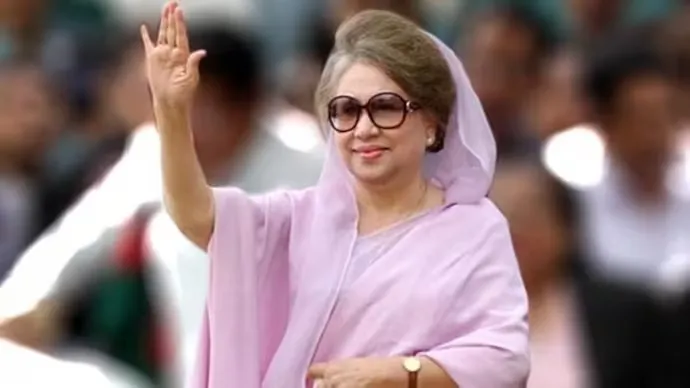
Bangladesh’s first woman Prime Minister and Bangladesh Nationalist Party Chairperson Begum Khaleda Zia has passed away at the age of 80. The octogenarian BNP leader’s physical condition had been critical for the past few days. She was undergoing treatment in the CCU (Coronary Care Unit) of a hospital in the capital, Dhaka. She died at the hospital around 6:00 AM on Tuesday (according to Bangladesh local time).
Khaleda had a long-standing kidney problem. She was admitted to the hospital on November 23 due to respiratory distress. After tests, a lung infection and pneumonia were diagnosed. According to sources, her condition had become very complicated due to her age, as she already had multiple health issues. Treating one ailment adversely affected other conditions. Khaleda’s kidney function had also significantly decreased.
On Monday, members of the medical board formed for Khaleda’s treatment stated that the BNP leader’s condition was extremely critical. Due to the deterioration of her health, she was placed on life support. She was also undergoing regular dialysis.
Khaleda’s son, Tarique Rahman who has been living for 17 years in exile in London, flew down last week to visit his ailing mother at the hospital.
Who was Khaleda Zia?
In her initial years, Khaleda became popular as the wife of former Bangladesh President Ziaur Rahman. However, after her husband’s death, Khaleda created her own identity. She took the helm of the Bangladesh Nationalist Party (BNP). In 1991, Khaleda became the first woman Prime Minister of Bangladesh.
Khaleda served as Prime Minister of Bangladesh for two terms. The first time from 1991 to 1996, and the second and last time from 2001 to 2006. Many acknowledge the role of Khaleda’s government in promoting women’s education.
However, allegations of corruption were also raised during her tenure. In 2018, Khaleda was sentenced to 17 years in prison on corruption charges related to two NGOs. Since then, she had been falling ill repeatedly.
Earlier this year, she was flown to London for advanced treatment. A similar plan was considered this time as well, but the risk could not be taken due to the unstable condition of the BNP leader’s health.

From Housewife to a Resolute Leader
Khaleda Zia started her married life as a housewife. Seven months after the death of Ziaur Rahman, she joined the BNP under special circumstances. Within less than ten years of entering politics, Khaleda became Prime Minister. Her political career spanned nearly 43 years. From a housewife, Khaleda gradually transformed into a resolute and courageous leader. She kept the BNP united through crises and adversities. And in her later life, she became a ‘symbol of unity’ for Bangladesh.
BNP founder and then-President Ziaur Rahman was assassinated on May 30, 1981. The BNP was plunged into disarray due to the leadership crisis. In this situation, Khaleda Zia joined the BNP on January 3, 1982. Khaleda initially became the party’s Senior Vice Chairman, then Acting Chairman, and finally Chairperson. She was then under forty years old. The BNP began its journey under new leadership.
She gradually managed to solidify her position in politics. Analysing Khaleda Zia’s long political life, including movements, struggles, and governance, political observers say that in her later life, she became a symbol of respect and unity for everyone, regardless of party affiliation.
Khaleda Zia was released on August 5 last year after the fall of the autocratic Sheikh Hasina government in a mass uprising. On August 7, Khaleda Zia delivered a brief video address at a BNP rally in Nayapaltan, Dhaka. Referring to the dreams of the youth in the mass uprising, she said, “Let us build a society based on love, peace, and knowledge; not destruction, not revenge, not vengeance.”
The uncompromising leader
Joining politics in 1982, Khaleda Zia launched the anti-Ershad movement against the autocratic ruler in 1983. A seven-party alliance was formed under her leadership. Political researchers say that her leadership played a key role in Ershad’s downfall. During the nine-year-long movement, she earned the reputation of being an ‘uncompromising leader’. Following the mass movement of the 1990s, the BNP came to power in the 1991 national parliamentary elections with unprecedented public support. Khaleda Zia became the first female Prime Minister in the history of the country. She later served as Prime Minister two more times.
Although Khaleda Zia was seen in an uncompromising role during movements and struggles, she never completely rejected the idea of ’dialogue and compromise’ in politics. Analysing Khaleda Zia’s overall political life, political analysts and researchers say that her rise to power after a long period of movements and struggles, followed by imprisonment, oppression, and persecution, and finally, unprecedented state honours—all combined to make Khaleda Zia a powerful political figure in Bangladesh, which made her a ‘symbol of unity’.
And in governance, her role was unparalleled in various fields, including the establishment of democracy, fulfilling public expectations, providing successful leadership in administration, handling disasters and calamities, and managing foreign relations.
Political crisis and personal tragedy
A major storm hit Khaleda Zia and her family in 2007. At that time, the military-backed government declared a state of emergency. Khaleda Zia, her eldest son Tarique Rahman, and her younger son Arafat Rahman Koko were arrested. At that time, various attempts were made to break up the BNP and send Khaleda Zia abroad.
Against this backdrop, in the first week of April 2007, rumours circulated that Khaleda Zia would leave the country and go to Saudi Arabia. She had been devastated after Tarique Rahman’s arrest on March 8. In the ensuing situation, many top leaders of the party went into hiding. On the night of April 22, the then central leader of the BNP and former minister, Brigadier A.S.M. Hannan Shah, informed journalists that Khaleda Zia would not go to Saudi Arabia. She was prepared to face any situation but would not leave the country.
Later, Khaleda Zia herself said, “I have no address outside the country; this (Bangladesh) is my address. This country, its soil and people are everything to me. Therefore, I will not go abroad.”
During the military-backed government of 1/11 in 2007, Tarique Rahman was arrested on March 7 in a corruption case. Arafat Rahman Koko was arrested on September 3. Khaleda Zia was also arrested on the same day. Later, Tarique Rahman was sent to London and Arafat Rahman to Thailand for treatment. Although attempts were made to send Khaleda Zia abroad while she was in prison, she refused.
When the Awami League came to power, Khaleda Zia was evicted from her cantonment residence on November 13, 2010. She had lived in that house for 28 years. Khaleda Zia moved to a rented house called ‘Firoza’ in Gulshan. In 2013, when a massive movement gained momentum, she was confined to her house by barricades on the street in front of it. After the one-sided election of January 5, 2014, when another movement started in 2015, Khaleda Zia was confined to her Gulshan office by 14 trucks and vans blocking the road.
Amidst all this, in January 2015, Khaleda Zia’s younger son, Arafat Rahman, died while undergoing treatment in Malaysia. Yet, even during this time of extreme crisis, Khaleda Zia maintained her faith in the people of Bangladesh.