


What is Tax Loss Harvesting? A Guide for Investors to Reduce Tax Liability
The CSR Journal Magazine

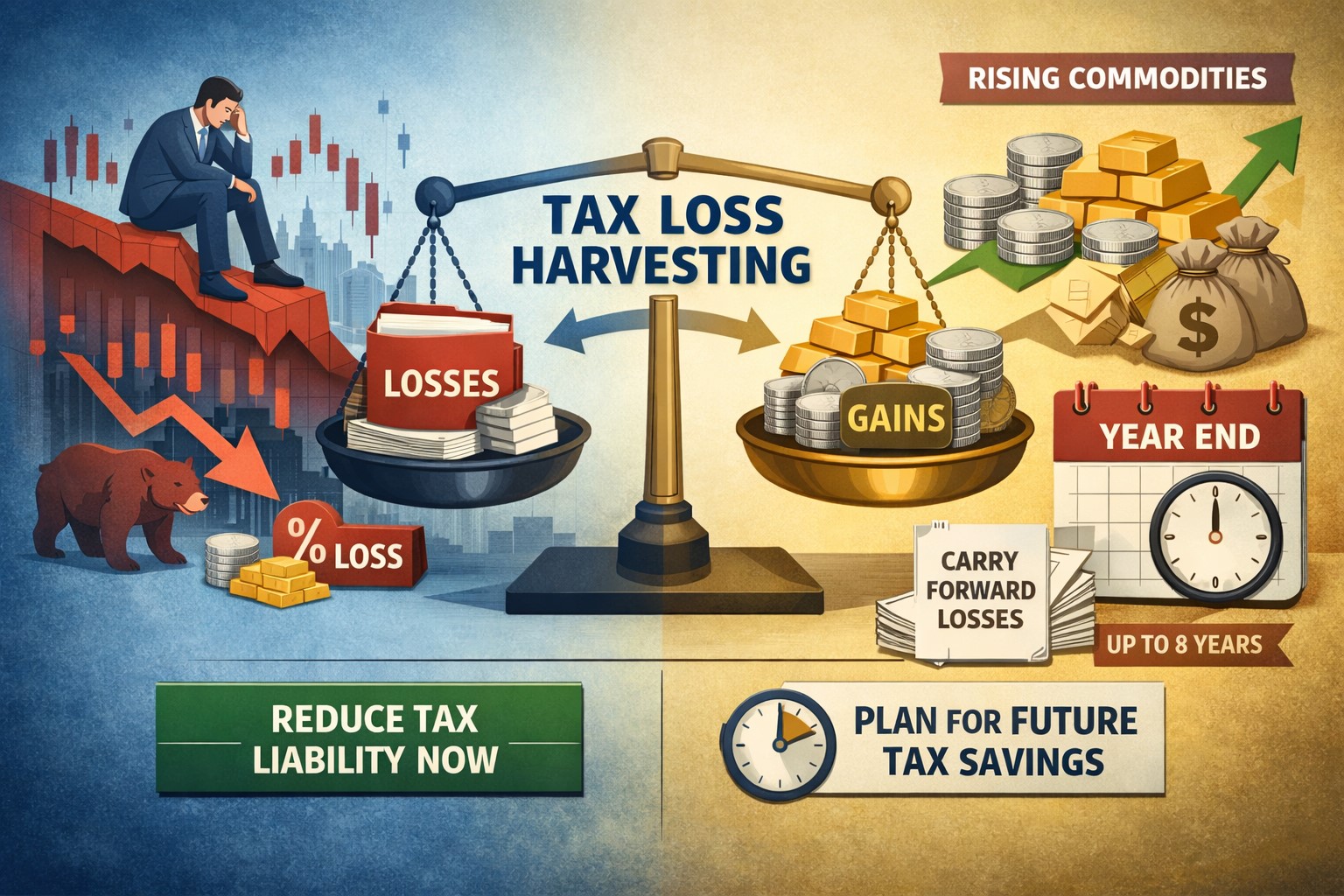
As the financial year comes to an end today, investors are actively seeking ways to lessen their tax obligations. While traditional options such as Equity Linked Saving Schemes (ELSS) and standard deductions are commonly utilized, tax loss harvesting is a frequently overlooked approach. This technique has gained heightened relevance this financial year due to notable market fluctuations, leaving many investors with unrealized losses in their equity portfolios. Conversely, assets like gold and silver have performed well, resulting in increased tax liabilities for some. This scenario offers a unique opportunity where losses in one investment category can counterbalance gains in another.

Understanding Tax Loss Harvesting

Tax loss harvesting involves the strategic use of losses from one type of investment to offset taxable gains in another. For instance, if an investor has experienced profits from gold or silver investments but has incurred losses in stocks, those stock losses can be applied to lower the taxable income generated from the gains in gold or silver. Additionally, if an investor does not realize gains within the financial year, they can carry forward these losses for a period of up to eight years, allowing for potential tax reductions in subsequent years.

Current Market Dynamics and Its Implications

This financial year has presented a clear divergence in asset performance. Equities have faced downward pressure, while commodities like gold and silver have shown robust returns. Consequently, many investors may find themselves with losses in their stock investments but gains from their commodity holdings. Through tax loss harvesting, these investors can utilize their stock losses to mitigate the tax impact associated with profits from commodities, which can be taxed at rates as high as thirty percent. A recent clarification highlighted that tax loss harvesting is not merely a tool for immediate tax reduction, but also a means of long-term financial planning.

Evaluating Payoff Strategies

Investors face an important decision regarding whether to utilize losses immediately or defer their application for potential future benefits. It is often tempting to apply the remaining losses to achieve a zero tax outlay for the current year. However, as illustrated by a recent case, carrying forward a portion of the losses may yield greater tax savings in subsequent years. For example, an investor who had gains of six hundred thousand rupees from gold alongside losses of six hundred ninety thousand rupees in equities was able to fully offset the gold gains with three hundred thousand rupees of the losses. Instead of using remaining losses solely for immediate tax relief, it may be prudent to reserve them for future gains, potentially maximizing tax savings over multiple years.

Caution for Investors

The effective use of tax loss harvesting hinges on the likelihood of future gains. If no profitable opportunities arise, the advantages of carrying forward losses may remain untapped. Additionally, investors should exercise caution and refrain from liquidating quality stocks solely for the purpose of recording losses, as this could compromise long-term investment objectives. With the deadline approaching, it is advisable for investors to thoroughly assess their portfolios, identify assets that are underperforming, evaluate potential gains that could be offset, and decide strategically whether to realize losses or carry them forward.

Long or Short, get news the way you like. No ads. No redirections. Download Newspin and Stay Alert, The CSR Journal Mobile app, for fast, crisp, clean updates!

App Store –  https://apps.apple.com/in/app/newspin/id6746449540 

Google Play Store – https://play.google.com/store/apps/details?id=com.inventifweb.newspin&pcampaignid=web_share

Latest News

Popular Videos
