


app-store-logo
play-store-logo
February 18, 2026

“We Have To Build The Models Here”: Hillary Clinton Praises India’s Climate Leadership
The CSR Journal Magazine

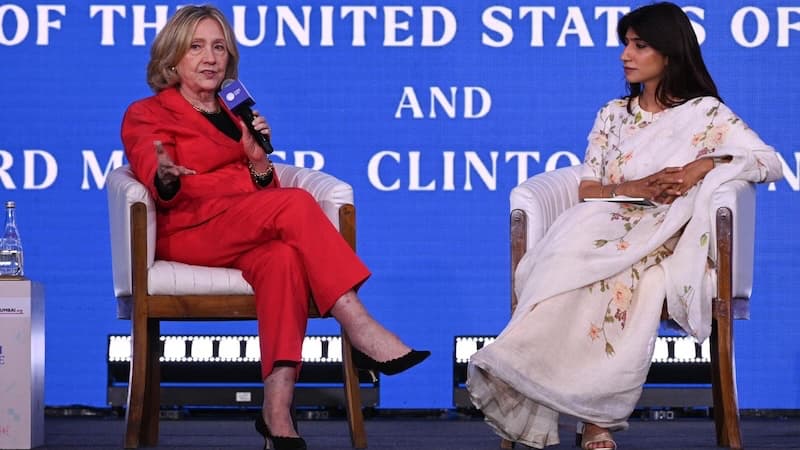
Former United States Secretary of State Hillary Clinton hailed India as a major centre of climate innovation while urging urgent, collaborative global action during a fireside chat at the inaugural Mumbai Climate Week.

Addressing policymakers, business leaders and civil society representatives, Clinton emphasised that the world cannot afford to delay climate action while waiting for political shifts in major economies. She said countries such as India are already demonstrating practical models that can be scaled globally.

“We cannot wait for the political change that I know will come to the United States because that’s a few years off. We have to build the models here. We have to do the innovation here,” she said.

Grassroots Innovations Offer Scalable Solutions

Clinton highlighted community-level initiatives in India as powerful examples of climate resilience combined with social inclusion. She cited an insurance programme that has reached around five lakh women who previously had no financial protection.

“This insurance product… 500,000 policyholders now, women who’ve never had insurance for anything. So this is not only a good thing to do, it is smart. It is a new market,” she noted, suggesting that climate solutions can also unlock new economic opportunities.

She also referred to clean cooking initiatives that reduce indoor air pollution and improve health outcomes, particularly for women and children. Even small technological interventions, she said, can produce life-saving results when implemented at scale.

“Now, that’s a small thing, but it could have a big impact,” she said.

Partnerships Key To Systemic Change

Calling for stronger cooperation across sectors, Clinton stressed that governments alone cannot tackle the climate crisis. She urged deeper collaboration between public institutions, private companies and philanthropic organisations to drive systemic change.

“We have to be creative about how we bring the public and private and philanthropic sectors together,” she said, adding that she was encouraged by the potential of such partnerships through platforms like the Clinton Global Initiative.

She also argued that philanthropy must move beyond traditional charity and address structural inequalities that intensify climate vulnerability. With a massive intergenerational wealth transfer underway globally, she described equitable redistribution as “one of the most fundamental economic justice issues of our time.”

According to Clinton, philanthropy must pursue a dual strategy: responding to immediate humanitarian needs while also tackling root causes.

“It needs to help alleviate the kind of suffering… that we can all see. However, that is not enough,” she said.

Climate, Health And Local Action

Clinton drew a direct link between fossil fuel use, climate change and public health, especially in cities facing severe air pollution. Fine particulate matter, she noted, has profound health consequences, particularly for children.

“That’s why when I talk about climate, I always talk about climate and health,” she said.

She also encouraged businesses, communities and individuals to act independently of political leadership where necessary.

“Just because the President of the United States does not want corporations to care about climate change, doesn’t mean you shouldn’t care,” she said, urging proactive engagement despite policy uncertainty.

Resilience Funds And Future Pathways

Discussing the Climate Resilience Fund launched under the Clinton Global Initiative, she said philanthropic capital can serve as the “first dollars” that catalyse broader investment and systemic shifts in adaptation and mitigation efforts.

Concluding her remarks, Clinton reiterated that multi-sector collaboration and innovation are essential to confronting the climate crisis effectively.

“Now is the time for us to get creative, focused, and determined to address climate change in all the ways that each of us can,” she said, positioning India as a crucial partner in shaping global climate solutions.

Her comments underscored a broader theme of the Mumbai Climate Week: that emerging economies are no longer just climate stakeholders but increasingly central drivers of innovation, resilience and scalable action.

Long or Short, get news the way you like. No ads. No redirections. Download Newspin and Stay Alert, The CSR Journal Mobile app, for fast, crisp, clean updates!

App Store –  https://apps.apple.com/in/app/newspin/id6746449540 

Google Play Store – https://play.google.com/store/apps/details?id=com.inventifweb.newspin&pcampaignid=web_share

Latest News

Popular Videos
