


app-store-logo
play-store-logo
February 21, 2026

The US Supreme Court Ruled that Presidents Can’t Impose Tariffs Without Congressional Approval, Affirming Separation of Powers

The CSR Journal Magazine

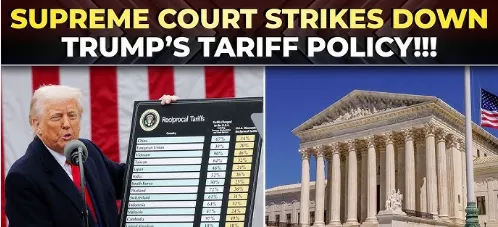
The recent ruling by the US Supreme Court, which invalidated tariffs imposed under emergency powers, raises important constitutional questions regarding the authority of the presidency. Specifically, it examines whether a president, such as Donald Trump, can negate or circumvent a Supreme Court decision concerning tariffs. The Constitution’s framework suggests a clear answer: a president lacks the power to overturn a Supreme Court ruling. This outcome is not only rooted in legal precedent but is also articulated within the judgment itself, which details the limited options remaining for the executive branch in this context.

Supreme Court’s Authority on Interpretation

According to Article III of the US Constitution, the Supreme Court holds the ultimate judicial authority to interpret federal law and assess whether the actions taken by the president align with established statutes and constitutional limits. In the case of Learning Resources, Inc. v. Trump, the Court determined that the International Emergency Economic Powers Act (IEEPA) does not empower a president to levy tariffs without Congressional authorization. This ruling emphasized that tariffs are fundamentally taxes, a power exclusively belonging to Congress. The Court stated, “There is no exception to the major questions doctrine for emergency statutes,” reaffirming the congressional exclusivity over tariff imposition.

Presidential Limitations Defined by Constitutional Structure

The Constitution delineates governmental powers across three branches: Congress (Article I), which creates laws and controls taxation; the president (Article II), who enforces laws; and the judiciary (Article III), which interprets laws. The ruling clarified that since tariff authority is rooted in Congress’s power to tax, “the president has no inherent authority to impose tariffs independently during peacetime.” As such, a president cannot take certain actions in relation to a Supreme Court ruling. These include nullifying a decision via executive order, reissuing the same tariffs based on a disallowed legal framework, or ignoring the ruling entirely without resulting in a constitutional conflict.

Core Constitutional Principles at Play

At the center of this ruling are principles of separation of powers, which aim to prevent any single branch of government from accumulating unchecked power. The justices cautioned that allowing tariff authority to emerge from vague emergency declarations would grant excessive presidential control over trade matters and the wider economy. Historically, Congress has only conferred tariff authority through statutes that impose specific limits concerning scope, duration, and procedural safeguards.

Possibilities for Future Presidential Actions

While the decision prohibits tariffs under IEEPA, it does not completely eliminate presidential authority concerning trade. The Constitution offers several lawful avenues for future actions. A president can seek new legislation from Congress for explicit authorization of tariffs under clearly defined statutes. Additionally, other legal frameworks may permit tariffs under specific conditions, although these aspects were not addressed in the ruling. Presidents may also pursue future litigation to revisit relevant legal questions, but only the Supreme Court possesses the authority to overturn its prior decisions. Indirectly, presidents can influence the interpretation of constitutional law through judicial appointments during periods of vacancy.

Legal Boundaries for Presidential Actions

The ruling sets firm boundaries around the president’s capabilities, making it clear that a president cannot claim emergency authority solely to impose tariffs, reinterpret statutes contrary to the Court’s ruling, or bypass Congressional authority when exercising tax powers. The justices underscored that emergencies do not justify the transfer of core legislative powers to the executive branch without explicit Congressional language.

Wider Significance of the Decision

This case represents a critical juncture in the ongoing discussion about the balance of power within the federal government, particularly concerning economic policy. The Court’s decision illustrates that granting expansive powers to the administration based on a presidential emergency declaration could have led to tariffs without limits on amount, scope, or duration. By rejecting this argument, the ruling reinforces Congressional oversight over trade policy and restricts the potential for emergency powers to alter economic frameworks.

Long or Short, get news the way you like. No ads. No redirections. Download Newspin and Stay Alert, The CSR Journal Mobile app, for fast, crisp, clean updates!

App Store –  https://apps.apple.com/in/app/newspin/id6746449540 

Google Play Store – https://play.google.com/store/apps/details?id=com.inventifweb.newspin&pcampaignid=web_share

Latest News

Popular Videos