


app-store-logo
play-store-logo
February 3, 2026

Trump Slashes India Tariffs to 18% in Landmark Trade Deal; Russian Oil Penalties Eased
The CSR Journal Magazine

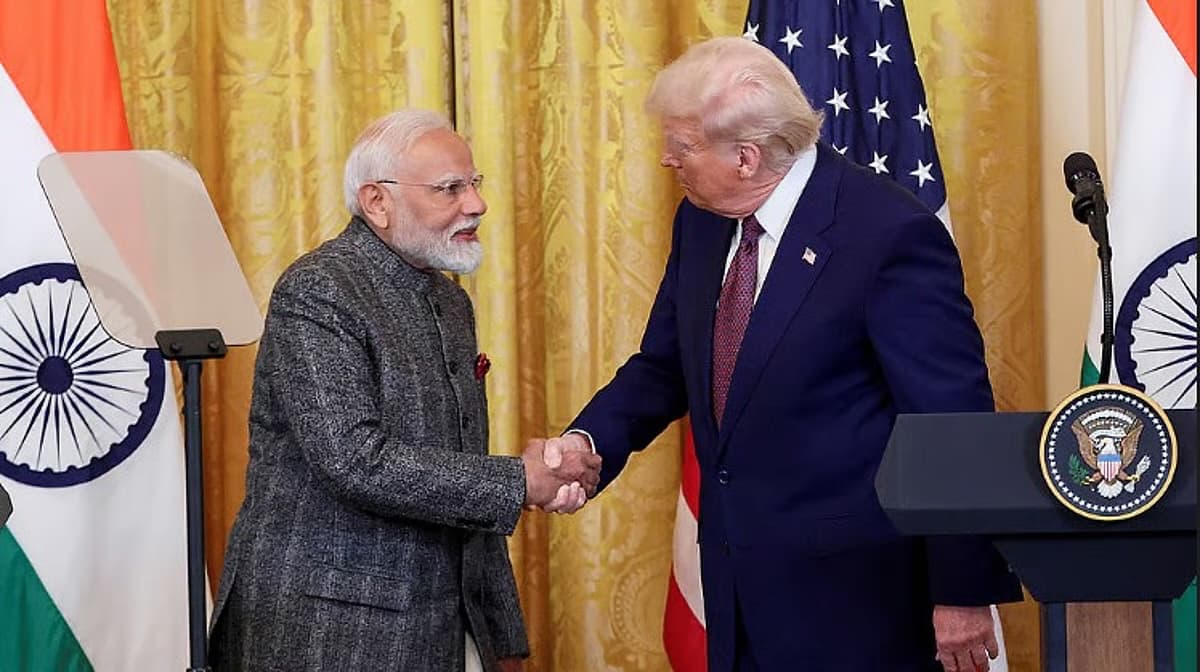
US President Donald Trump and Prime Minister Narendra Modi have finalised a landmark trade deal that substantially reduces American tariffs on Indian exports. The agreement, announced late Monday, lowers the “reciprocal tariff” on Indian goods to 18%, down from the 25% level that has recently strained bilateral relations. Crucially, the deal appears to resolve the contentious 25% penal tariff previously imposed on New Delhi for its procurement of Russian crude oil, though the relief comes with a rigorous condition that could reshape India’s energy security strategy.

The White House has confirmed that the 25% punitive levy linked to Russian energy imports will be withdrawn. However, officials emphasised that this rollback is predicated on a commitment from New Delhi to completely cease, rather than merely reduce, its intake of Russian crude. While President Trump took to social media to declare that Prime Minister Modi had agreed to this total halt, the Indian government’s official statements have remained more nuanced, focusing on the immediate economic relief for “Made in India” products.

Ending the Russian Crude Deadlock

The removal of the penal tariff marks the end of a high-stakes standoff between Washington and New Delhi. Since the onset of the Russia-Ukraine conflict, India had emerged as a primary buyer of discounted Russian seaborne crude, with Moscow’s share in India’s import basket climbing to nearly 40%. This trade had become a major friction point, with the Trump administration arguing that these purchases indirectly financed the Russian war effort. By linking the tariff reduction to a total cessation of Russian oil imports, the US is seeking to tighten the global economic squeeze on Moscow.

White House officials clarified that the agreement is not for a gradual phase-out but a definitive stop to Russian oil purchases. To fill the impending energy vacuum, President Trump indicated that India would significantly increase its energy imports from the United States and potentially resume large-scale purchases from Venezuela. This shift is expected to be a cornerstone of a broader commitment by India to purchase over $500 billion worth of US energy, technology, agricultural products, and coal over the coming years.

Reciprocal Tariffs and Market Access

Beyond the oil dispute, the trade deal addresses the “reciprocal” nature of US-India commerce. President Trump’s announcement on Truth Social highlighted that the baseline tariff for Indian exports is now set at 18%, effective immediately. This is a vital reprieve for Indian exporters in the textile, apparel, and seafood sectors, who had struggled under the weight of a combined 50% tariff – comprising the 25% reciprocal duty and the 25% Russian oil penalty. The new 18% rate places India in a more competitive position compared to regional peers like Vietnam and Bangladesh.

In exchange for this access, the US President claimed that India has pledged to move towards “zero” for its own tariffs and non-tariff barriers against American products. This would mark a historic shift in India’s traditionally protectionist trade policy. While Prime Minister Modi’s response on X expressed gratitude for the 18% reduction and praised the “limitless potential” of the partnership, New Delhi has yet to officially confirm the specific timeline for the “zero tariff” commitment or the exact details of the multi-billion dollar “Buy American” pledge.

D-Street Roars as Policy Uncertainty Ends

The news of the deal triggered a historic rally on Dalal Street on Tuesday morning. In early trade, the BSE Sensex soared by over 2,200 points, while the Nifty 50 surged by 700 points, reflecting immense investor optimism across sectors. Export-oriented industries, particularly Information Technology and Textiles, saw their stock prices skyrocket as the market priced in the removal of the 50% “tariff wall” that had deterred foreign capital through much of the previous year.

Market analysts suggest that the removal of policy uncertainty will likely trigger a sustained surge in foreign institutional investment (FII), which had seen a decline throughout 2025. The agreement is also seen as a strategic pivot for India, coming just days after New Delhi concluded a major free trade agreement with the European Union. By securing deals with its two largest trading partners, India is positioning itself as a central hub in the evolving global supply chain, though the true test of the agreement will lie in the implementation of the energy transition away from Russia.

Long or Short, get news the way you like. No ads. No redirections. Download Newspin and Stay Alert, The CSR Journal Mobile app, for fast, crisp, clean updates!

App Store –  https://apps.apple.com/in/app/newspin/id6746449540 

Google Play Store – https://play.google.com/store/apps/details?id=com.inventifweb.newspin&pcampaignid=web_share

Latest News

Popular Videos
