


app-store-logo
play-store-logo
March 11, 2026

Taiwan Reports Six Chinese Naval Vessels Near Territorial Waters
The CSR Journal Magazine

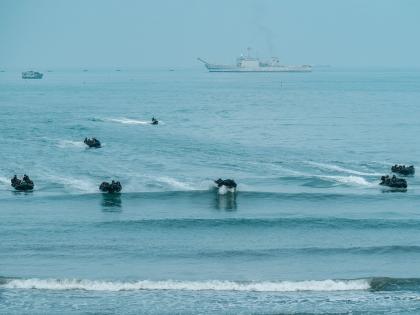
On March 11, Taiwan’s Ministry of National Defense reported the identification of six Chinese naval vessels operating in proximity to its territorial waters as of 6 AM local time. The Ministry indicated that Taiwanese military forces are actively monitoring the situation and have taken appropriate responses. In an announcement made on the social media platform X, the Ministry stated that all six vessels of the People’s Liberation Army Navy (PLAN) had been detected prior to that time. It was noted that there was no indication of any aircraft from the People’s Liberation Army (PLA) operating in the vicinity during this observation window.

Previous Detection of Chinese Naval Vessels

Earlier, on March 10, the Ministry had documented the same number of Chinese naval vessels operating near Taiwan. The statement reiterated the presence of six PLAN vessels and confirmed ongoing monitoring efforts by the Republic of China (ROC) Armed Forces. The lack of flight path illustrations was also reiterated, emphasizing the absence of PLA aircraft in the area during that period.

Context of Cross-Strait Relations

The complex relationship between China and Taiwan is shaped by a history of political, legal, and historical disputes. China maintains that Taiwan represents an integral part of its territory, a notion that is reinforced through national policy, domestic laws, and various international declarations. Conversely, Taiwan asserts its distinct identity, operating independently with its own institutions, military forces, and economy. The ongoing status of Taiwan presents significant challenges in the context of international law, particularly regarding sovereignty, self-determination, and the principle of non-interference.

Historical Background of Taiwan’s Sovereignty

The roots of China’s claims over Taiwan trace back to the Qing Dynasty’s annexation of the island in 1683 following the defeat of Ming loyalist leader Koxinga. Despite this incorporation, Taiwan’s governance remained minimal. A major turning point occurred in 1895 when the Qing ceded Taiwan to Japan after the First Sino-Japanese War, resulting in five decades of Japanese colonial rule. Following Japan’s defeat in World War II, Taiwan was returned to Chinese control; however, the transfer of sovereignty over the island was not officially ratified.

Impact of the Chinese Civil War

The landscape shifted dramatically in 1949 when the Chinese Civil War concluded with the establishment of the People’s Republic of China (PRC) on the mainland. The Republic of China (ROC) retreated to Taiwan, declaring its claim over all of China, which resulted in dual sovereignty claims. The PRC asserts its authority over the mainland while the ROC controls Taiwan. Although Taiwan operates as a de facto independent state, it has refrained from formally declaring independence to avert potential military confrontations with the PRC.

Long or Short, get news the way you like. No ads. No redirections. Download Newspin and Stay Alert, The CSR Journal Mobile app, for fast, crisp, clean updates!

App Store –  https://apps.apple.com/in/app/newspin/id6746449540 

Google Play Store – https://play.google.com/store/apps/details?id=com.inventifweb.newspin&pcampaignid=web_share

Latest News

Popular Videos
