Should We Read Donald Trump’s Tweets Before Investing?
The CSR Journal Magazine

There is a moment, familiar to every investor alive today, when you wake up at 3 a.m., reach for your phone, and before checking your portfolio, before looking at Sensex futures, before even thinking about your morning chai — you open Twitter/X app to see what the 47th President of the United States has been “truthing” in the dark.

Welcome to modern finance.

Warren Buffett famously said to be fearful when others are greedy, and greedy when others are fearful. He never said anything about being terrified when a septuagenarian in a golf cart posts in all caps. But perhaps he should have.

The question is no longer academic.

In the last 12 months, Donald J. Trump’s posts on X have moved more money than most central banks, triggered diplomatic crises across three continents, and provided at least one occasion where a sitting US president may — emphasis on may — have given the world’s greatest stock tip four hours before he himself caused the rally. This is either genius, corruption, performance art, or all three simultaneously. Either way, the Indian textile worker in Tiruppur has opinions about it, and so do the quant traders on Wall Street who have now, in all sincerity, built algorithms to read the man’s posts.

We live in extraordinary times.

Academic research has established, with the full weight of peer-reviewed scholarship, that Trump’s tweets cause US stock market declines, increased trading volume, and increased uncertainty — particularly when the words “tariff” or “products” appear. This is the kind of finding that makes economists feel both very smart and deeply helpless.

But the crown jewel — the Kohinoor diamond of Trump market-moving moments — arrived on the morning of April 9, 2025. The stock market had been in freefall for four days following Trump’s sweeping “Liberation Day” tariff announcements. The S&P 500 was bleeding. Investors were, in the president’s own memorable word, “yippy.”

At 9:37 a.m. ET, Trump posted on X in full capital letters: “THIS IS A GREAT TIME TO BUY!!!” He signed off with the letters “DJT” — which happens to be both the president’s initials and the stock ticker for Trump Media & Technology Group.

Less than 4 hours later, Trump announced a 90-day pause on nearly all his tariffs. Stocks soared, closing up 9.5% by the end of trading. The market gained back about $4 trillion — roughly 70% of the value lost over the previous four trading days.

Stop.

Read that again.

A man posted “THIS IS A GREAT TIME TO BUY” and then, 4 hours later, made it a great time to buy. The sheer circularity of this is enough to make a philosophy professor weep. A government ethics expert at Washington University called it sending a message that he “can effectively and with impunity manipulate the market.” The White House said Trump was merely “reassuring” investors. The SEC declined to comment. The Nasdaq, for its part, had its best day since January 2001.

The Dow skyrocketed 2,963 points (7.87%), the S&P 500 shot up 9.52%, and the Nasdaq soared 12.16% — its second-best day in its entire history. All because of a 90-day pause on tariffs. Not a cancellation. Not a treaty. A pause. The global financial system celebrated a homework extension like it was the end of World War II.

There is an additional wrinkle, as delicious as it is disturbing: Trump Media’s stock jumped over 8% after the president’s post — because DJT, the initials he signed with, is also DJT, the company’s ticker symbol. It was impossible to tell if Trump was recommending the stock market in general, or his own company’s shares specifically. The White House was asked. The White House did not address this.

This is the investment landscape of 2025. Your portfolio now depends, in part, on whether the leader of the free world meant “DJT” as a personal signature or a stock recommendation. Welcome to late capitalism’s final form.

You might think this is a uniquely American problem — the peculiar chaos of a republic that elects reality television personalities to its highest office. You would be wrong.

Research published in Finance Research Letters in 2025 found that Trump’s tweets significantly impact the stock market volatility of Germany and France, with these effects increasing as attention to his posts rises. The UK market is somewhat more resistant — presumably because the British have centuries of practice ignoring Americans.

The implications for global investors are staggering. A man tweeting from Palm Beach at midnight can rattle the Frankfurt stock exchange by morning. This is either the most connected world in human history or the most fragile one. Possibly both.

One research team even built an automated trading system based purely on Trump’s tweet content that achieved positive abnormal returns. In other words, the optimal investment strategy in 2025 may be to hire a linguistics PhD to monitor X at 2 a.m. and flag anything containing the words “China,” “tariff,” or “GREAT.”

The system reportedly outperforms most hedge funds. Most hedge funds charge 2% management fees and 20% of profits. The X subscription is $3 a month. The arbitrage opportunity is self-evident.

Company-specific tweets move individual stocks by 0.25% in the direction of Trump’s sentiment — positive tweets push them up, negative tweets push them down — and increase daily trading volume by 19%, with volatility persisting for up to four days. Four days of elevated volatility from a single social media post. Imagine explaining this to Benjamin Graham.

Now we arrive closer to home (India) — specifically, to the ₹480 billion question that India spent the second half of 2025 trying to answer.

The story begins with oil.

India, ever the pragmatic nation, continued buying Russian crude at a discount long after the West had turned it into a sanctions showpiece. This was economically sensible, geopolitically defensible, and, as it turned out, absolutely enraging to Donald Trump.

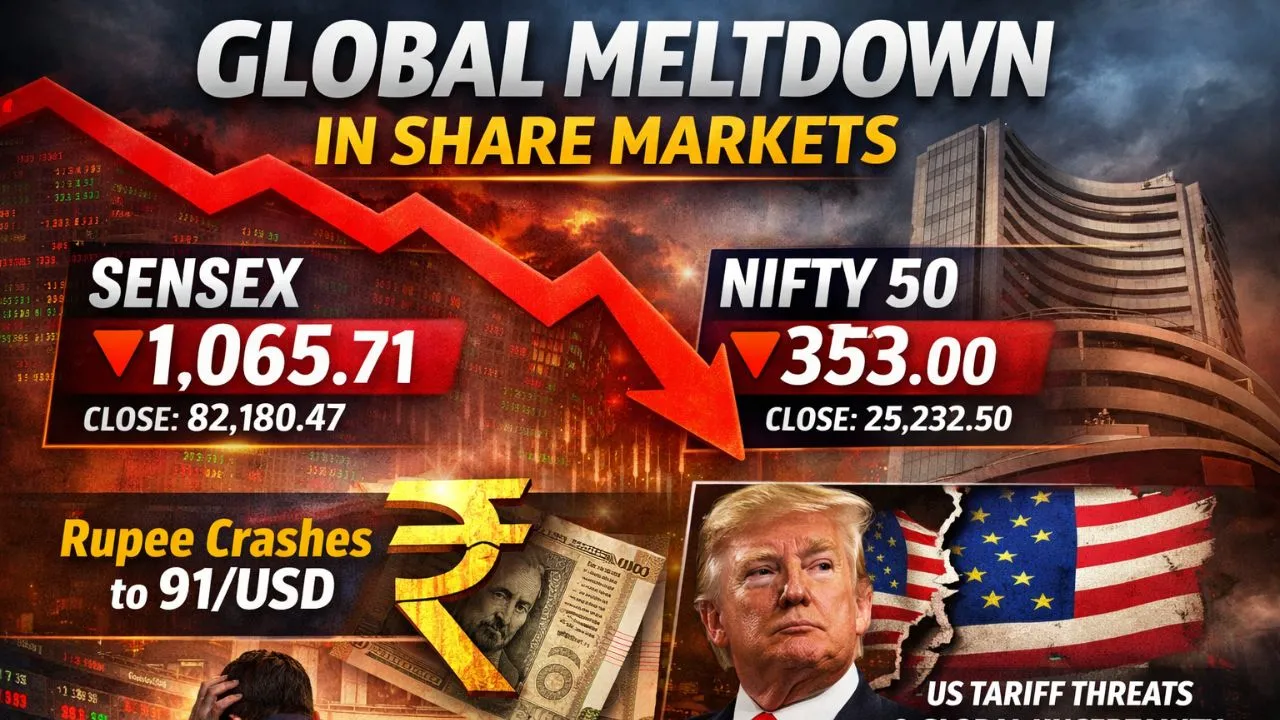
The US first slapped a 25% tariff on India in July 2025, and a week later imposed an additional 25%, citing New Delhi’s purchase of Russian oil. The resulting 50% tariff rate — one of the highest applied to any trading partner — would impact a range of goods from gems and jewellery, garments, footwear and furniture to industrial chemicals.

To put this in context: India was placed in the same tariff bracket as Myanmar and Syria. Journalist Fareed Zakaria described this as reversing decades of bipartisan efforts to strengthen ties with New Delhi, while former US Ambassador Kenneth Juster noted surprise and indignation in India — especially after Trump labeled Indian tariffs “obnoxious” and claimed to have brokered an India-Pakistan ceasefire that New Delhi publicly rejected.

The Sensex did not take this well. Indian markets were battered, becoming the worst-performing market among emerging nations in 2025, with record outflows of foreign investors. Every time Trump posted something about India — and he posted several things — market participants in Mumbai had to play a real-time game of interpretive linguistics: Is this a negotiating position? A genuine policy? A threat? A boast? Is he aware that India is not, in fact, a small country?

UBS estimated that $8 billion worth of Indian exports were most vulnerable, including gems and jewellery, apparel, textiles, and chemicals. Economists forecast a negative GDP impact of around $36 billion, or 0.9% of GDP.

One Indian textile exporter described the situation as being “in a nightmare where you do not know what new, random tariff number you wake up to next.” This is not a metaphor. This is literally what investing in Trump-era markets feels like. You go to sleep, and during the night, the President of the United States may or may not have changed the fundamental economics of your industry.

The irony is rich enough to butter a paratha: India, a country of 1.4 billion people with the world’s fastest-growing major economy, found its market fate increasingly hostage to the nocturnal posting habits of a 78-year-old American businessman-turned-politician. Indian fund managers — people with MBAs from IIMs, with years of financial modelling experience — were refreshing Twitter like it was Zerodha during a bull run.

India’s $434 billion export engine, with $87 billion directed to the US (equivalent to 2.5% of GDP), was suddenly at the mercy of a trade policy that changed based on whether the president felt India was being “very unfair.” Engineering exports alone faced a potential $4-5 billion drop.

The government responded admirably. India overhauled its GST system, cutting levies on consumer items from toothpaste to small cars, losing an estimated ₹480 billion in revenue — essentially handing out a massive economic stimulus to cushion the Trump shock. Modi took to the ramparts of Red Fort to declare economic self-reliance. Farmers in Punjab burned effigies of the American president. And investment advisors across the country quietly added “check Trump’s Tweets” to their morning routine, right between checking RBI policy updates and reading the Economic Times.

Meanwhile, in the other great economic story of our age, China was playing a different game — and Trump was playing it at them too.

In October 2025, Trump wrote a 500-word post on X app accusing China of holding the world “captive” through its monopoly on rare earth metals. One paragraph — about a “massive increase of tariffs on Chinese products” — wiped $2 trillion in market value in a single trading day. Nvidia lost 5%, AMD sank nearly 8%, Apple lost 3%, and Tesla shed 5%. A total of 424 out of 500 S&P 500 members closed in the red.

500 words. Two trillion dollars. That is $4 billion per word. The most expensive prose in human history, and it wasn’t even a particularly well-written post.

Research confirms that Trump’s “trade war” tweets affect both the US and Chinese stock markets negatively, while gold prices respond positively. The gold lobby — if such a thing exists — may be the only constituency that genuinely benefits from Trump’s social media activity. Every all-caps post about China is essentially a bull market signal for Mumbai’s Zaveri Bazaar.

The Chinese response, typically, has been to tighten its grip on rare earth metals rather than tweet about it. China controls roughly 70% of the global rare earth supply — materials critical for semiconductors, electric vehicles, and advanced military systems. Beijing does not post about this on social media. It simply does it. The contrast in communication styles is instructive: one superpower governs through opaque bureaucratic processes that take months to understand; the other announces trillion-dollar policy shifts on an app that also hosts wrestling fans and cryptocurrency promoters.

The Chinese stock market’s reaction to Trump tweets, academic research notes, is “almost opposite” to that of the NYSE — when Trump posts something negative about China during US trading hours, Chinese markets often recover because the posts don’t reach their exchanges in time. There is a dark comedy in this: geopolitical chaos has a time-zone arbitrage built in.

Let us return, inevitably, to that April morning and the question that Democrats demanded answers to, ethics lawyers raised publicly, and the White House batted away like a badminton shuttlecock.

Senator Elizabeth Warren asked on the floor of Congress whether this was “corruption in plain sight.” Senator Adam Schiff sent a letter asking who in the administration knew about the tariff reversal in advance. The SEC declined to comment.

Richard Painter, the chief ethics lawyer under President George W. Bush, said that if anyone in the Bush administration had done this, they would probably have been fired.

And yet, nothing happened. Because nothing does. The post stands as a monument to the peculiar democracy we now inhabit: one where the president can tell 87 million followers to buy stocks four hours before he personally causes a stock market rally, and the formal response is a White House statement and a collective shrug.

As one financial analyst put it: “Trump illustrated to everyone in the market today how incredibly difficult it is to trade around his tariff regime, because he and only he knows when it ends.”

This is the defining investment insight of our era. Not “buy low, sell high.” Not “past performance is no guarantee of future results.” The guiding principle of 2025 markets is: one man knows when it ends, and he posts about it on his own platform.

Given all of the above, allow us to offer some genuinely useful guidance for the modern investor, particularly those managing money in Indian markets with exposure to global trade.

On tariff tweets: The academic consensus is clear — tweets containing the words “tariff” and “products” generate the strongest negative market response. Set up a keyword alert immediately. Consider it a free volatility index.

On all-caps posts: Historical data suggests that when Trump abandons the shift key entirely, something significant is about to happen. “THIS IS A GREAT TIME TO BUY” was in all caps. So was the announcement of Liberation Day tariffs. Caps lock appears to correlate with the magnitude of market impact. Assign a caps-lock premium to your risk models accordingly.

On the DJT ambiguity: Until the US Securities and Exchange Commission establishes clear guidelines on whether a president signing posts with his stock ticker constitutes a buy recommendation, treat all “DJT” signatures as material ambiguity. Hedge accordingly.

On India-specific exposure: India’s economy eventually proved remarkably resilient — GDP grew 8.2% in the September quarter, beating all 38 estimates in a Bloomberg survey — but the path there was littered with destroyed export orders and sleepless nights in Surat’s diamond polishing units. Diversify your trade exposure. The EU free trade agreement India just signed is partly a direct result of learning, expensively, that a single foreign leader’s social media mood can torpedo your export sector.

On gold: Buy some. The research is unambiguous.

On timing: The impact of Trump’s tweets is most significant when posted outside US market trading hours — which, for Indian investors in IST, means posts between roughly 9:30 p.m. and 9:30 a.m. the next day are especially worth monitoring. This is not the sleep schedule any of us signed up for. Hire someone younger.

We are left with an uncomfortable truth, which is that “read Trump’s tweets before investing” is no longer satirical advice. It is, in 2025, a legitimate risk management framework. The academics have confirmed it. The traders have built algorithms around it. The Indian government spent the equivalent of $5.49 billion in tax revenue managing the downstream consequences of it.

It took India stopping Russian oil purchases and committing to buy $500 billion in US goods before the tariff was finally reduced to 18% — a negotiation conducted partly through formal channels and partly through the interpretive exercise of reading Trump’s social media posts and figuring out what, precisely, he actually wanted.

The world’s fourth-largest economy restructured its energy supply chain because of what a man posted online. The Sensex whipsawed for months. A hundred and fifty thousand textile workers in Tiruppur faced unemployment. And through it all, the tweets kept coming — sometimes threatening, sometimes boasting, occasionally bullish on America, frequently bullish on himself.

Warren Buffett, we are told, does not use social media. He reads annual reports. He thinks in decades. He is, by most accounts, doing fine.

The rest of us, though — the ones watching the Nifty 50 with one eye and Twitter with the other, building DCF models by day and sentiment analysis algorithms by night — we have inherited a world where the difference between a 5% portfolio gain and a 5% loss may come down to whether the president felt like posting at 9:37 in the morning.

In this world, the most valuable financial skill is no longer reading balance sheets. It is reading the room — specifically, a very particular room in Mar-a-Lago, where a man who controls the world’s largest economy types in capital letters and occasionally signs his posts with a stock ticker.

Stay diversified. Stay hedged. And for the love of all that is holy — set up those notifications.

Views of the author are personal and do not necessarily represent the website’s views.

Dr. Jaimine Vaishnav is a faculty of geopolitics and world economy and other liberal arts subjects, a researcher with publications in SCI and ABDC journals, and an author of 6 books specializing in informal economies, mass media, and street entrepreneurship. With over a decade of experience as an academic and options trader, he is keen on bridging the grassroots business practices with global economic thought. His work emphasizes resilience, innovation, and human action in everyday human life. He can be contacted on jaiminism@hotmail.co.in for further communication.

Long or Short, get news the way you like. No ads. No redirections. Download Newspin and Stay Alert, The CSR Journal Mobile app, for fast, crisp, clean updates!

App Store – https://apps.apple.com/in/app/newspin/id6746449540

Google Play Store – https://play.google.com/store/apps/details?id=com.inventifweb.newspin&pcampaignid=web_share

Latest News

Popular Videos