


Saturn Welcomes 11 New Moons, Raising Total Count to 285
The CSR Journal Magazine

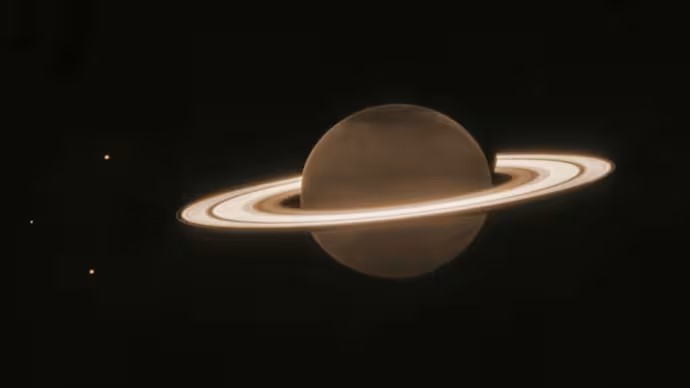
Astronomers recently announced the discovery of 11 new moons orbiting Saturn, as communicated in an official announcement from the Minor Planet Center. This discovery marks a significant milestone, increasing the total number of known moons around Saturn to 285. The report, identified as MPEC 2026-F14, reinforces Saturn’s status as the planet with the largest number of natural satellites in the Solar System.

Characteristics of Newly Discovered Moons

The newly recognized moons are categorized as irregular satellites, characterized by their small size and distant orbits. Each of these moons is estimated to measure only a few kilometers across. In contrast to the larger, more prominent moons like Titan and Enceladus, which are well-studied, these recently discovered satellites orbit at greater distances and follow highly tilted, elongated, and often retrograde paths.

Formation Theories of the Moons

Scientists theorize that these small moons did not form alongside Saturn; instead, they are believed to have been captured by the planet’s gravitational influence during the early development of the Solar System. The Minor Planet Center has provided comprehensive orbital parameters for each of these satellites, detailing their distances from Saturn, inclinations, and eccentricities. Such data is crucial for astronomers as it aids in understanding their movement and potential familial relationships among the moons.

Methodology of Discovery

The discovery was achieved through the utilization of advanced telescopes and a series of long-term sky surveys designed to track faint moving objects against a background of stars. Data collected over several nights allowed astronomers to validate that these newly discovered moons are indeed gravitationally bound to Saturn, rather than being transient asteroids passing through the vicinity.

Scientific Significance of the Findings

Despite their modest sizes, the addition of these 11 moons holds substantial scientific interest. Each newly identified satellite provides valuable information regarding the tumultuous early years of the Solar System, a time when planetary bodies migrated and captured debris from surrounding regions. Analyzing their orbits and spatial distribution can lead to insights into historical collisions and gravitational interactions that have shaped the current layout of Saturn’s moons.

Implications for Future Discoveries

With this recent addition, Saturn’s vast array of moons continues to expand, further extending its lead over Jupiter in terms of the total number of planetary satellites. This find underscores the advancements in modern observational technologies, which continue to unveil new celestial bodies in our cosmic environment. As astronomers persist in exploring the skies with increasingly sophisticated instruments, it is likely that more undiscovered moons remain hidden around the ringed planet.

Long or Short, get news the way you like. No ads. No redirections. Download Newspin and Stay Alert, The CSR Journal Mobile app, for fast, crisp, clean updates!

App Store –  https://apps.apple.com/in/app/newspin/id6746449540 

Google Play Store – https://play.google.com/store/apps/details?id=com.inventifweb.newspin&pcampaignid=web_share

Latest News

Popular Videos
