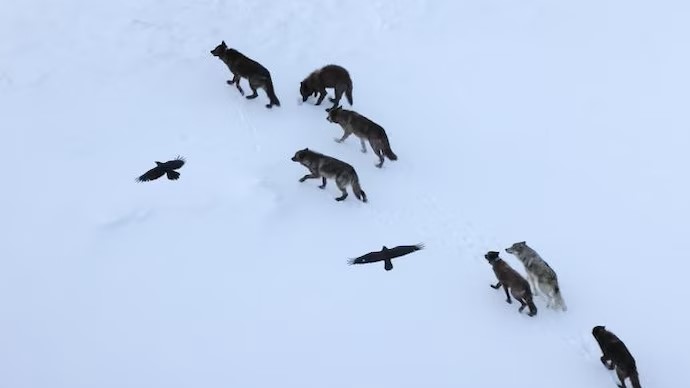
For many years, the prevailing view among scientists was that ravens trailed wolves to access carcasses before the blood had dried. Recent research, however, has overturned this assumption. Conducted over a span of two and a half years in Yellowstone National Park, the study reveals that ravens use spatial memory to navigate their environment, returning to locations where wolf kills are likely to occur. This significant finding was published in the journal Science and was spearheaded by the Research Institute of Wildlife Ecology at the University of Veterinary Medicine Vienna alongside the Max Planck Institute of Animal Behaviour in Germany.
Details of the Tracking Study
The research team equipped 69 ravens with small GPS tracking devices, which allowed for detailed monitoring of their movements. Additionally, tracking data was collected from 20 GPS-collared wolves during winter months. Movements were recorded at intervals of up to 30 minutes for ravens and up to one hour for wolves. Over the study period, researchers noted only one instance of a raven following a wolf for longer than a kilometer or for more than an hour.
Insight into Raven Behavior
Upon analyzing the data, the researchers were initially confused regarding how ravens managed to appear swiftly at wolf kills. Upon further examination, it became clear that the relationship between ravens and wolves was not about direct stalking. Instead, ravens returned to specific areas historically known for wolf kills, such as flat valley bottoms where hunting success rates are higher. Some ravens were tracked flying distances of up to 155 kilometers in a single day towards likely carcass locations, despite the unpredictability of the exact timing of a wolf kill.
Learning from the Landscape
The study highlighted that ravens possess a remarkable ability to remember stable food sources, extending this memory to learn which areas are prone to wolf kills. While a single kill may be uncertain, some regions are more productive over time, and ravens utilize these patterns to enhance their foraging success. This extends prior knowledge about the birds and their scavenging habits.
Impact on Understanding Scavenger Behavior
This research has significant implications for how the behavior of scavengers like ravens is understood. The findings suggest that these birds exhibit flexibility in their feeding strategies and do not remain solely associated with individual wolf packs. Ravens can exploit a range of foraging opportunities based on their keen senses and memories of previous feeding sites. Senior author John M Marzluff of the University of Washington indicated that this research reshapes our understanding of scavenger foraging behavior, implying that some species may have been underestimated in their abilities.
Long or Short, get news the way you like. No ads. No redirections. Download Newspin and Stay Alert, The CSR Journal Mobile app, for fast, crisp, clean updates!