


Persian Influence on Mughal Empire: Trade, Horses, and Cultural Exchange
The CSR Journal Magazine

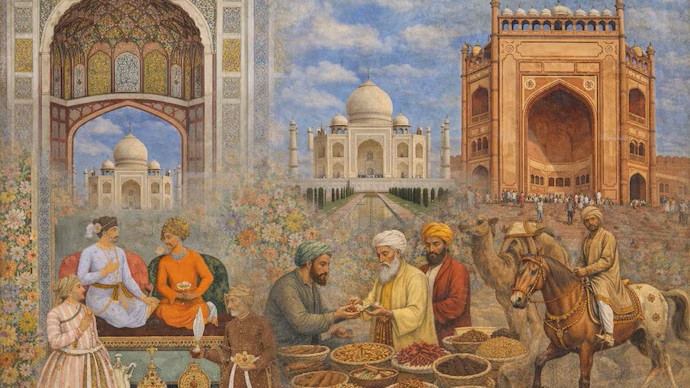
Four centuries ago, Persian culture played a significant role in the political and artistic landscape of India. As the Mughal Empire established itself, Persian civilization deeply influenced the empire’s language, artistic taste, and governance. The Mughal rulers embraced various aspects of Persian culture, including art, architecture, etiquette, literature, and administrative practices, creating a blend that made it challenging to define what was purely Mughal versus Persian. Horses from Iran significantly enhanced the imperial cavalry, while Persian craftsmanship found its way into military tools, and carpets adorned Mughal palaces. Furthermore, intellectuals and artists from the Persianate world received patronage from Mughal emperors, broadening the cultural tapestry of the empire. Persian influences were evident not only in royal courts but also in everyday structures, gardens, and trade practices that connected India and Iran.

The Historical Context of Iranian and Mughal Relations

The linkage between India and Persia was not initiated by the Mughals but deepened during their reign. By the time the emperors secured their rule in India, Persianate civilization had already matured into a significant zone of culture in Eurasia. The Mughals, originally from Central Asia, inherited and refined a political language that was inherently Persian. As a result, Persian became the dominant language for administration, literary expression, and statecraft within the Mughal court. Notably, Persian provided a cohesive framework through which the Mughals governed their diverse empire effectively.

The Importance of Cavalry in the Mughal Empire

The Mughal Empire’s military prowess was directly tied to its cavalry. The effectiveness of the empire in battles and campaigns largely depended on the quality and speed of its horse-mounted forces. The Mughals relied heavily on swift cavalry units rather than infantry alone to conduct military operations, particularly noted during the Deccan campaigns where they showcased disciplined formations. Many horses utilized in these military endeavors were imported from Persia, Arabia, and Central Asia, as regional Indian breeds often fell short of the rigorous demands of sustained warfare. Historical studies indicate that the Mughal administration actively managed the horse trade, establishing regulations and systems to ensure a steady supply of quality horses for both military and noble purposes.

Kandahar: A Strategic Nexus

Kandahar serves as a significant case study of Mughal-Iranian relations, especially in terms of trade and commerce. During the 16th and 17th centuries, it emerged as a crucial point for overland trade, facilitating the exchange of goods like textiles, military materials, and horses between India and Iran. The city was more than a mere geographic border; it functioned as a customs gate and a symbol of power in the region. Control over Kandahar meant dominion over vital trade routes, making it a frequent site of conflict between the Mughal and Safavid empires.

A Rich Exchange of Goods and Cultural Arts

The exchange between the Mughal Empire and Persia was extensive, involving the flow of diverse products and cultural elements. India exported textiles, spices, and precious stones, while receiving horses, luxury goods, and Persian literary works in return. Persian books on various subjects, including ethics and history, permeated Mughal scholarly circles, while Persian carpets influenced the interiors of Mughal courts. The Mughal military arts benefited from innovations in weaponry sourced from Iran, including intricately crafted swords and armor. This vast commercial and cultural exchange defined an era marked by intricate connections between the two great civilizations.

Legacy of Cultural Interconnection

The interplay between Mughal India and Persia created a lasting legacy, shaping artistic traditions and cultural narratives for centuries. Despite the tumultuous events, such as Nadir Shah’s invasion of Delhi in the 18th century and the accompanying violence, the foundational exchanges of culture, language, art, and trade continued to underpin the relationship. This enduring influence reflects a complex and interwoven history that highlights the deep-rooted connections between two of history’s most notable civilizations.

Long or Short, get news the way you like. No ads. No redirections. Download Newspin and Stay Alert, The CSR Journal Mobile app, for fast, crisp, clean updates!

App Store –  https://apps.apple.com/in/app/newspin/id6746449540 

Google Play Store – https://play.google.com/store/apps/details?id=com.inventifweb.newspin&pcampaignid=web_share

Latest News

Popular Videos
