



app-store-logo
play-store-logo
December 22, 2025

Paralysed Man Dragged to Court as Wife Demands Alimony, Says “He’s Fit to Pay”

The CSR Journal Magazine

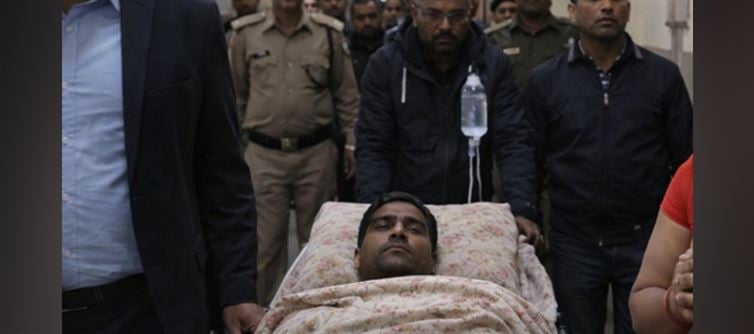
A deeply unsettling scene played out inside a Kanpur family court when a man who has been paralysed and bedridden for nearly five years was wheeled into the courtroom on a stretcher. His family says the move was unavoidable after repeated allegations that he was feigning illness to escape paying maintenance to his estranged wife.

The man, whose identity has not been disclosed, suffered a massive brain haemorrhage five years ago. Since then, he has been unable to speak or walk, cannot sit without support, and depends entirely on others for even the most basic bodily functions. Medical records indicate that the left side of his body is completely paralysed.

Despite this, the family alleges that during ongoing maintenance proceedings, the wife claimed before the court that her husband was “completely healthy” and deliberately avoiding responsibility. According to relatives, these statements continued even though hospital records, doctors’ certificates and photographs documenting his condition were already part of the court record.

Faced with the possibility of coercive action, the family says they were left with no choice but to present him physically before the judge. An ambulance transported him from hospital to the court, where he was produced on a stretcher. Those present described the courtroom falling silent at the sight.

Marriage Broke Down in a Month, Cases Followed

The legal dispute dates back to shortly after the marriage. Family members say the relationship broke down within a month, after which the wife left the matrimonial home and initiated legal proceedings, including a maintenance petition and a case under Section 498A of the Indian Penal Code. Not long after these cases were filed, the man suffered the brain haemorrhage that left him permanently disabled.

As the years passed, the litigation continued even as his health collapsed. Matters escalated further in the criminal case when he was reportedly declared an absconder. The family alleges that police officials warned them that unless he was physically produced before the court, action under Sections 82 and 83 of the Code of Criminal Procedure could be taken, including attachment of property. The warning, they say, made no allowance for his medical condition.

“We weren’t trying to make a statement,” a family member said privately. “We were trying to prevent punishment for something he physically cannot do.”

Alongside producing him in court, the family again submitted medical documentation confirming his paralysis and long-term incapacity. His lawyer later told reporters that the extraordinary step was taken only to counter what he described as baseless claims and to demonstrate the reality of his condition beyond doubt. The court subsequently ordered a medical examination and indicated that it was taking the issue seriously.

Family Says Wife Stayed Absent Through Years of Treatment

Speaking to the media, the man’s sister said the family has spent the past five years managing treatment, physiotherapy and round-the-clock care. She added that during this entire period, the wife never once enquired about his health or offered any assistance.

Legal observers say the episode raises troubling questions about how maintenance and criminal procedures are sometimes applied. Maintenance laws, they point out, are designed to prevent destitution, not to ignore documented medical incapacity. Similarly, criminal procedure exists to secure justice, not to mechanically enforce compliance when physical production serves no meaningful legal purpose.

For many, the image of a paralysed, non-communicative man lying on a stretcher inside a courtroom has become a stark reminder of what can happen when procedure overtakes empathy. The case remains pending before the Kanpur Family Court.

Latest News

Popular Videos