


app-store-logo
play-store-logo
February 6, 2026

Just Before Losing Power, This Congress CM Ordered Destruction of Anti-Hindi Protest Files in 1967

The CSR Journal Magazine

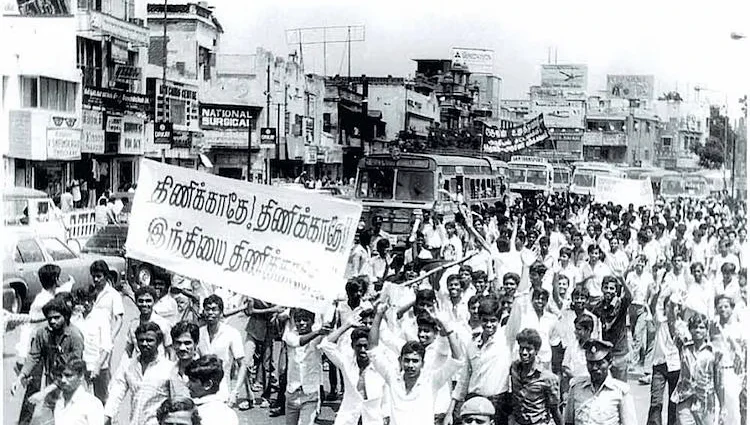
In the mid-1960s, Tamil Nadu became the epicenter of one of India’s most significant language-based political movements, the anti-Hindi agitation. Triggered by concerns over the imposition of Hindi as the sole official language, the protests saw widespread participation from students, cultural activists, and political parties. The movement opposed the potential marginalization of Tamil speakers in education and government jobs, making it a defining moment in the state’s post-Independence history.

M. Bhaktavatsalam and the Congress Government

At the helm during this period was M. Bhaktavatsalam, Chief Minister of Madras State and a leader of the Indian National Congress. His government faced growing unrest as the Official Languages Act deadline approached, intensifying public opposition to Hindi imposition. Bhaktavatsalam’s handling of the agitation drew criticism, contributing to a perception of administrative indifference to local sentiment and linguistic identity.

Mass Protests and Public Unrest

The protests reached their peak in early 1965, with students and activists organising strikes, demonstrations, and public meetings across the state. On January 26, 1965, Republic Day, the Dravida Munnetra Kazhagam (DMK) called for a “day of mourning,” leading to clashes with authorities. Several self-immolations and violent confrontations heightened tensions, showcasing the depth of public opposition and the movement’s emotional intensity.

DMK’s Historic Victory in 1967

The sustained agitation weakened the Congress party’s hold on the state. In the 1967 assembly elections, the DMK leveraged public sentiment, securing a landmark victory. C.N. Annadurai became the first non-Congress Chief Minister of Tamil Nadu, marking the beginning of Dravidian political dominance. This transition highlighted the critical role the anti-Hindi movement played in reshaping state politics.

Archival Records and Document Preservation

Years later, efforts to reconstruct official records from this period revealed gaps. In December 2025, Chief Minister M.K. Stalin released a compilation of government documents covering the anti-Hindi agitation from 1927 to 1967.

The collection included departmental correspondence, police reports, and administrative files, though some sensitive documents were reportedly lost or destroyed. This release has helped historians and researchers better understand the government’s response and the scale of public mobilization.

Legacy of the Movement in Tamil Nadu Politics

The anti-Hindi agitation left a lasting imprint on Tamil Nadu’s political and cultural landscape. It not only shaped language policy debates but also reinforced the significance of regional identity in Indian politics.

Today, the movement is remembered as a testament to grassroots activism and the ability of cultural assertion to influence democratic governance. Its legacy continues to inform political discourse and policy decisions in the state.

Long or Short, get news the way you like. No ads. No redirections. Download Newspin and Stay Alert, The CSR Journal Mobile app, for fast, crisp, clean updates!

App Store –  https://apps.apple.com/in/app/newspin/id6746449540 

Google Play Store – https://play.google.com/store/apps/details?id=com.inventifweb.newspin&pcampaignid=web_share

Latest News

Popular Videos