


North Korea Commissions Second Naval Destroyer to Enhance Defence
The CSR Journal Magazine

North Korean leader Kim Jong Un has inaugurated the country’s second naval destroyer, as reported by state media. This development occurs against the backdrop of heightened military activities in the region, particularly a trilateral exercise involving the United States, South Korea, and Japan, which North Korea perceives as a direct security challenge.

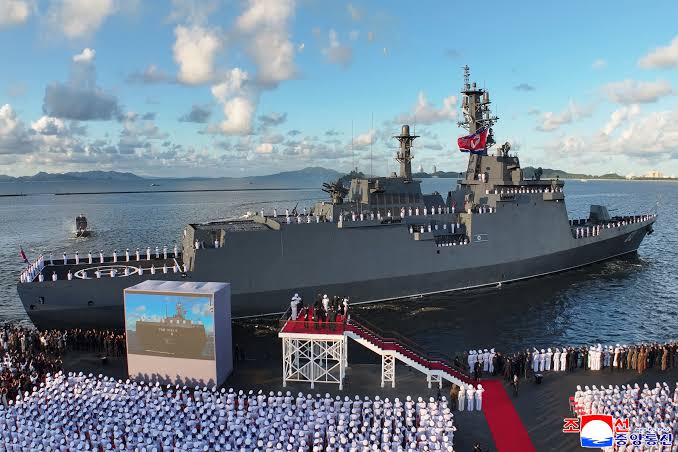
The new destroyer, named Kang Kon, was officially commissioned during a ceremony held on Sunday in Wonsan, a port city located in eastern North Korea. Kim was accompanied by his teenage daughter, who has been identified by South Korea’s intelligence as a potential future leader. Photographs from state media depicted the young girl in formal attire, touring the warship alongside her father.

The Kang Kon, along with the earlier commissioned Choe Hyon, represents significant advancements in North Korea’s naval capabilities, with each destroyer weighing approximately 5,000 tons. State media claims that these vessels are equipped to carry a range of conventional and nuclear weapons and are characterised as the most sophisticated warships in North Korea’s arsenal.

Strengthening Nuclear Capabilities

During the commissioning ceremony, Kim asserted that the addition of these destroyers would enhance North Korea’s ability to deter enemies, claiming that their nuclear capabilities would be utilised more effectively. He stated, “Concerns of the enemies will be surely deepened,” emphasising the need for a robust and dependable nuclear deterrent to support diverse military operations.

Kim has shifted focus towards modernising naval forces after years of prioritising ballistic missile development. He acknowledged that until recently, the navy lacked ships suitable for its intended missions. Analysts believe that the technological advancements in the destroyers could significantly bolster both offensive and defensive capabilities for North Korea.

Furthermore, Kim hinted at plans for a future naval development, which is anticipated to be revealed in eight months. This potential advancement is believed to be related to ambitions for a nuclear-powered submarine, adding another layer to North Korea’s strategic maritime capabilities.

Regional Military Exercises Heighten Tensions

On Monday, the trilateral military exercise named Freedom Edge commenced, involving US, South Korean, and Japanese forces off the southern coast of South Korea. According to South Korea’s military, the drill is aimed at enhancing defensive measures in response to perceived threats from North Korea, showcasing key naval and aerial resources from all three nations.

North Korea’s Foreign Ministry recently condemned the exercise, suggesting it reflects a confrontational stance from the US. The statement referenced the ongoing military drill and comments indicating US commitment to the complete denuclearisation of North Korea. These activities have further intensified the strained relationship between Pyongyang and Washington.

Historically, North Korea’s leadership has expressed willingness to engage in talks if the US alters its approach and acknowledges North Korea’s status as a nuclear power. Past diplomatic efforts with the US faced significant setbacks in 2019, primarily due to disputes over the balance of concessions related to denuclearisation.

In recent weeks, North Korea conducted missile tests, reportedly in reaction to military drills conducted by the US and South Korea. This series of events underscores the ongoing friction between North Korea and its adversaries, highlighting the complex dynamics influencing regional stability and security.

Long or Short, get news the way you like. No ads. No redirections. Download Newspin and Stay Alert, The CSR Journal Mobile app, for fast, crisp, clean updates!

App Store –  https://apps.apple.com/in/app/newspin/id6746449540 

Google Play Store – https://play.google.com/store/apps/details?id=com.inventifweb.newspin&pcampaignid=web_share

Latest News

Popular Videos
