


app-store-logo
play-store-logo
March 9, 2026

New Study Suggests Stellar Plasma May Obscure Alien Signals
The CSR Journal Magazine

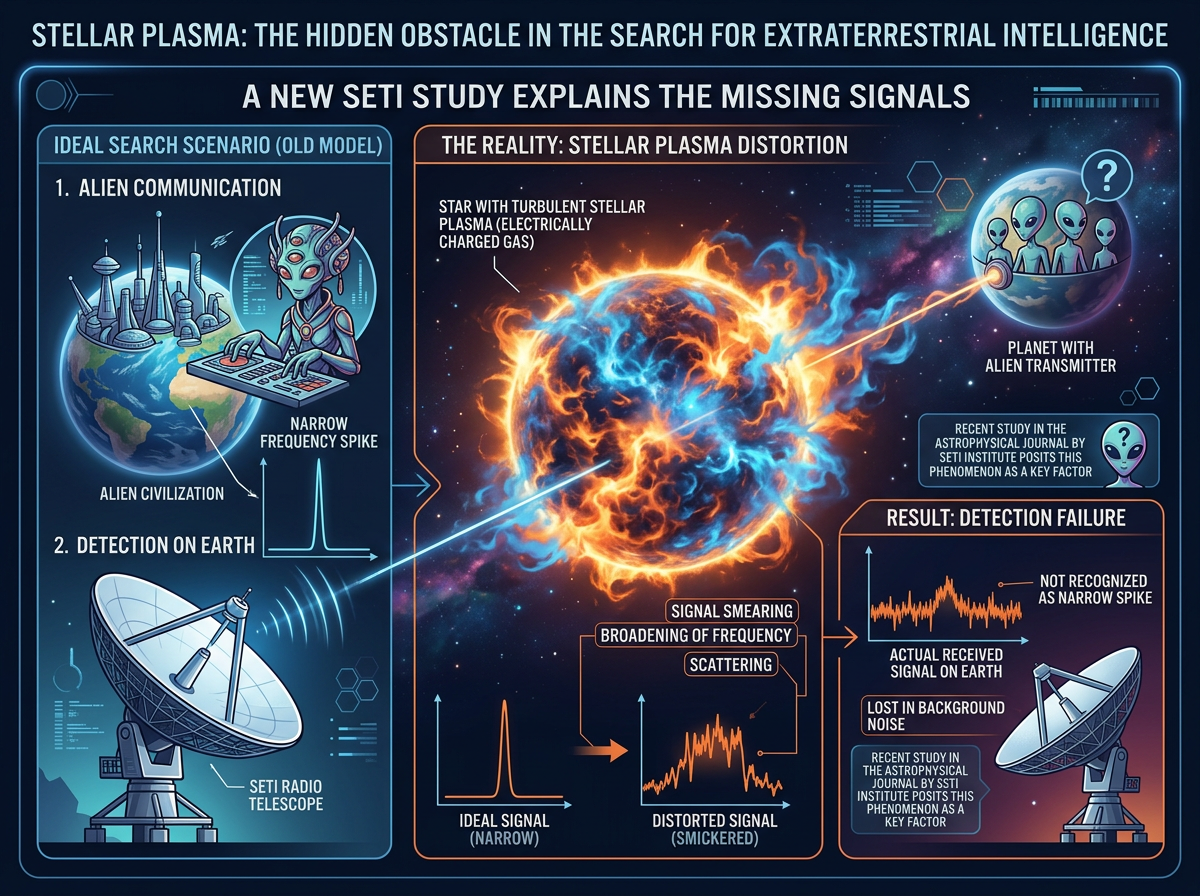
For many years, researchers have been focused on searching for extraterrestrial life by analyzing radio signals from space. These signals are characterized as narrow frequency spikes, which have yet to be conclusively detected. A recent study conducted by the Search for Extraterrestrial Intelligence (SETI) Institute, and published in The Astrophysical Journal, posits that the reason for this absence might be linked to space weather that interferes with the clarity of these signals. The researchers propose that if signals do exist, they may be distorted by stellar plasma, a phenomenon that could prevent our detection systems from recognizing them.

The Role of Stellar Plasma in Signal Distortion

Researchers from SETI have identified stellar plasma as a primary factor affecting the detection of potential alien communications. Stellar plasma consists of a turbulent and electrically charged gas that surrounds stars. As radio signals emitted from planets travel through this plasma, they can become blurred, spreading across a broader range of frequencies. Traditional SETI methodologies are designed to capture ultra-narrow signals; therefore, if a signal gets distorted while passing through its home star’s plasma environment, it may not align with the parameters of current detection technology, leading to missed signals entirely. Dr. Vishal Gajjar, the lead author of the study, emphasized that this distortion could be a reason for the lack of observable technosignatures in previous searches.

Methodology Behind the Findings

The study utilized radio signals transmitted from spacecraft within our solar system to measure the impact of solar plasma on these communications. By analyzing how signals are altered during their journey through the solar environment, the researchers were able to devise a framework to assess similar distortions around other stars. Co-author Grayce C Brown noted that by quantifying how stellar activity affects narrowband signals, scientists can refine their search parameters closer to what is realistically received on Earth, rather than what might ideally be transmitted from distant worlds.

Focus on M-Dwarf Stars

The implications of this research are particularly significant regarding M-dwarf stars. These stars, which represent roughly 75 percent of the Milky Way, are smaller and more prone to intense stellar activity and space weather phenomena. Their frequent storminess dramatically increases the likelihood of signal distortion. Consequently, the study advocates for a re-evaluation of SETI’s approach to detecting alien life, suggesting that future detectors should be sensitive to a wider array of signals—not just the perfectly sharp frequencies that are currently prioritized.

The Interplay Between Stellar Activity and Signal Detection

This new understanding prompts a reconsideration of how the search for extraterrestrial life is conducted. The researchers assert that the universe’s environmental factors, particularly stellar plasma activity, may lead to the contention that communication efforts from alien civilizations are being masked from our detection capabilities. This revelation emphasizes the complexity of the conditions surrounding star systems in relation to the possibility of finding signs of life beyond Earth.

Long or Short, get news the way you like. No ads. No redirections. Download Newspin and Stay Alert, The CSR Journal Mobile app, for fast, crisp, clean updates!

App Store –  https://apps.apple.com/in/app/newspin/id6746449540 

Google Play Store – https://play.google.com/store/apps/details?id=com.inventifweb.newspin&pcampaignid=web_share

Latest News

Popular Videos
