


Nepal Floods Highlight Growing Disaster Risks Across Warming Himalayas
The CSR Journal Magazine

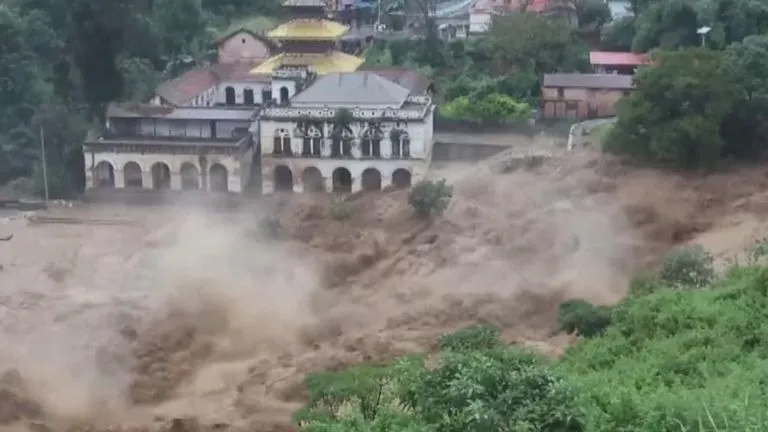
The devastating floods that struck Nepal and neighbouring China on August 26 have renewed concerns over the ability of Himalayan communities to rebuild and remain safe as glaciers melt, rivers alter their courses and climate-related risks intensify. More than 1,000 people were killed and thousands remained missing after debris and water surged through several Himalayan river systems.

The disaster has also raised questions about the future of infrastructure and settlements in the region, where communities already face the threat of earthquakes. Scientists say it is too early to directly attribute the latest catastrophe to global warming, but rising temperatures are increasing the likelihood of interconnected hazards such as landslides, avalanches, glacial melt and flash floods.

Floods Force Villagers To Seek Shelter

In a remote Nepali village, Pema Tamang and other residents fled uphill as water, rocks and mud swept through their community. They took refuge at a Buddhist shrine that had been rebuilt only last year after being destroyed in the 2015 earthquake.

“We were able to rebuild the stupa only last year after it was destroyed during the earthquake,” Tamang told The Associated Press. “Sheltering in it was how we saved our lives from the floods,” she said from a temporary shelter at a monastery in Kathmandu.

The August 26 floods followed the collapse of bedrock and glacier ice, which sent a massive flow of debris and water into multiple rivers. Satellite imagery indicated that a large mass of rock and glacial ice had fallen into a valley, generating a wall of water and mud that travelled several kilometres downstream.

Hundreds of people are also feared to have been trapped in tunnels at hydropower projects, adding to the scale of the disaster in a region where major infrastructure is often located in narrow and difficult mountain terrain.

Climate Change Intensifies Multiple Hazards

Experts caution that the precise role of climate change in the latest floods has not yet been established. However, the Himalayan region is warming rapidly as global temperatures rise due to the continued burning of oil, gas and coal.

“Climate change has been playing a large role in the Hindu Kush Himalayas, causing these kinds of complex disasters which have really impacted downstream communities and investments,” said Saswata Sanyal, a disaster risk resilience expert at the International Centre for Integrated Mountain Development in Kathmandu.

Sanyal said warmer temperatures are accelerating the loss of high-altitude ice and contributing to a combination of hazards, including rockslides, avalanches and floods. One event can also trigger another. An avalanche, for example, can block a river before the accumulated water is suddenly released, while heavy rainfall following an initial disaster can amplify the destruction.

The region has experienced several major disasters in recent years. Flash floods in Nepal last year killed nine people and caused millions of dollars in damage. Across the wider Himalayas, the 2013 Kedarnath floods, the 2021 Chamoli disaster and the 2023 South Lhonak glacial lake outburst flood, along with other landslides and floods, have killed thousands and caused hundreds of billions of dollars in losses.

“People in Nepal were still recovering from last year’s floods,” Sanyal said, “and before they could fully adapt, the next one came.”

Glacier Loss And Thawing Permafrost Add To Risk

The Hindu Kush Himalaya extends across Afghanistan, Pakistan, India, Nepal, Bhutan, Bangladesh, Myanmar and China. It contains the world’s largest concentration of ice outside the polar regions, while rivers originating in the mountains provide water and other resources to nearly 2 billion people.

Sanyal’s intergovernmental climate research group has found that glacier ice loss has accelerated sharply since 2000. Another emerging concern is the thawing of permafrost, the ground that remains frozen for prolonged periods. As it thaws, mountain slopes can become less stable and more vulnerable to collapse.

The growing risks could have implications beyond individual communities. Experts warned that some locations may eventually become too dangerous for reconstruction, forcing residents to relocate. Climate-related hazards could also complicate plans to expand roads, bridges and hydropower infrastructure across the mountains.

“The adaptation threshold has been crossed in some areas,” said Manjeet Dhakal, a Nepali climate policy expert and United Nations climate negotiator.

Dhakal said a catastrophic flood can destroy much more than a home. It can remove the land on which homes stand and damage roads, schools, water supply networks and electricity infrastructure. He said future resettlement plans would need to account for climate risks from the outset.

Experts Call For Stronger Warnings And Safer Planning

Experts said the impact of future disasters could be reduced through tighter land-use regulations, more rigorous assessments before infrastructure projects are approved, stronger monitoring across national borders and improved early warning systems.

Sanyal said 670,000 people received text alerts ahead of the August 26 floods. However, some recipients were visitors or migrant workers who could not understand Nepali, while others failed to recognise the seriousness of the warning. Some river monitoring systems were also overwhelmed or destroyed by the floods.

Chanda Lal Chitrakar, a 62-year-old resident of Nuwakot in Nepal, told AP that he paid little attention to the warnings before being forced to run uphill as the water rose.

Sanyal said warnings need to provide more precise instructions about the actions people should take when a disaster approaches. He also called for development to be directed towards safer locations, infrastructure to be assessed for multiple hazards rather than individual risks, and Indigenous knowledge to be incorporated into disaster planning.

Dhakal pointed out that Nepal has contributed less than 0.1 per cent of the greenhouse gas emissions responsible for global warming, despite facing some of its severe consequences.

“We should blame those who are responsible for increasing the global temperature, those who have benefited from the fossil fuel economy for such a long time,” he said. “We can at least use this devastating example as an inspiration to urgently reduce carbon emissions.”

The latest floods have exposed the immediate vulnerability of Himalayan communities while highlighting a longer-term challenge: how to rebuild homes and infrastructure in a region where interconnected natural hazards are becoming increasingly difficult to predict and manage.

Long or Short, get news the way you like. No ads. No redirections. Download Newspin and Stay Alert, The CSR Journal Mobile app, for fast, crisp, clean updates!

App Store –  https://apps.apple.com/in/app/newspin/id6746449540 

Google Play Store – https://play.google.com/store/apps/details?id=com.inventifweb.newspin&pcampaignid=web_share

Latest News

Popular Videos
