


app-store-logo
play-store-logo
February 26, 2026

This is the Most Detailed Image of the Heart of the Milky Way Galaxy
The CSR Journal Magazine

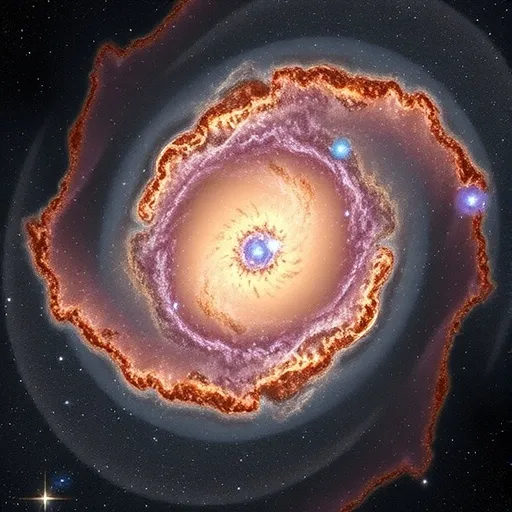
A team of astronomers has presented an unprecedented visual representation of the central region of the Milky Way galaxy, revealing a complex tapestry of cosmic gas filaments orbiting the galaxy’s supermassive black hole. This remarkable image was produced using the Atacama Large Millimeter/submillimeter Array (ALMA) and comprises the largest dataset ever collected by this facility. The image showcases the Central Molecular Zone (CMZ), a dense area of cold molecular gas that spans more than 650 light-years in diameter, surrounding the Milky Way’s central black hole and providing the essential material for star formation.

Detailed Mapping of Cold Molecular Gas

For the first time, researchers have successfully mapped the cold gas throughout the entire CMZ in exceptional detail. Ashley Barnes from the European Southern Observatory (ESO) and part of the international research team, remarked that this area represents extreme conditions that are otherwise invisible to the naked eye, but are now captured with remarkable clarity. The data reveals an intricate network of gas filaments funneling material into dense regions where stars begin their formation.

Insights from the ALMA CMZ Exploration Survey

The observations were conducted as part of the ALMA CMZ Exploration Survey (ACES), which is led by Steve Longmore from Liverpool John Moores University. This survey’s primary focus is on cold molecular gas, a critical ingredient in the formation of stars. Utilizing ALMA’s advanced radio technologies, researchers identified numerous molecules within the CMZ, including simpler molecules like silicon monoxide and complex organic compounds such as methanol, acetone, and ethanol. This information is crucial for understanding how stars form in varied environments across the galaxy.

The Role of the CMZ in Star Formation

While the processes of star formation are well-documented in the more stable outskirts of the galaxy, conditions at the galactic core present significant challenges. The Central Molecular Zone contains some of the most massive stars in the Milky Way, many of which have short lifespans and end their existence in explosive supernova or hypernova events. Researchers suggest that this turbulent region may reflect the chaotic conditions observed in early galaxies billions of years ago, offering valuable insights into the evolution of galaxies and their formation processes.

The Creation of the Mosaic Image

To produce the large mosaic image, scientists amalgamated multiple individual observations, covering a sky area approximately equivalent to the combined size of three full Moons placed side by side. The researchers noted that the complexity of the structures revealed in the image surpassed their expectations. The findings have been documented in five papers accepted for publication in the Monthly Notices of the Royal Astronomical Society, with an additional paper currently undergoing review.

Future Prospects for Galactic Exploration

With planned advancements to ALMA, along with the upcoming Extremely Large Telescope, astronomers express optimism that this groundbreaking survey represents only the beginning of more in-depth investigations into the Milky Way’s dynamic heart. The results of this work are likely to pave the way for a deeper understanding of not only our galaxy but also the broader cosmos.

Long or Short, get news the way you like. No ads. No redirections. Download Newspin and Stay Alert, The CSR Journal Mobile app, for fast, crisp, clean updates!

App Store –  https://apps.apple.com/in/app/newspin/id6746449540 

Google Play Store – https://play.google.com/store/apps/details?id=com.inventifweb.newspin&pcampaignid=web_share

Latest News

Popular Videos
