


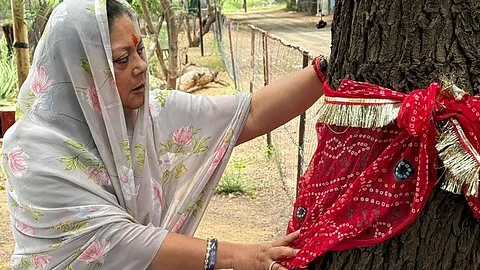

In Rajasthan’s arid desert regions, a significant confrontation has emerged surrounding the khejri tree, defined as the state tree and a vital ecological asset. Local markets have closed, religious leaders initiated strikes, and diverse political parties have united under an overarching banner—the ‘Khejri Bachao Andolan’—to demand immediate protective measures for this essential species.
This movement gained traction in Bikaner, originally sparked by concerns over the alleged cutting of khejri trees for solar energy projects. As the agitation escalated, advocates started calling for comprehensive legal protections against further deforestation.
Khejri’s Ecological Importance
Known scientifically as Prosopis cineraria, the khejri tree is deeply rooted in the identity and culture of many communities within western Rajasthan. Chief Minister Bhajan Lal Sharma has referred to it as the “Kalpavriksha,” or wish-fulfilling tree, reflecting its symbolic and practical significance in sustaining local livelihoods. The protests are not solely centered on development versus conservation; they resonate with issues of history and community identity, particularly highlighted by the Bishnoi community’s longstanding reverence for the tree.
Recent Developments in the Agitation
The current phase of protests began in early February when over 360 local saints and residents initiated a hunger strike in Bikaner, demanding a complete ban on the destruction of khejri trees due to solar projects. Demonstrators initially gathered at the Polytechnic College but later moved their protest to the Bishnoi Dharamshala, where many are continuing their fast.
On a recent Monday, local markets temporarily shut down following calls from trade associations, and various schools observed a half-day holiday in solidarity with the cause. Thousands assembled before marching to the Collectorate, where demonstrators pledged to maintain an indefinite sit-in until their demands are addressed.
Political and Community Support
Support for the Khejri Bachao Andolan has flowed in from both political parties and local communities across Rajasthan and neighboring states. Organizers noted that nearly 100,000 participants were nourished and logistics managed by numerous volunteers. Although local law enforcement increased security around protest areas and deployed water cannons, the gatherings remained peaceful.
During the hunger strike, several individuals required medical attention, indicating the desperation of the participants. Protesters expressed their commitment, stating that they would not relent until their demands for the protection of khejri trees are met.
Motivation Behind the Protests
The impetus for the movement arises from allegations that extensive felling of khejri trees has occurred to accommodate solar power plants, capitalizing on the region’s favorable conditions for renewable energy. While such projects align with India’s energy transition initiatives, campaigners assert that they threaten crucial local ecosystems.
The government responded to these concerns by restricting tree cutting only in specific divisions, which protesters deemed insufficient. Protest leaders have pressed for a comprehensive statewide ban and formal written assurances from the government.
Legislative Attention and Community Resilience
The issue has reverberated through the Rajasthan Assembly, where political representatives have raised significant concerns over tree conservation laws. There have been calls from various legislators for more stringent regulations to ensure the khejri tree’s protection.
In response, Chief Minister Sharma indicated that legislation is being drafted to safeguard the species. The political climate surrounding this movement has intensified, with even former Chief Minister Vasundhara Raje expressing her commitment to protect the khejri tree, urging collective action beyond political divides.
Historical Context and Ongoing Legacy
The current agitation echoes a historic episode from 1730 when members of the Bishnoi community sacrificed their lives to save khejri trees from royal deforestation. This event has become a cornerstone of environmental activism in the region, symbolizing the deep-rooted significance of the khejri tree in local culture. The memory of these sacrifices reinforces the ongoing campaign, as many activists continue to invoke these historical narratives to galvanize support.
Ecological Function and Local Demand for Protection
Khejri trees thrive in arid conditions and are instrumental in stabilizing the ecosystem. Their deep roots allow them to access groundwater, making them vital for local agriculture and livestock. Not only do khejris enhance soil fertility and reduce desertification, but they also provide resources critical for the sustenance of local communities.
Current laws protect the tree, but activists argue that regulatory gaps allow for continued illegal logging and exploitation. They demand straightforward legal frameworks and immediate action to safeguard this vital species for future generations in the desert landscape of Rajasthan.