


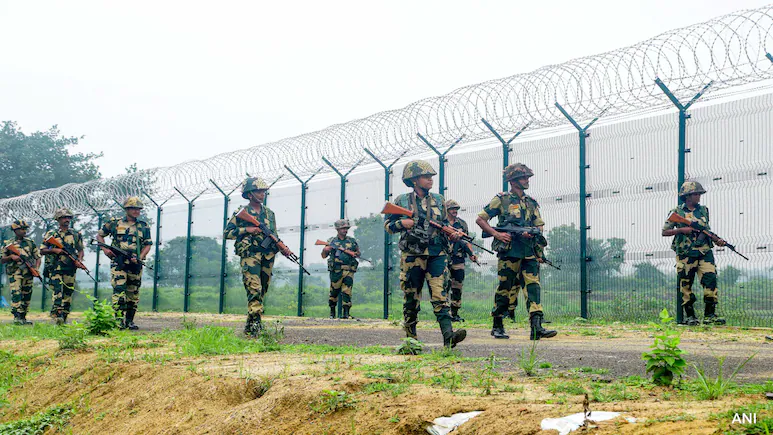

Five Indian states share a border with Bangladesh including West Bengal, Assam, Meghalaya, Tripura, and Mizoram. West Bengal has the longest stretch with about 2,217 km, followed by Tripura (856 km), Meghalaya (443 km), Mizoram (318 km), and Assam (262 km). This combined border is India’s longest international land boundary, stretching over 4,000 kilometres.
India’s Eastern and North-eastern states, particularly West Bengal, Assam and Tripura stay alert due to the possibility of ISIS-linked recruitment efforts spilling over. These regions, with long and porous borders with Bangladesh, have historically been vulnerable to infiltration and radicalisation.
Indian states bordering Bangladesh are vulnerable due to a porous, complex border facilitating illegal migration, human/drug/cattle smuggling, and security threats, compounded by socio-economic disparities, shared cultural landscapes making identification difficult, environmental degradation from climate change, and geopolitical issues, all straining resources and internal stability in states like Assam and West Bengal, with specific concerns for the Siliguri Corridor (Chicken’s Neck).
The key challenges include:
Difficulty in preventing illegal activities
Porous borders and dense forests making it difficult to monitor and prevent illegal activities. Riverine stretches, unfenced areas, and dense habitation make monitoring difficult, while shared cultures/languages blur lines between locals and infiltrators.
Human trafficking and smuggling
Smuggling, human trafficking, and arms trafficking along the border. There is significant cross-border smuggling of drugs, arms, and cattle, fuelling criminal activities and challenging enforcement. Human trafficking networks involved in cross-border infiltration operate through multiple layers.
The first group in Bangladesh selects people and escorts them across the border. The second network transports them from the border area to railway stations or bus terminals inside India. A third group sends them to states such as Uttar Pradesh, Delhi and Maharashtra through long-distance trains. The last set of handlers arranges temporary shelter, work and essential supplies in urban slums.
Demographic change and terrorism threatening India’s security
Illegal migration from Bangladesh leading to demographic changes and resource competition. Economic disparity drives migration from Bangladesh, creating social tensions and impacting resources in Indian border states, with concerns about undocumented populations. Most infiltrators enter India through districts like Malda, North and South 24 Parganas, Murshidabad and Dinajpur of West Bengal, and settle in Muslim-majority localities.
This has significantly altered the demographic makeup in several regions. In Murshidabad, the Hindu population dropped from 44.1 percent in 1961 to 33.2 percent in 2011, while the Muslim population rose from 55.9 per cent to 66.3 per cent. Similar demographic shifts have been observed in multiple pockets across Bengal.
Also, there are risks of terrorism, fake currency proliferation, and demographic changes that affect internal security and political stability. In May 2025, the West Bengal Special Task Force arrested two functionaries of the banned terrorist group, the Jamatul Mujahideen Bangladesh, following raids at Nalhati and Murarai in Birbhum district. Earlier, police in Assam launched Operation Praghat, and arrested at least ten functionaries of the al-Qaida-affiliated Ansarullah Bangla Team from across three states in the country. Several such terror modules have been busted in the past as well.
Other challenges across the border
Groups like ULFA and NDFB operation in these areas, exploiting border vulnerabilities.
Differences in economic opportunities and resources drive illegal activities across the border.
The narrow “Chicken’s Neck” corridor in Siliguri is a critical chokepoint for India’s Northeast, vulnerable to external threats, prompting increased military fortification.
Issues like the NRC/CAA in India have caused anxieties, while communal violence in Bangladesh can spill over, creating internal security challenges.
Illegal Bangladeshi migration through border
Illegal Bangladeshi migration poses significant challenges for India, straining resources, altering demographics (especially in the Northeast), impacting social harmony, creating political tensions, and posing national security risks, all exacerbated by India’s long, difficult-to-fence border with vulnerable riverine and jungle sections, leading to complex border management issues despite cooperation efforts like Joint Border Management Plans.
The question of the influx of illegal migrants, especially Bangladeshis and Rohingyas, is a constant source of worry for India. A large number of such illegal migrants are found across the country, depriving the locals of resources and impacting the population composition. The influx of illegal immigrants, amongst other factors, is closely linked to the level of vigilance on our borders.
Illegal immigration from Bangladesh to India has increased over the past year, especially after the fall of the Awami League regime in August 2024. It has raised concern in the Indian government and prompted a desperate search in official circles for measures to halt the illicit movement.
Infiltration from Bangladesh is extremely well-organized. A network of touts from both countries facilitate the crossing of people through the border to cities and towns in India. Sonamura in Tripura and Karimganj in Assam are among the infiltration hotspots where security forces thwarted several attempts to cross into India in recent months.
Three years ago, India’s National Investigation Agency (NIA) unearthed a five-layered network that facilitated the infiltration of Rohingya and Bangladeshi nationals into India.
Lack of fencing across entire stretch of India-Bangladesh border
The India-Bangladesh border stretches 4,096.7 kilometres, out of which 3,232.7 kilometres have already been fenced. However, infiltration occurs through patches where fencing is not possible due to rivers, hilly terrain or land acquisition issues. In West Bengal alone, nearly 112 kilometres remain without fencing, making it a preferred route for smugglers and traffickers. Similar vulnerabilities exist elsewhere. In Assam, 201.5 kilometres of the 267.5-kilometre border are fenced. In Meghalaya, fencing covers 367.1 kilometres out of 443. Tripura has full fencing along all 856 kilometres, but riverine gaps still exist.
India’s Bangladesh border isn’t fully fenced due to challenging terrain (rivers, marshes), local village objections disrupting lives, land acquisition issues, Border Guard Bangladesh (BGB) objections to construction, and political sensitivities, leading to significant unfenced stretches despite technological solutions being used for riverine areas. Over 800 km remains unfenced, with ongoing efforts to resolve disputes and complete feasible sections, but hurdles like terrain and local concerns slow progress.
A recent viral video featuring travel blogger Pulkit Chaudhary (often referred to as ‘the_tall_trotter’), has caused significant controversy by showing open, unfenced stretches of the India-Bangladesh border in Meghalaya. The footage was reportedly recorded in a forested/rural border area of Meghalaya, highlighting sections where no barbed wire fence or, in some scenes, visible Border Security Force (BSF) personnel are present.
The vlogger suggests it is extremely easy to cross into Bangladesh, jokingly telling officials not to blame him for crossing, and shows locals casually crossing with goods. The video has sparked a heated debate on social media regarding national security, infiltration, and the effectiveness of border management in the Northeast.
The video highlights the issue of over 50 kilometers of the 443-km Meghalaya-Bangladesh border that remain unfenced due to difficult terrain. The video has prompted questions regarding the gap between official border security claims and the on-ground reality in the region.
Meghalaya government taking initiative to complete Bangladesh border fencing
Following the controversy over the viral video, the Meghalaya government has intensified efforts to complete the remaining stretches of fencing along the international border with Bangladesh, with the Centre closely monitoring the progress. Chief Minister Conrad K Sangma on Friday (January 16) said the state was moving “very aggressively” to finish the pending work and expressed hope that the remaining portions would be completed soon.
The India–Bangladesh border in Meghalaya stretches for nearly 440 km, of which around 40 km remains unfenced. According to the Chief Minister, the largest unfenced stretch lies in the West Jaintia Hills sector. He said the delay in completing the project was due to multiple challenges, including population-related concerns, land acquisition issues and ongoing court cases.
CM Sangma acknowledged that legal disputes in certain areas have slowed down the work but assured that the state government is taking necessary steps to resolve these issues. “We are working closely with all stakeholders to ensure that the remaining fencing work is completed at the earliest,” he said.
Emphasising that border security remains a top priority, the Chief Minister said the Meghalaya government is maintaining heightened vigilance along the international boundary in coordination with the Border Security Force (BSF) and other central agencies. He added that regular monitoring and coordination mechanisms are in place to prevent illegal activities and ensure overall security.
Long or Short, get news the way you like. No ads. No redirections. Download Newspin and Stay Alert, The CSR Journal Mobile app, for fast, crisp, clean updates!
App Store – https://apps.apple.com/in/app/newspin/id6746449540
Google Play Store – https://play.google.com/store/apps/details?id=com.inventifweb.newspin&pcampaignid=web_share