


India Develops Indigenous Unmanned Surface Vessel, Joins Elite Group of Nations in Maritime Technology

The CSR Journal Magazine

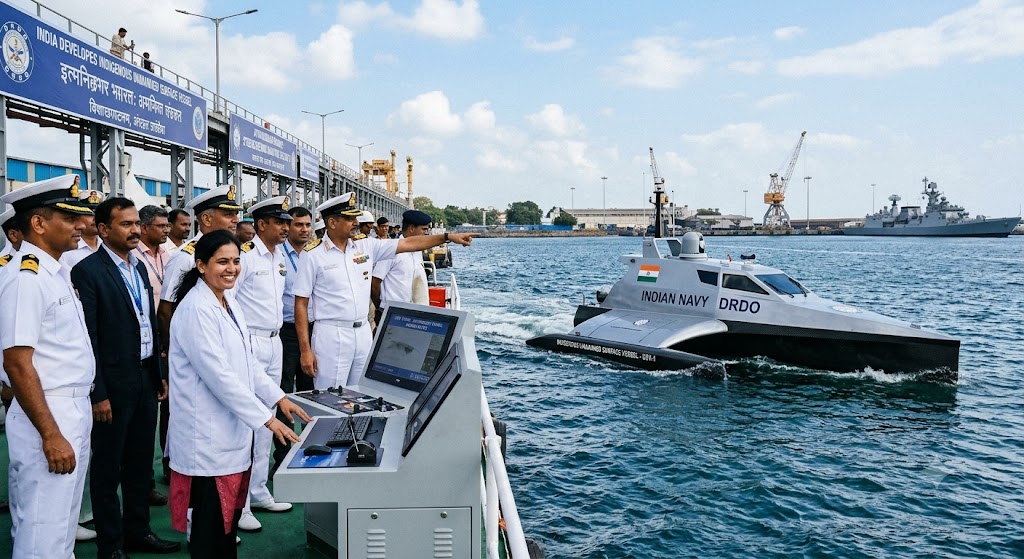
India has achieved a notable milestone by developing its own unmanned surface vessel (USV), placing it among a select group of nations capable of creating such technology. This advancement comes at a time when naval warfare is undergoing significant transformation globally, with unmanned systems increasingly influencing combat strategies across various regions, including the Black Sea and the Red Sea. The USV operates either remotely or autonomously, making it a valuable asset in modern naval operations.

According to Nikunj Parashar, the founder of Sagar Defence Engineering, this vessel is specifically designed for high-risk missions. Its capabilities include surveillance, reconnaissance, force protection, and asymmetric warfare. The primary advantage of deploying USVs is the reduced risk to personnel, allowing for safer operations in potentially hostile environments. As drones and unmanned systems become predominant in contemporary warfare, USVs are emerging as crucial tools for enhancing naval strength.

Showcasing Innovation at the Swavalamban Exhibition

The USV was showcased for the first time at the Swavalamban exhibition held in Delhi, following its induction into the Indian Navy. This exhibition is an initiative of the Indian Navy aimed at promoting innovation and indigenisation within the defence sector. It serves as a platform to bridge the gap between the armed forces and the Indian industrial and startup ecosystem.

The display of the USV at the exhibition sent a clear message that India is moving away from reliance on imports and is now capable of developing advanced systems independently. The inclusion of the USV is expected to significantly enhance the operational capabilities of the Indian Navy, particularly in maintaining continuous surveillance in the Indian Ocean region.

As navies worldwide rapidly adopt unmanned and automated platforms, India’s entry into this domain aligns with global trends. With this development, India joins the ranks of countries such as the United States, China, Israel, and the United Kingdom in utilising this cutting-edge technology. This achievement not only bolsters national security but also opens up prospects for defence exports.

Role of Private Sector in Defence Innovation

The contribution of private companies like Sagar Defence Engineering highlights the significant role that startups can play in the defence sector. The Indian government’s Atmanirbhar Bharat initiative has provided private enterprises with opportunities to innovate, leading to tangible results. In the future, it is anticipated that more systems will be developed to cater to various mission requirements.

USVs are expected to be highly effective in tasks such as maritime border security, anti-smuggling operations, and monitoring adversaries during conflict situations. Overall, this development is steering India’s maritime capabilities in a new direction. Unmanned systems have become integral to future warfare, and India has established its position in this competitive landscape.

Emphasising indigenous technology will not only reduce dependence on foreign systems but also strengthen national security. The advancements in USV technology signify a critical step towards enhancing India’s maritime power and ensuring a robust defence posture in an increasingly complex global environment.

Long or Short, get news the way you like. No ads. No redirections. Download Newspin and Stay Alert, The CSR Journal Mobile app, for fast, crisp, clean updates!

App Store – https://apps.apple.com/in/app/newspin/id6746449540

Google Play Store – https://play.google.com/store/apps/details?id=com.inventifweb.newspin&pcampaignid=web_share

Latest News

Popular Videos