


app-store-logo
play-store-logo
January 13, 2026

How will ‘Chicken Shield’ ensure Delhi’s Republic Day airspace security?
The CSR Journal Magazine

The Delhi government will purchase 1275 kg of boneless chicken meat to ensure the safety of air traffic during the Republic Day parade! Warplane rehearsals are underway for the Republic Day air show in 2026. The fighter jets are preparing to roar across the skies of the capital for rehearsals before the display in front of various high-profile guests from home and abroad. In this situation, to ensure the safe conduct of these rehearsals, the administration is adopting a peculiar strategy.

The Republic Day ceremony is a platform to showcase India’s military might across land, sea, and air. From demonstrations by the Air Force’s most advanced fighter jets to the army parade, people witness a shining spectacle of self-reliant India on the streets of Delhi.

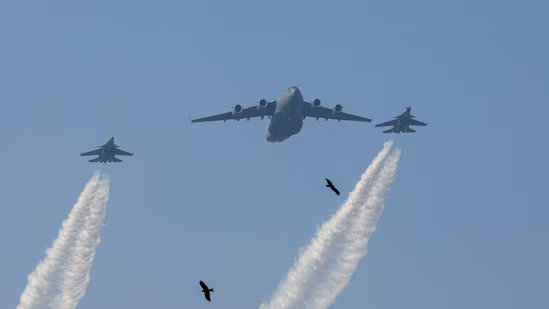
This time, the government is taking an unusual approach to prevent any flying birds from obstructing the flight path of Indian Air Force aircraft, an obstacle which pilots often face. In the skies of Delhi, black kites pose this kind of threat. A collision with these birds could lead to accidents involving the Indian Air Force’s expensive fighter jets.

Essentially, birds fly into the path of the aircraft engines during take-off. The high-powered engines then suck the birds inside, potentially damaging the engines. In many cases, the engines even shut down. There have been several instances where pilots have had to make emergency landings after an engine failure caused by a bird hit. If such an incident were to occur during the Republic Day parade, multiple aircraft could be damaged simultaneously.

To prevent such a situation, the government plans to buy more than 1,275 kg of boneless chicken! This meat will be used to control these flying obstacles and prevent dangerous bird strikes during the Republic Day parade. These large birds, such as kites and hawks, create problems during the rehearsals that take place every year before January 26, in coordination with the Indian Air Force. They come in front of the aircraft while hunting or flying. Bird strikes are considered a serious risk during air shows, especially when the aircraft are flying at low altitudes.

Why boneless meat to protect flying Sukhoi and Rafale jets?

Why did the Delhi administration choose boneless meat to protect the flying Sukhoi and Rafale jets? A senior Forest Department official told the media that carnivorous birds like kites and hawks are naturally attracted to open spaces and food. If they enter the aircraft’s flight corridor, it can pose a serious danger to the aircraft. Large birds like kites are notorious for roaming in open spaces in search of food. Every year, they are lured away by tempting them with animal meat.

What’s different this year is the change in the ‘recipe’. Previously, buffalo meat was used for this type of exercise. This year, it will be replaced with boneless chicken meat to strike a balance between controlling the movement of birds and ensuring the smooth conduct of Republic Day celebrations.

The practice of scattering meat will be conducted from January 15 to January 26 at 20 designated locations in the capital. These include sensitive areas like the Red Fort and Jama Masjid, which are densely populated and usually experience a high presence of kites. The meat-scattering initiative will also include areas near Mandi House, Delhi Gate, and Maulana Azad Institute of Dental Sciences.

According to the Forest Department, these areas are selected every year based on the movement patterns of the birds. The strategy of providing food to the birds at specific locations is to keep them away from the air show route and also ensure they receive sufficient food.

Small pieces of chicken meat are thrown into the air at designated spots so that the birds remain busy feeding at lower altitudes and do not fly towards the air show route. Rehearsals are also conducted before Republic Day to help the birds adapt to this feeding pattern. This strategy is repeated daily for about two weeks.

Every day, 200-400 kg meat will be thrown into the air for the birds. The quantity of meat will be highest on January 22 – 250 kg. Forest Department officials have identified a total of 20 locations for scattering the chicken. According to the Forest Department, approximately 20 kg of meat will be used at each location.

Delhi Govt to spend Rs 4.5 lakh on the birds’ Republic Day feast!

The Delhi government has issued a short-term tender for the supply of 1,275 kg of chicken. The tender specifies that the birds at all locations will be fed equally. For ease of distribution, the meat must be supplied in 20 to 30-gram pieces in five-kilogram packets. The company will have to supply 34 to 51 packets per day.

Although the cost is not specified in the government documents, a trader from Uttar Pradesh’s Ghazipur chicken and fish market said that boneless chicken meat is currently selling at Rs 350 per kg. Based on that price, the government might spend approximately Rs 4.5 lakh on the birds’ Republic Day feast!

Long or Short, get news the way you like. No ads. No redirections. Download Newspin and Stay Alert, The CSR Journal Mobile app, for fast, crisp, clean updates!

App Store –  https://apps.apple.com/in/app/newspin/id6746449540

Google Play Store – https://play.google.com/store/apps/details?id=com.inventifweb.newspin&pcampaignid=web_share

Latest News

Popular Videos
