


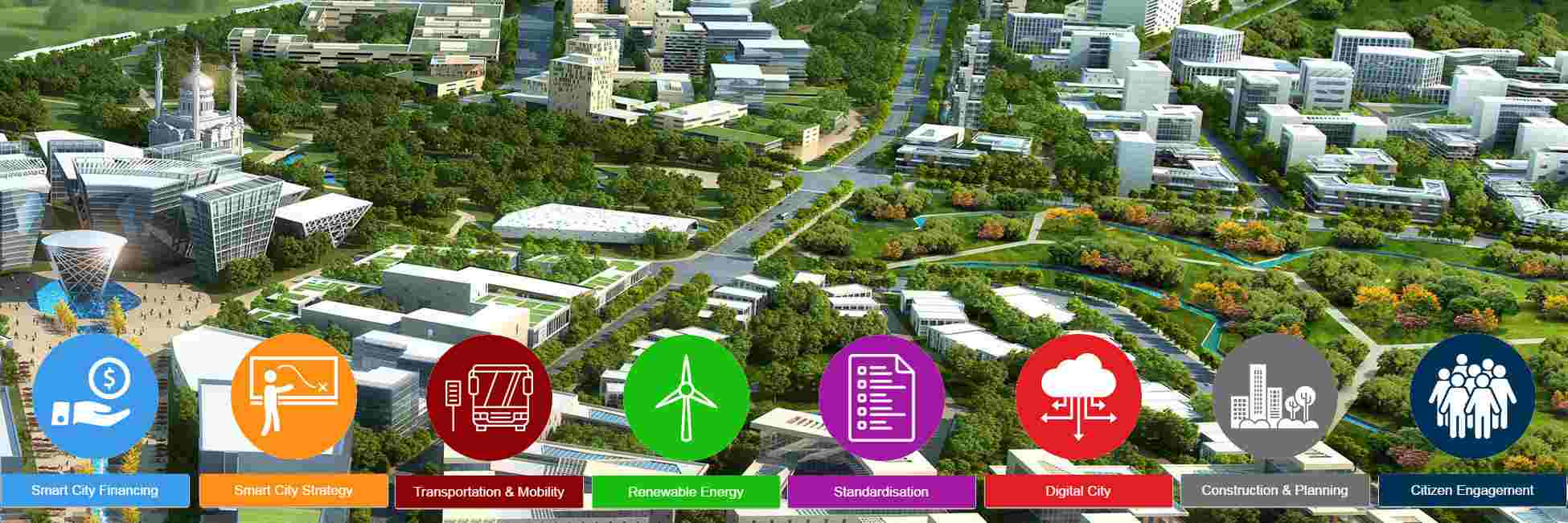

The Government of India launched ‘Smart Cities Mission’ in 2015 with the aim to develop 100 cities with core infrastructure, a clean & sustainable environment, and a high quality of life using “smart solutions” (ICT) for efficient services, economic growth, and inclusive development, focusing on areas like water, power, transport, health, and education. The focus is on urban renewal, retrofitting, redevelopment, greenfield development, and city-wide smart applications, implemented through Special Purpose Vehicles (SPVs) for efficient project execution.
Launched on June 25, 2015 by Prime Minister Narendra Modi, the Smart Cities Mission includes 100 selected cities across India, covering major urban centres like Bhubaneswar, Pune, Jaipur, Surat, Kochi, Ahmedabad, Indore, Chennai, Lucknow, Bengaluru, Mumbai, Delhi (NDMC), and many more state capitals and smaller cities. The cities have been selected in several rounds from 2016 onwards with an aim to ensure holistic urban development.
As per The Ministry of Housing and Urban Affairs, the total allocated union budget for the Smart Cities Mission was Rs 47,652 crores. By March 31, 2025, 99.44% of the total budgeted outlay was released to 100 cities in the mission. The centre’s share is supplemented by other sources of funding such as contributions by the state governments, urban local bodies, public-private partnerships, etc., making the total investment Rs 1.64 lakh crores.
The primary objectives behind the Smart Cities Mission include to ensure constant water/power supply, efficient public transport, and robust digital connectivity, to promote energy efficiency, waste management, and conservation. It also aims to improve health, education, safety, and recreation facilities and create opportunities for jobs and livelihoods. The aim is to develop cities that are citizen-friendly and cater to diverse needs.
How does Smart Cities Mission work?
A total of 100 cities were chosen through competitive selection rounds. Special Purpose Vehicles (SPVs) are created at the city level, with state/ULB equity, to plan and execute projects. Key strategies include area-based development (retrofitting, redevelopment, greenfield) and pan-city initiatives. Smart solutions like intelligent traffic management, e-governance, smart grids, and digital libraries are a characteristic feature of Smart Cities.
In smart cities, technology is used for better traffic flow and parking management. This includes smart metering, efficient waste collection, and recycling, broadband provisioning and smart classrooms.
Smart Cities Mission has achieved substantial progress: Government of India
The assessment of India’s Smart Cities Mission is mixed, with the government highlighting high project completion rates while urban experts and independent reports point to significant failures in governance, equity, and achieving core objectives. The mission officially concluded in March 2025, after multiple extensions.
As of May 9, 2025, 94% of the total 8,067 projects have been successfully completed, reflecting significant progress in reshaping urban landscapes across India.
According to India’s Ministry of Housing and Urban Affairs, “With 100 cities driving the initiative, the Smart Cities Mission has achieved substantial progress. As of May 9, 2025, a total of 7,555 projects—94% of the total 8,067 projects—have been completed, amounting to Rs 1,51,361 crores. Additionally, 512 projects worth Rs 13,043 crores are in the advanced stages of implementation. This amounts to overall 8,067 multi-sectoral projects valued at Rs 1.64 lakh crore.”
What are the achievements of the Smart Cities Mission?
As of May 2025, official data from the Ministry of Housing and Urban Affairs (MoHUA) indicated that 94% of the total 8,067 projects had been completed, with an investment of over Rs 1.64 lakh crore.
All 100 cities now have operational Integrated Command and Control Centres (ICCCs), which use technologies like AI and IoT for data-driven urban management, including public safety and transport monitoring.
It has been claimed that there are visible advances in specific areas, such as improved public safety through extensive CCTV networks, creation of smart roads and cycle tracks, and a more data-driven approach to city operations to handle situations like the COVID-19 pandemic.
A key dimension of the Smart Cities Mission includes creating a Special Purpose Vehicle (SPV) structure for programme implementation, promoting multiple sources of funding for projects and engaging citizens.
Where is the Smart Cities Mission lacking?
There is absence of a universally accepted definition for a “smart city” in the Indian context led to a jumble of unrelated projects, from installing swimming pools to laying concrete roads, without a cohesive vision or measurable outcomes.
The creation of Special Purpose Vehicles (SPVs) for implementation side-lines democratically elected local governments and officials, leading to a lack of local accountability and poor coordination with existing municipal departments. SPVs are typically headed by a CEO, a senior bureaucrat appointed by the state government, with limited representation from elected local urban bodies. This structure places SPVs beyond the direct administrative purview of local authorities, diminishing the role of elected officials and centralizing control.
The “area-based development” approach meant that most funds were concentrated on upgrading small, often already developed, patches of a city (e.g., Church Street in Bengaluru), rather than addressing city-wide basic amenities like water, sanitation, and affordable housing for all residents.
The projects have been criticised for being elitist, with services like online-payment-only public bicycle sharing systems pushing the urban poor further to the margins. There were also reports of forced evictions of slum dwellers in several cities for project development.
The mission failed to attract significant private or foreign investment, relying heavily on central and state funds. Many projects faced significant delays, poor quality work, and allegations of corruption and fund mismanagement.
The project avoids cities from states like West Bengal which have a political conflict with the ruling BJP at the centre.
While significant funds were spent and a large number of projects were technically completed, the mission has largely failed to achieve its initial transformative ambitions for inclusive and sustainable urban development across all 100 cities.
Long or Short, get news the way you like. No ads. No redirections. Download Newspin and Stay Alert, The CSR Journal Mobile app, for fast, crisp, clean updates!
App Store – https://apps.apple.com/in/app/newspin/id6746449540
Google Play Store – https://play.google.com/store/apps/details?id=com.inventifweb.newspin&pcampaignid=web_share