



app-store-logo
play-store-logo
December 23, 2025

Forget Pakistan — Bangladesh Is Where India Is Actually Losing the Great Game

The CSR Journal Magazine

When Sheikh Hasina’s plane lifted off from Dhaka in August 2024, it wasn’t just the departure of a prime minister—it marked the potential unraveling of decades of Indian strategic investment in Bangladesh. Yet, India’s response has been remarkably muted, almost hesitant.

This isn’t just poor optics; it’s dangerous strategy. For a nation that claims regional leadership, India’s unwillingness to robustly defend its interests in Bangladesh reveals a troubling gap between its ambitions and its actions.

The Hasina Legacy India Cannot Afford to Lose

Let’s be clear about what Sheikh Hasina represented for India. She wasn’t merely pro-India; she was the architect of the most stable and productive phase in Indo-Bangladesh relations since 1971. As the daughter of Sheikh Mujibur Rahman—the founding father who led Bangladesh to independence with Indian support—Hasina carried both legitimacy and gratitude that transcended typical diplomatic relations.
Under her leadership, Bangladesh handed over dozens of Indian insurgent leaders who had found safe haven across the border. The Northeast, long India’s most volatile region, saw a dramatic decline in separatist violence. The Land Boundary Agreement of 2015 resolved a 68-year-old territorial dispute, exchanging enclaves and finally giving both nations a settled border. Transit rights through Bangladeshi territory opened up India’s landlocked Northeast to international trade through Chittagong port.

These weren’t small favors. They were foundational shifts in regional security architecture. And India has responded to Hasina’s ouster with what can only be described as strategic paralysis.

The Strategic Geography India Ignores At Its Peril

Bangladesh isn’t just another neighbor. It’s a nation of 170 million people wedged between India’s volatile Northeast and the Bay of Bengal—a waterway that China has been steadily militarizing. The geography alone should make Bangladesh a critical priority.

Consider India’s position. To the northwest, Pakistan remains a perpetual adversary. To the north, China controls Tibet and has made aggressive moves along the Line of Actual Control. To the east, Myanmar—once seen as a potential partner—has fallen firmly into China’s orbit, becoming a key link in Beijing’s “String of Pearls” strategy to encircle India through naval bases and economic zones stretching from the South China Sea to the Arabian Sea.

Bangladesh was supposed to be India’s eastern anchor. A friendly Bangladesh meant that India could focus its military and diplomatic resources elsewhere. It meant secure supply lines to the Northeast. It meant a buffer against Chinese influence creeping into the Bay of Bengal.

Now that anchor is adrift, and India seems content to watch from the shore.

The Myanmar Equation and China’s Tightening Grip

Let’s talk about Myanmar, because this is where India’s Bangladesh policy—or lack thereof—becomes truly shortsighted. Myanmar was meant to be India’s gateway to Southeast Asia, a partner in its “Act East” policy. Instead, Myanmar’s military junta has become increasingly dependent on Chinese weapons, trade, and diplomatic cover.

China now has deep-water port projects at Kyaukpyu, giving it direct access to the Indian Ocean that bypasses the Malacca Strait. Beijing has invested billions in economic corridors cutting through Myanmar to Yunnan province. While India hesitated and attached conditions, China wrote checks and built infrastructure.
A stable, India-friendly Bangladesh could have served as a counterweight.

Combined with better relations in Myanmar, India could have created an eastern corridor that balanced Chinese influence. Instead, India now faces the very real possibility of hostile or unstable governments on both its eastern flanks.

The “String of Pearls”—Chinese port facilities in Gwadar (Pakistan), Hambantota (Sri Lanka), Kyaukpyu (Myanmar), and potentially Chittagong (Bangladesh)—isn’t a conspiracy theory. It’s a visible strategy that India has failed to counter with anything approaching the same level of commitment.

The Hindu Minority Crisis: A Humanitarian and Strategic Failure?

Since Hasina’s departure, reports of attacks on Hindu minorities in Bangladesh have surged. Temples have been vandalized, homes burned, businesses looted. The numbers are disputed, but even conservative estimates suggest hundreds of incidents within weeks of the political transition.
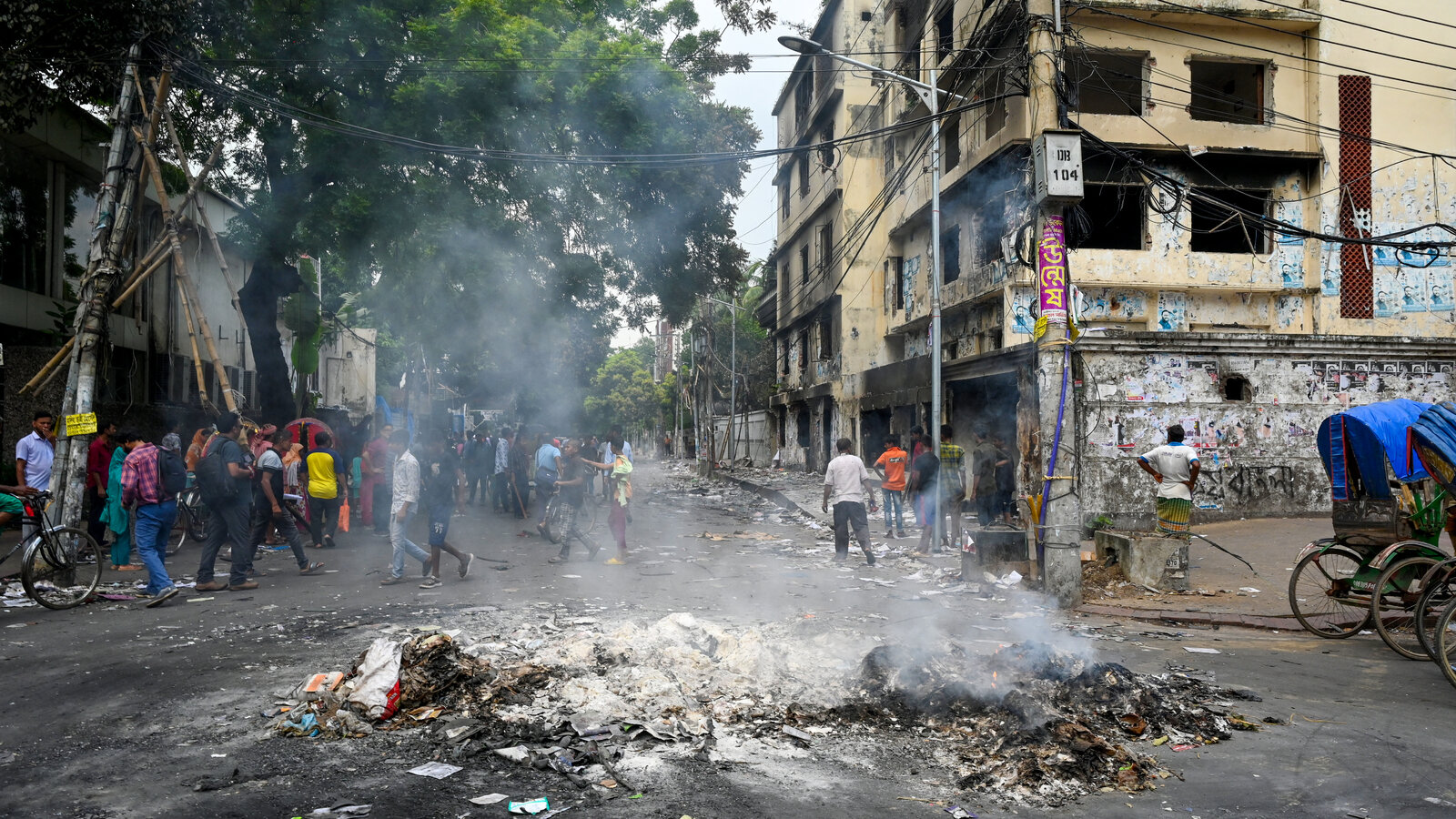

This isn’t just a humanitarian crisis; it’s a direct challenge to India’s credibility as a regional power. India has long positioned itself as the protector of Hindu and South Asian minorities. Its citizenship laws explicitly reference the need to shelter persecuted religious minorities from neighboring countries. Yet when Hindus in Bangladesh—roughly 8% of the population, or about 13 million people—face organized violence, India’s response has been limited to diplomatic statements.
Compare this to how other nations respond when their diaspora or co-religionists face threats abroad. Russia has used the protection of Russian speakers as justification for interventions. Turkey positions itself as the protector of Turkic peoples across Central Asia. Even smaller powers like Israel have conducted operations to protect Jewish communities worldwide.

India talks about being a vishwaguru—a global teacher—but seems unable or unwilling to protect millions who share its majority religion and live just across the border. This sends a message of weakness that reverberates far beyond Bangladesh.

Why Cutting Electricity Isn’t Enough

Some have suggested that India is already exerting pressure through economic means. Adani Power, which supplies over 1,600 MW of electricity to Bangladesh—roughly 15% of the country’s power supply during peak hours—has occasionally reduced supply due to payment disputes. Some analysts suggest this is New Delhi’s way of sending a message.

This is strategic thinking at its most anemic. Economic pressure only works when it’s part of a comprehensive strategy backed by credible alternatives, including the threat of more serious consequences. Cutting electricity for a few days’ causes inconvenience but doesn’t change fundamental political calculations. It’s the geopolitical equivalent of a passive-aggressive text message when what’s needed is a clear, direct conversation backed by real stakes.

Here’s a telling example of India’s selective toughness: Pakistani cricketers have been systematically excluded from the Indian Premier League (IPL) since 2008, following the Mumbai attacks. This isn’t official policy, but it’s an understood red line. The message is clear—if you’re from a country that harbors terrorism against India, you don’t get to profit from Indian entertainment dollars, regardless of your personal views or involvement.

Yet Bangladeshi cricketers continue to play in the IPL, earn millions, and are celebrated by Indian crowds, even as Hindu temples burn in their home country and their government potentially pivots toward anti-India positions. Shakib Al Hasan, Mustafizur Rahman, Litton Das—all playing in Indian leagues, building their brands, making their fortunes, while India supposedly “sends messages” through power cuts.

The inconsistency is glaring. Pakistan, which has been adversarial for decades, faces cultural and economic boycotts. Bangladesh, which is actively moving in a hostile direction under India’s watch, faces… nothing comparable. No IPL ban discussions. No Bollywood boycott conversations. No restrictions on Bangladeshi students in Indian universities. Business as usual, except for some occasional electricity drama that affects ordinary Bangladeshis more than political elites.

If India is serious about applying pressure, why not start with symbols that actually matter to both publics? Why not make Bangladeshi athletes and entertainers choose between their lucrative Indian careers and their government’s treatment of minorities? This isn’t about punishing individuals—it’s about creating visible consequences that generate domestic pressure within Bangladesh itself.

Moreover, economic coercion alone rarely works against nationalist sentiment. When Bangladeshis see power cuts as Indian bullying, it doesn’t make them more compliant—it makes them more determined to find alternative partners. China is more than happy to step in with loans for power projects, grid infrastructure, even entire power plants. India’s half-measures don’t preserve influence; they actively undermine it.

The Pakistan Factor: Why the Threat Matrix Has Changed

For decades, India’s strategic thinking has been dominated by Pakistan. Every decision, every defense budget, every foreign policy move has been filtered through the question: “How does this affect our position vis-à-vis Pakistan?” This made sense when Pakistan was India’s primary security threat.

But the strategic environment has evolved. Pakistan’s economy is in shambles, with foreign reserves barely covering a few weeks of imports. Its military, while still formidable, is overstretched dealing with internal terrorism. Its nuclear arsenal prevents existential threats but doesn’t translate into meaningful conventional leverage.

China, meanwhile, has become the dominant challenge. Its economy is fifteen times larger than India’s. Its military budget is three times higher. And unlike Pakistan, which is constrained by its own weakness, China has the resources to reshape the entire regional order.

A hostile or chaotic Bangladesh in this context isn’t just a problem on its own—it’s a force multiplier for China and a distraction from where India’s strategic focus should be. Every resource India commits to managing instability on its eastern border is a resource not available for deterring China along the LAC or in the Indian Ocean.

This is why the current situation is so dangerous. Pakistan doesn’t need to actively do anything in Bangladesh. Simply by existing as a model of an Islamic republic that’s historically been hostile to India, it provides an alternative narrative that certain Bangladeshi political forces can embrace. The idea of a Bangladesh that leans away from India and toward a broader Islamic identity—whether that means closer ties with Pakistan, Turkey, or Gulf states—is exactly what undermines Indian interests.

The Case for a Limited Conventional Response

Here’s the uncomfortable truth that Indian policymakers seem unwilling to confront: sometimes, limited military force is necessary to defend vital interests. This doesn’t mean invasion or occupation—the very idea is absurd given both countries’ sizes and the human cost. But it does mean considering carefully calibrated military options that send clear messages about red lines.

What might this look like? Precision strikes against infrastructure supporting cross-border terrorism if credible threats emerge. Naval demonstrations in the Bay of Bengal that remind everyone of India’s maritime dominance. Air defense exercises along the border that showcase capability. Perhaps most importantly, visible preparations that signal India’s willingness to act, which often matters more than action itself in deterring hostile moves.

This isn’t warmongering. It’s basic deterrence theory. States that are unwilling to use force are states that cannot credibly defend their interests. Every nation India compares itself to—whether the United States, China, or even medium powers like France—has shown willingness to use military force in defense of strategic interests. India’s restraint is often praised as moral superiority, but there’s nothing moral about allowing your citizens or co-religionists to be attacked with impunity, or watching your strategic position erode because you’re too hesitant to push back.

The academic literature on deterrence is unambiguous on this point. Thomas Schelling, who won the Nobel Prize for his work on conflict and cooperation, argued that the threat of force must be credible to be effective. Credibility comes from capability plus will. India has the capability—the fourth largest military in the world, nuclear weapons, power projection in the Indian Ocean. But will? That’s increasingly in question.

Learning from Historical Precedents

India has actually done this before. In 1971, when East Pakistan was burning, when millions of refugees were flooding across the border, when the humanitarian catastrophe demanded response, India didn’t just issue statements. It intervened militarily, decisively, and successfully. The result was Bangladesh’s independence and one of India’s greatest strategic victories.

The 1971 intervention wasn’t without costs. India faced international criticism. It took risks. But it secured a decades-long strategic advantage and prevented a humanitarian catastrophe from festering on its doorstep.

Today’s situation is obviously different—Bangladesh is an independent nation, not a contested territory within another state. But the principle remains: there are moments when strategic interests and humanitarian concerns align to make a strong response necessary.

Even more recently, India showed willingness to act when it conducted surgical strikes in Pakistan-occupied Kashmir in 2016 and airstrikes after the Pulwama attack in 2019. These were controversial and risky moves, but they signaled that India had limits and would enforce them.

Why should Bangladesh be different? Why should threats to millions of Hindus and the potential rise of a hostile government receive less response than a terrorist attack, however horrific?

What India Should Actually Do

None of this means India should simply march into Dhaka. What India needs is a comprehensive strategy that includes multiple elements:

First, diplomatic offense. India should be actively working with the international community—the United States, Russia, European Union, Japan—to shape the narrative and the outcome in Bangladesh. This means making clear that persecution of minorities is unacceptable and that any government in Dhaka will be judged by its treatment of all citizens. It means using India’s growing economic and diplomatic weight to make clear that there are consequences for anti-India policies.

Second, visible military preparedness. India should conduct exercises along the Bangladesh border, increase naval presence in the Bay of Bengal, and make clear through action—not just words—that it has both capability and will. This isn’t about starting a war; it’s about making clear that India has options and isn’t afraid to consider them.

Third, economic statecraft that goes beyond petty cuts. If India is going to use economic leverage, it should be comprehensive. This means working with allies to offer an alternative development model that makes partnership with India more attractive than alternatives. It means infrastructure investment, trade agreements, and financial assistance that comes with clear conditions about governance and minority protection.

Fourth, information operations. India needs to tell its story better, both domestically and in Bangladesh. The narrative that India is a bullying neighbor needs to be countered with the reality of Indian assistance, the historical bonds, and the mutual benefits of cooperation.

Finally, red lines. India needs to clearly communicate what will trigger a stronger response. Is it attacks on Indian citizens? State-sponsored persecution of Hindus? Allowing anti-India terrorist groups to operate? China establishing a military presence? These need to be clearly stated and credibly enforced.

The Cost of Continued Weakness

Every day that India fails to respond decisively to the Bangladesh crisis is a day that its strategic position weakens. Other neighbors are watching. Nepal, already flirting with Chinese investment, sees that India won’t fight for its interests. Sri Lanka, which has seen Chinese debt diplomacy firsthand, notes India’s inability to match Chinese commitment. Even smaller states like Bhutan and Maldives are reassessing what Indian partnership actually means.

More importantly, China is watching. Beijing’s entire strategy in the region depends on the calculation that India is rhetorically ambitious but operationally timid. Every time India fails to respond to a challenge, this calculation is reinforced.

The brutal logic of international relations is that power unused is power that atrophies. India can have the world’s fourth-largest military, a growing economy, and nuclear weapons, but if it’s unwilling to leverage these assets in defense of vital interests, they become largely irrelevant to actual outcomes.

The Moment Demands Courage

Sheikh Hasina’s departure didn’t just remove a friendly leader. It opened a window—possibly a brief one—where the future orientation of Bangladesh hangs in balance. India can either actively shape that future or passively accept whatever emerges.

The choice isn’t between war and peace. It’s between strategic assertiveness and strategic irrelevance. It’s between defending vital interests with all available tools—diplomatic, economic, and yes, when necessary, military—or watching those interests erode while claiming moral superiority.

Bangladesh matters. It matters for India’s security in the Northeast. It matters for balancing China’s “String of Pearls.” It matters for protecting millions of Hindus facing persecution. It matters for India’s credibility as a regional power.

The question is whether India’s leadership understands this urgency. Whether they’re willing to take risks, accept criticism, and use the full range of national power in defense of national interests. Because right now, India is doing none of these things. And every day of inaction is a day that India’s strategic position in its own neighborhood weakens.

The daughter of Sheikh Mujibur Rahman stood with India when it mattered. The question now is whether India will stand for its own interests with the same courage.

Views of the author are personal and do not necessarily represent the website’s views.

Dr. Jaimine Vaishnav is a faculty of geopolitics and world economy and other liberal arts subjects, a researcher with publications in SCI and ABDC journals, and an author of 6 books specializing in informal economies, mass media, and street entrepreneurship. With over a decade of experience as an academic and options trader, he is keen on bridging the grassroots business practices with global economic thought. His work emphasizes resilience, innovation, and human action in everyday human life. He can be contacted on jaiminism@hotmail.co.in for further communication.

Long or Short, get news the way you like. No ads. No redirections. Download Newspin and Stay Alert, The CSR Journal Mobile app, for fast, crisp, clean updates!

App Store – https://apps.apple.com/in/app/newspin/id6746449540

Google Play Store – https://play.google.com/store/apps/details?id=com.inventifweb.newspin&pcampaignid=web_share

Latest News

Popular Videos