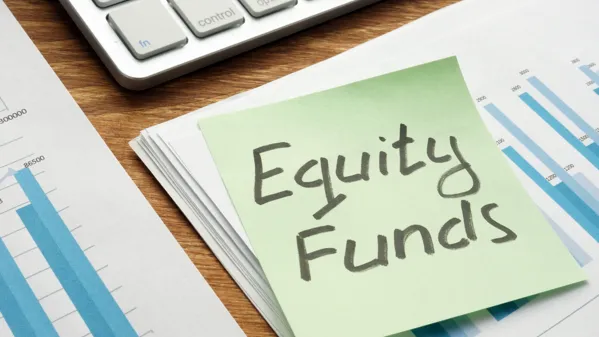
Equity funds are a commonly explored mutual fund category for investors who wish to participate in the growth potential of companies through the stock market. These funds invest a significant portion of their portfolio in equities, making them sensitive to market movements. This article explains how equity funds work, the factors that influence their behaviour, and how they may fit into a long-term investment approach.
What equity funds are
Equity funds are mutual fund schemes that invest at least 65% of their assets in equity shares of listed companies. Based on their investment mandate, they may focus on companies of different sizes, sectors, or investment styles. The objective of equity funds is to reflect the performance of the underlying equity markets over time, subject to market conditions and portfolio choices.
performance: Past performance may or may not be sustained in future.
Because equity markets tend to fluctuate in the short term, equity funds are usually associated with higher volatility compared to debt-oriented funds. At the same time, they are often considered for longer investment horizons, where market cycles may play out more fully.
How equity funds are structured
Equity funds follow a defined investment strategy outlined in their scheme documents. Some focus on large companies, others on mid-sized or smaller firms, while some follow a diversified approach across market segments. Fund managers select stocks based on the stated objective and rebalance portfolios periodically.
The composition of an equity fund may change over time due to market movements, corporate actions, or adjustments made to stay aligned with the scheme’s mandate. These changes may influence returns and risk levels, making it useful to review portfolio disclosures from time to time.
Risk and return considerations
Equity funds are exposed to market risk, sector-specific risk, and company-level risk. Prices of shares may rise, or fall based on economic conditions, interest rates, policy changes, or company performance. As a result, short-term outcomes may vary significantly.
Over longer periods, the likelihood of equity funds reflecting broader economic growth may increase, though this is not assured. Investors generally review their own risk tolerance and investment horizon before considering equity exposure, as temporary declines are a possibility.
Investment horizon and approach
The time horizon plays a meaningful role when evaluating equity funds. A longer holding period may help in absorbing interim volatility, while shorter horizons may be more affected by market swings. Some investors prefer staggered investments through an SIP to spread market entry over time, while others may consider lumpsum investments based on individual circumstances.
The choice between different equity fund categories often depends on factors such as financial goals, comfort with volatility, and overall asset allocation. There is no single structure that suits every investor.
Tax treatment of equity funds
For taxation purposes, equity funds are treated as equity-oriented schemes when they maintain the required equity exposure. Short-term capital gains apply to units held for up to 12 months, while long-term capital gains apply beyond that period, subject to prevailing tax rules.
Tax treatment may influence post-tax outcomes, but it is only one aspect of decision-making. Investors usually consider taxation alongside risk, horizon, and portfolio balance rather than in isolation.
Comparing equity funds with other fund categories
Equity funds differ from debt and hybrid funds primarily in their exposure to equities and their sensitivity to market movements. While debt-oriented funds focus more on interest income and capital preservation, equity funds are linked to stock market performance.
A diversified portfolio may include multiple fund categories based on individual preferences. The relative allocation to equity funds often reflects an investor’s growth expectations and tolerance for fluctuations.
Using tools to understand long-term impact
To visualise how investments may evolve over time, some investors refer to a compounding calculator. Such tools help illustrate how periodic investments or a one-time amount might grow over an extended period, based on assumed rates and duration.
When reviewing equity funds, a compounding calculator may help set expectations around long-term accumulation rather than short-term movements. The calculator is an aid, not a prediction tool. It may provide only an indicative picture.
Conclusion
Equity funds offer exposure to equity markets through a professionally managed structure, with returns linked to market behaviour over time. They involve higher volatility compared to some other fund categories and are often reviewed from a longer-term perspective. Understanding how equity funds function, their risks, and their tax treatment may help investors assess whether they align with personal financial goals and risk appetite.
Mutual Fund investments are subject to market risks, read all scheme related documents carefully.
This document should not be treated as endorsement of the views/opinions or as investment advice. This document should not be construed as a research report or a recommendation to buy or sell any security. This document is for information purpose only and should not be construed as a promise on minimum returns or safeguard of capital. This document alone is not sufficient and should not be used for the development or implementation of an investment strategy. The recipient should note and understand that the information provided above may not contain all the material aspects relevant for making an investment decision. Investors are advised to consult their own investment advisor before making any investment decision in light of their risk appetite, investment goals and horizon. This information is subject to change without any prior notice.
Long or Short, get news the way you like. No ads. No redirections. Download Newspin and Stay Alert, The CSR Journal Mobile app, for fast, crisp, clean updates!
The Indian stock market faced a considerable downturn on Monday, following a week of gains. The benchmark indices, Nifty50 and BSE Sensex, fell sharply...
Reliance Industries Limited (RIL) is on the verge of becoming India's most valuable conglomerate, potentially overtaking Tata Group following the listing of Jio Platforms....