A family wedding in Lahore has unexpectedly set off a wider conversation in Pakistan one that blends fashion, politics, and public sentiment in equal measure.
Junaid Safdar, the son of Punjab Chief Minister Maryam Nawaz and grandson of former Prime Minister Nawaz Sharif, recently married Shanzay Ali Rohail, who belongs to the political family of Sheikh Rohail Asghar. The celebrations were intimate and largely limited to family and close associates. Still, once images from the ceremonies surfaced online, the event quicklby moved beyond the private sphere.
What drew attention was not the guest list or the venue, but the bride’s wardrobe.
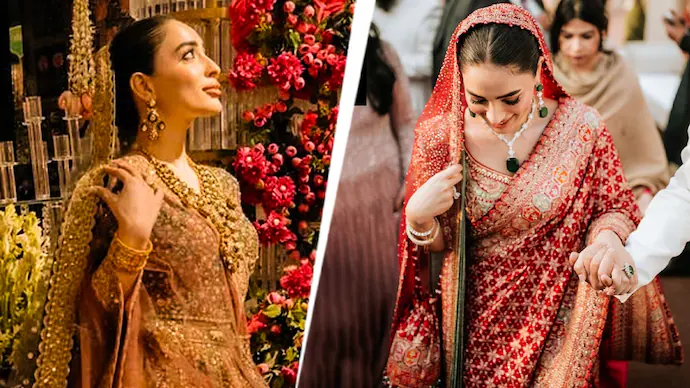
For her wedding festivities, Shanzay chose to wear creations by two well-known Indian designers Sabyasachi Mukherjee and Tarun Tahiliani. The decision immediately stood out, especially given the bride’s connection to one of Pakistan’s most influential political households.
Her mehendi look featured a deep green lehenga marked by heavy gold detailing, layered panels, and contrasting dupattas. The design leaned heavily into traditional craftsmanship and rich colour, giving the outfit a distinctly regal presence. For the nikah ceremony, her style shifted to something more restrained yet classic a red saree with fine embroidery and a matching veil, paired with elegant jewellery.
Bridal Outfits Win Praise
The outfits were widely praised by fashion watchers for their finish and attention to detail. Many described the looks as timeless and graceful, noting the balance between ornate clothing and soft styling.
However, admiration soon turned into argument.
On Pakistani social media, users began questioning the symbolism of the bride’s choices. Some felt that selecting Indian designers particularly at a time when relations between India and Pakistan remain tense sent the wrong message. Others argued that local designers could have created ensembles that carried deeper cultural meaning.
The discussion grew sharper when the political background of both families came into focus. For critics, the issue wasn’t fashion alone, but what it represented when tied to power, privilege, and national identity.
Supporters Defend Bride’s Fashion Choices Amid Criticism
At the same time, a strong counter-view emerged. Supporters defended Shanzay’s right to dress as she pleased on her wedding day, insisting that clothing should not be burdened with political expectations. Many pointed out that cross-border fashion exchange is not new, noting that Indian celebrities frequently wear Pakistani designers as well.
This was also not unfamiliar territory for the Sharif family. In the past, Maryam Nawaz herself faced backlash for wearing an Indian designer outfit at a family event, suggesting that such criticism tends to resurface whenever personal style intersects with public life.
As the online debate continues, one thing is clear: a wedding meant to celebrate two families has instead highlighted how deeply personal choices are scrutinised in Pakistan especially when they belong to those in the public eye.
In the end, what Shanzay Ali Rohail wore has become more than a bridal look. It has become a mirror reflecting the complex mix of culture, politics, and expectation that defines public discourse today.