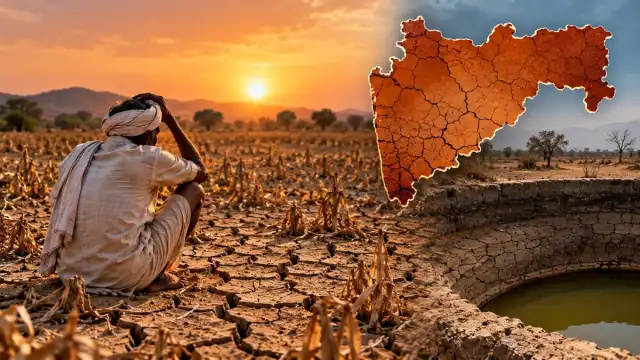
Maharashtra has officially recognised that 265 out of its 358 talukas are experiencing drought conditions, indicating that nearly three-quarters of the state’s administrative areas are now under drought measures. This notification was issued on Saturday, September 26, as the prolonged absence of rainfall significantly impacts agriculture, livestock, and water supply across the region.
Particularly hard-hit are districts in Marathwada, where places like Dharashiv and Beed have not seen meaningful rainfall since July. This has resulted in severe water shortages for farms, cattle, and rural households that depend on these resources for their daily needs.
At first glance, the rainfall statistics for Maharashtra appear rather moderate. According to data from the India Meteorological Department (IMD) covering June 1 to September 25, the state has registered an 18 per cent deficit in rainfall. Under the IMD’s criteria, rainfall variations between -19 per cent and +19 per cent of the long-period average are categorised as ‘normal’. However, this overarching classification obscures significant regional disparities.
An assessment by the state government indicated that certain regions are facing more serious drought conditions. The Chhatrapati Sambhajinagar division has reported a rainfall deficit of 30.8 per cent, while the Pune and Nashik divisions are nearly 30 per cent below normal. Furthermore, the Amravati and Nagpur divisions have seen deficits of about 27 per cent. These disparities highlight why a state can still be considered to have ‘normal’ rainfall overall, while some areas endure severe impacts affecting crops and water availability.
Impact on Agriculture and Rural Communities
The agricultural sector is experiencing the brunt of this drought during the kharif season, a crucial period when farmers rely on monsoon rainfall for cultivating various crops, including soybean, cotton, maize, millets, tur, moong, and urad. Reports indicate that the extended dry spell has damaged crops in multiple areas and has also led to increased pest and disease issues, compounding the challenges faced by farmers.
In response to the developing situation, the state government has initiated crop-damage assessments and verification efforts to ascertain the scale of agricultural losses. Concerns are escalating beyond crop failures, as insufficient rainfall has rendered many local water sources unreliable, creating critical shortages of drinking water and fodder for rural communities. Maharashtra’s Agriculture Minister has instructed officials to evaluate the needs for water and fodder while the government develops relief measures to address these challenges.
This drought declaration has occurred at a pivotal moment in the monsoon period, with the season already receding from northern India. While the state’s total rainfall falls within the IMD’s broad ‘normal’ range, the uneven distribution of rainfall and its lengthy absence have resulted in a starkly different and troubling reality for widespread areas of Maharashtra.
Long or Short, get news the way you like. No ads. No redirections. Download Newspin and Stay Alert, The CSR Journal Mobile app, for fast, crisp, clean updates!