


app-store-logo
play-store-logo
February 13, 2026

Cannonball-Sized Dinosaur Eggs with Crystal Formation Discovered in China
The CSR Journal Magazine

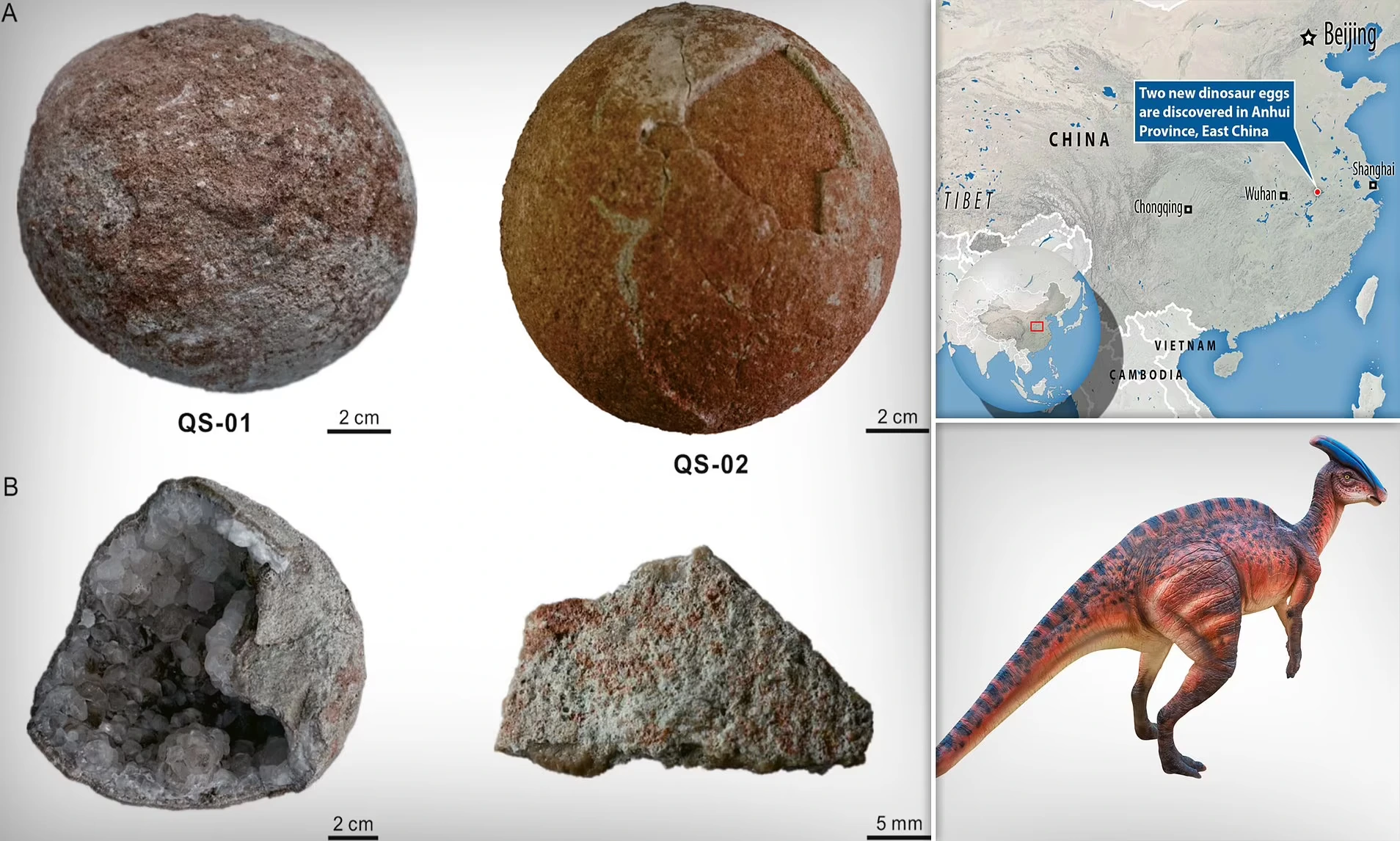
Recent paleontological research in eastern China has uncovered two fossilized dinosaur eggs, each approximately the size of a cannonball, embedded within red sandstone layers. These eggs, originating from the Upper Cretaceous Chishan Formation in the Qianshan Basin of Anhui Province, garnered attention after researchers cut them open for examination. Instead of finding expected tiny bones, they discovered hollow cavities lined with clear crystals.

Physical Characteristics of the Fossils

The eggs exhibit a nearly spherical shape, measuring around 10 to 13 centimeters in length, and possess shells with a thickness of up to 2.6 millimeters. While their outer appearance may seem unremarkable, microscopic analysis reveals distinct growth lines and tightly packed structures within the shell.

These unique characteristics have led scientists to identify them as a new oospecies, named Shixingoolithus qianshanensis. Unfortunately, no preserved embryonic remains were found within the eggs; what remains are mainly the intact shells and the minerals that accumulated inside after burial.

Crystal Formation Process Explained

A recent study, published in a reputable paleogeography journal, indicates that the crystals found in these eggs are primarily calcite. These crystals did not form while the eggs were intact or alive. Instead, after the eggs were buried, groundwater permeated the soil, carrying dissolved minerals that gradually deposited within the hollow spaces left behind as the organic material decayed.

This deposition process is typical in fossilization, where organic entities are either replaced or their voids filled with minerals. In this instance, the eggshell remained well-preserved, while no traces of embryos were detected.

New Oospecies Classification

Despite the absence of bones, the details observed in the eggshell were sufficient for scientific classification. Close examination of thin slices under a microscope revealed uniform units and dense structural features.

The distinct differences from previously identified types allowed researchers to classify the eggs within the Stalicoolithidae family as a new oospecies. This marks a significant development, as it is the first confirmation of this group in the Qianshan Basin. While numerous dinosaur eggs have been found in other regions of China, this basin had not previously provided direct evidence.

Contextualizing the Geological Significance

The fossilized eggs were discovered among sediments formed from ancient river and lake systems, dating to the Late Cretaceous period, an era just before the mass extinction event that led to the demise of the dinosaurs. The preservation of these eggs supports the dating of the geological layers, aiding geologists in understanding the chronological age of these rock formations and shedding light on the region’s historical evolution.

At present, only two eggs have been preserved for study, with one being incomplete. Nonetheless, this discovery contributes valuable information to the existing fossil record, offering insight into dinosaur life in eastern China amid vast geological timelines.

Long or Short, get news the way you like. No ads. No redirections. Download Newspin and Stay Alert, The CSR Journal Mobile app, for fast, crisp, clean updates!

App Store –  https://apps.apple.com/in/app/newspin/id6746449540 

Google Play Store – https://play.google.com/store/apps/details?id=com.inventifweb.newspin&pcampaignid=web_share

Latest News

Popular Videos
