


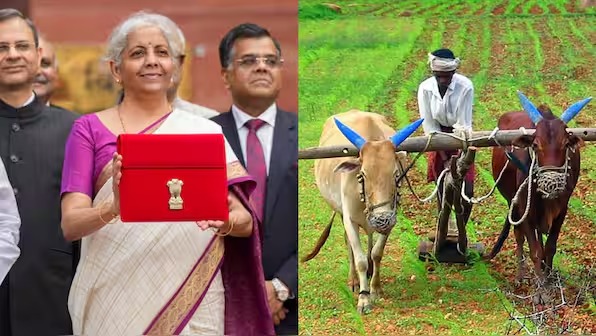

In the Union Budget 2026, presented on February 1, 2026, Finance Minister Nirmala Sitharaman reinforced agriculture as a primary “growth engine,” focusing on productivity, high-value diversification, and digital empowerment. In the Union Budget 2026-27, the sector received an allocation of Rs 1,62,671 crore, a 7% increase intended to bolster farmer welfare and food security.
In her Budget speech on Sunday, Sitharaman said the government’s third “Kartavya” focuses on increasing farm productivity and entrepreneurship, with special attention to small and marginal farmers, empowering youth with livelihood opportunities, strengthening support for vulnerable groups, and accelerating development in poorer states and the North East.
While presenting the budget 2026, FM Sitharaman introduced targeted programmes to diversify farm output and increase profitability. The government will focus on supporting high-value crops like coconut, sandalwood, cashew, and cocoa in coastal areas. Special initiatives will be taken to boost production of walnuts, almonds, and pine nuts in hilly regions, and Agar trees in the Northeast.
“I propose a coconut promotion scheme to increase production and enhance productivity through various interventions, replacing non-productive trees with new saplings or varieties in major coconut-growing states,” the Finance Minister said.
The government plans to launch a dedicated programme for cashew and cocoa cultivation to make India self-reliant in raw cashew and cocoa production and processing. Aim is to enhance export competitiveness and transform Indian cashew and Indian cocoa into premium global brands by 2030.
Attention will also be given on sandalwood, which is closely linked to India’s social and cultural heritage, to preserve and promote its legacy and economic potential. The Centre will partner with states to restore glory of sandal wood ecosystem, the finance minister announced.
The government has a dedicated proposal to enhance competitiveness by replacing non-productive trees with new varieties. Focus will be given on atmanirbharta (self-sufficiency) for oilseeds (mustard, groundnut, sesame, soybean, sunflower) and pulses (tur, urad, masoor).
The government aims to prioritise investments in warehouses, cold chains, and processing units to reduce post-harvest losses, which currently stand at 15–20% for perishables. Initiatives will be taken to develop 500 reservoirs to improve irrigation and water management. She also proposed credit-linked subsidy programme to encourage livestock farmer producer organisations to promote employment opportunities.
FM Siatharaman announced a significant reduction of GST on biopesticides to 5% to encourage sustainable farming.
AI-powered platform to assist farmers
In the Union Budget 2026, Finance Minister Nirmala Sitharaman announced Bharat Vistaar, a new multilingual AI-powered platform designed to provide real-time, data-driven support to Indian farmers. Aim is to strengthen last-mile delivery of agricultural knowledge.
Elaborating on the AI tool, the Finance Minister on Sunday said, “Bharat Vistar – Virtually Integrated System to access Agricultural Resources. I propose to launch Bharat Vistar, a multilingual AI tool that shall integrate the agri-stack portals and the ICAR package on agricultural practices with AI systems.”
This tool will assist farmers through several functions. Bharat Vistaar will help farmers to overcome language barriers said the Finance Minister. The tool provides real-time, voice-based assistance in various local dialects, making scientific data actionable for all farmers.
FM Sitharaman said the tool will combine the government’s Agri Stack portal with the Indian Council of Agricultural Research (ICAR) practices to deliver verified, scientific farming advice. Farmers can access real-time weather forecasts via APIs, soil health data, and crop-specific alerts to reduce risks.
Bharat Vistaar will offer customised tips for pest management, irrigation optimisation, and disease detection. It will provide insights on market prices and market-aligned crop planning to help farmers improve their overall income.
The tool streamlines the process for farmers to learn about and track various government welfare schemes.
Financial Inclusion for India’s farmers
FM Nirmala Sitharaman announced expansion of the Kisan Credit Card (KCC) scheme. JanSamarth-based KCCs will be issued in five states to simplify loan access. While pending official notification in some areas, the government aims to raise KCC limits from Rs 3 lakh to Rs 5 lakh.
With 2026 being the “International Year of the Women Farmer”, there will be a specific push to improve credit access for women.
Government’s support to Animal Husbandry
Also the fisheries value chain in coastal areas will be strengthened and the government will support animal husbandry through credit-linked subsidy programmes. The Centre plans to support the animal husbandry sector in entrepreneurship development through a credit-linked subsidy programme, Finance Minister Nirmala Sitharaman said on Sunday while presenting Union Budget 2026.
She proposed a credit-linked subsidy programme to encourage livestock farmer producer organisations to promote employment opportunities. The government will work together with aquaculture organisations and animal husbandry bodies to provide quality employment opportunities in rural and semi-urban areas. These efforts will focus on improving market linkages and supporting startups, women-led groups and fish farmer producer organisations, particularly in coastal areas.