


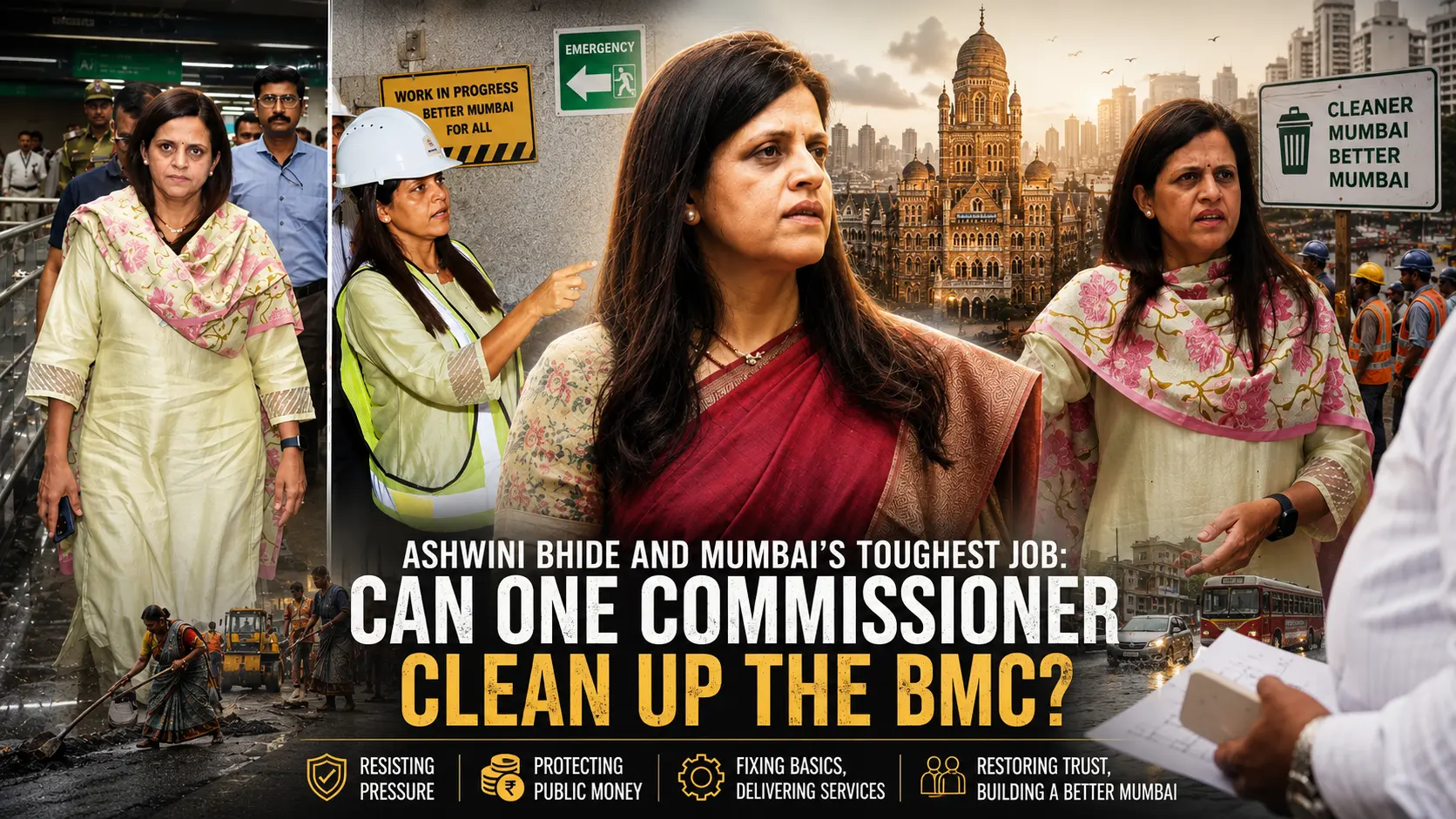
Ashwini Bhide and Mumbai’s Toughest Job: Can One Commissioner Clean Up the BMC?
The CSR Journal Magazine

Mumbai needs an administrator who can say “no” — to political pressure, vested interests, contractors and bureaucratic inertia. Ashwini Bhide now has perhaps the toughest civic job in India.

There are few government posts in India more demanding than the Municipal Commissioner of Mumbai. The Brihanmumbai Municipal Corporation controls an enormous civic machinery, a vast budget and responsibility for the daily lives of millions of people. Roads, drains, water, waste, hospitals, schools, flooding, encroachments, redevelopment, public spaces and infrastructure—all eventually land on the Commissioner’s desk.

And now, for the first time in its more than 160-year history, that desk belongs to a woman: Ashwini Bhide, a 1995-batch IAS officer and the BMC’s first woman Municipal Commissioner. Bhide’s reputation has been built not on speeches but on execution. She is widely described as a no-nonsense administrator, and her career has repeatedly placed her in the middle of politically sensitive, technically complex and publicly controversial projects. Her biggest test, however, may not be another mega-project. It may be whether she can make the BMC work differently.

A career built around difficult assignments

Before taking charge of the BMC, Bhide handled several important assignments in Maharashtra. As CEO of Nagpur Zilla Parishad, she was associated with a programme that resulted in the construction of hundreds of small dams across hundreds of villages, expanding irrigation potential. At the Mumbai Metropolitan Region Development Authority, she was involved with major infrastructure initiatives including the Eastern Freeway, Sahar Elevated Access Road, Mithi River-related work, Mumbai Monorail and early Metro projects.

As Managing Director of the Mumbai Metro Rail Corporation, she became closely identified with the ambitious Metro Line 3 project—the city’s first underground metro line. Her tenure also brought her into the centre of the highly contentious Aarey car-shed controversy. A government-appointed panel later concluded that procedural norms had been followed before tree felling for the project. She has therefore experienced both sides of public administration: the applause that comes with delivering infrastructure and the anger that comes when difficult decisions have environmental, political or social consequences. That experience matters in Mumbai because Mumbai does not need an administrator who only takes popular decisions. It needs someone willing to take necessary decisions—and defend them with facts.

The BMC is not an ordinary municipal corporation

The BMC is a gigantic institution, responsible for some of the most fundamental services that determine whether Mumbai functions or fails. But it also operates inside a complicated ecosystem of elected representatives, bureaucrats, contractors, developers, unions, citizens’ groups, hawkers, builders and multiple state agencies. The challenge is therefore not simply administrative. It is structural.

Mumbai’s civic problems have accumulated over decades: potholes, flooding, waste management, encroachments, traffic, ageing infrastructure, inadequate pedestrian space, redevelopment disputes, pollution, pressure on open spaces and the enormous challenge of managing a city where land is among the most expensive in the country. And then there is money. The BMC is one of India’s wealthiest civic bodies, yet its finances face competing demands and significant outstanding dues. In January 2026, the state government acknowledged outstanding amounts of about ₹10,948 crore involving grants, property tax and utility-related dues. At the same time, the corporation must protect every rupee of public money. That is where the Commissioner’s job becomes particularly uncomfortable.

The shadow of financial irregularities

The BMC has repeatedly faced allegations and audit observations concerning tendering, contracts, procurement and financial management. A CAG audit had previously identified irregularities in the awarding of contracts and cases where prescribed procedures were not followed.

Even in 2026, controversies continue. A civic probe was ordered into proposals cleared by the Mechanical and Electrical department after allegations surrounding a ₹62-crore LED lighting tender, including claims about pricing, quality and the tender process. These remain allegations subject to investigation, not established findings of wrongdoing. There have also been allegations surrounding transfers of civic engineers, redevelopment benefits and large infrastructure contracts. This is precisely why an administrator’s integrity matters. When thousands of crores are involved, governance cannot be based on relationships. It must be based on rules, transparency and accountability. It would be unfair to suggest that Bhide personally bears responsibility for historical irregularities in the BMC. But as Commissioner, she inherits the system—and therefore inherits the responsibility of strengthening it.

And Bhide appears to be pushing back

One of the most significant recent examples is her intervention regarding redevelopment concessions. Bhide has flagged approximately 300 SRA schemes where she alleges that concessions meant for slum redevelopment are being extended to vacant or non-slum plots, potentially affecting BMC revenue. She has taken the matter up with the state Urban Development Department. That is not a small administrative issue.It is about public revenue. And public revenue is ultimately citizens’ money. If concessions meant for the genuinely needy are misused, someone has to ask difficult questions. If Mumbai’s municipal finances are losing legitimate revenue, someone has to object. That is the kind of battle a Commissioner cannot avoid.

Back to basics—but with urgency

Soon after taking charge, Bhide revived monthly civic review meetings and pushed what she called a “back to basics” approach—focusing on roads, infrastructure and citizen-centric services. She also stressed completing road projects before the monsoon and finding permanent solutions to waterlogging. Her administration has also launched a “Pedestrian First” approach, with a target of addressing obstructions across around 320 km of footpaths. Bhide herself spent hours walking through the city to inspect pedestrian conditions.

She has subsequently clarified that licensed hawkers can operate on footpaths provided they do not obstruct pedestrians—a reminder that civic enforcement cannot simply mean destroying livelihoods; it has to balance livelihoods with citizens’ right to walk safely. The BMC has also introduced an online single-window system for Ganeshotsav pandal permissions and NOCs, another step towards reducing bureaucratic friction through digitisation. These may appear like small administrative measures. But cities are not transformed only by ribbon-cutting ceremonies. They are transformed by fixing thousands of everyday problems.

The political pressure will be enormous

This may ultimately be Bhide’s biggest challenge. Mumbai’s civic administration has returned to elected governance after years of bureaucratic rule, and tensions between elected representatives and the administration have already surfaced. A Municipal Commissioner must listen to politicians because they represent citizens. But listening is not the same as surrendering. The Commissioner must also be able to tell a politician, contractor, developer or senior official: No. This cannot be done. The rules do not permit it. The public interest does not permit it. That single word is perhaps the hardest word in Indian administration. And sometimes the most important.

The real test of integrity

Integrity should not be measured by photographs, speeches or public praise. It should be measured when a powerful person makes a request. It should be measured when a politically connected contractor wants a favour. It should be measured when an unpopular but necessary action has to be taken. It should be measured when billions of rupees are at stake. And it should be measured when nobody is watching. Bhide’s career has demonstrated a willingness to take difficult administrative positions. But the BMC will provide the strongest test yet. Because here, every decision has multiple stakeholders—and every mistake can affect millions.

Mumbai doesn’t need another administrator who manages files

It needs an administrator who understands that Mumbai is not a collection of files. It is a living city.

A child walking to school needs a safe footpath, A worker needs reliable public transport, A family needs a flood-free home, A senior citizen needs a usable pavement, A taxpayer needs to know that public money is not being wasted, A hawker needs a livelihood—but pedestrians need space, A developer needs predictable rules—but citizens need protection from exploitation and every Mumbaikar deserves a civic administration that works without fear or favour. That is the enormous responsibility now resting on Ashwini Bhide. Her biggest legacy will not be the number of meetings she conducts or projects she inaugurates. It will be whether she can leave behind a BMC where rules matter more than influence, public money matters more than private interests, and citizens matter more than politics.

Mumbai has seen powerful commissioners come and go. What Mumbai needs now is not simply a powerful commissioner. It needs an honest, fearless and accountable one. And if Ashwini Bhide can withstand the pressure, confront vested interests, protect public finances and deliver basic civic services with consistency, her most important project may not be a metro line, a road or a bridge. It may be restoring citizens’ faith in the institution that runs their city. That would be infrastructure of a different kind. Infrastructure of trust.

Latest News

Popular Videos
