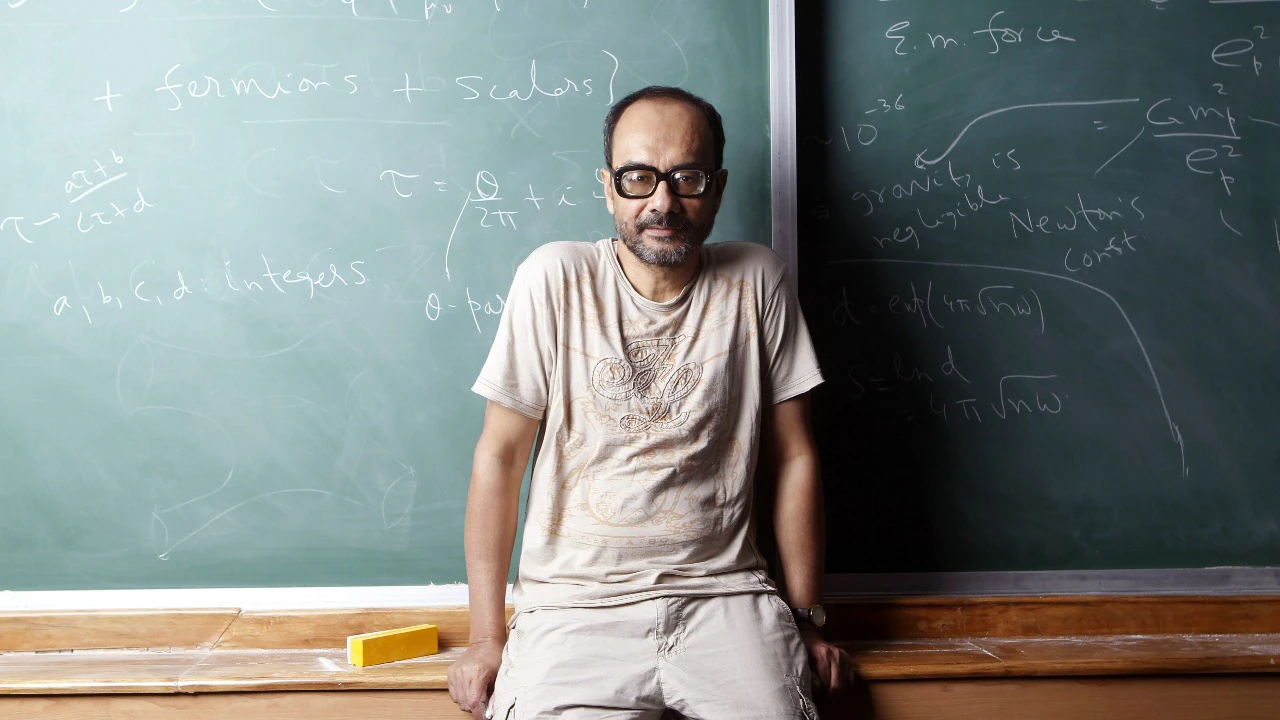
Ashoke Sen has been awarded the 2026 Oskar Klein Medal, marking a significant milestone as he becomes the first Indian physicist to receive this prestigious honour. The Oskar Klein Medal, established in 1988, is named after the renowned Swedish theoretical physicist.
It is awarded annually by Stockholm University in conjunction with the Nobel Committee for Physics of the Royal Swedish Academy of Sciences. Previous laureates include notable figures such as Stephen Hawking, Peter Higgs, and Kip Thorne, underscoring the importance of this recognition in the field of theoretical physics.
Sen’s Contributions to String Theory
Sen, a professor at the International Centre for Theoretical Sciences (ICTS) in Bengaluru, has made significant contributions to the understanding of string theory. His research has been pivotal in demonstrating that five string theories, once thought to be distinct, can be viewed as different manifestations of a single underlying framework.
String theory aims to unify the fundamental forces of nature and the building blocks of matter within one coherent model, which has profound implications for theoretical physics. During the award ceremony held in Stockholm on October 22, Sen delivered a lecture titled ‘Gravity from strings and strings from gravity’.
In his presentation, he explored how string theory can elucidate the nature of gravity through the lens of quantum physics, offering insights into complex phenomena such as black holes. This lecture highlighted the ongoing relevance of his work in contemporary physics and its potential to address fundamental questions about the universe.
Sen’s achievements in the field have also been recognised with the Breakthrough Prize in Fundamental Physics in 2012, further cementing his status as a leading physicist. His work continues to inspire future generations of scientists as they explore the intricacies of theoretical frameworks in physics.
From Kolkata to Global Recognition
Born and raised in Kolkata, Ashoke Sen developed a passion for physics during his academic journey. His early interest in mathematics was nurtured by his father, who was a physics professor. Sen recalls being inspired by local luminaries like Satyendra Nath Bose and Meghnad Saha, whose contributions to science were well-known in his community. One of his influential teachers was Amal Kumar Raychaudhuri, whose teaching left a lasting impression on him.
After completing his post-doctoral research in the United States, Sen chose to return to India, where he spent several years at the Harish-Chandra Research Institute in Prayagraj. It was during this time that he developed much of his groundbreaking work on string theory. Sen has expressed that he never considered staying abroad permanently, stating that his decision was primarily influenced by the opportunity to work in India.
Sen has been honoured with the Padma Shri in 2001 and the Padma Bhushan in 2013 for his contributions to science. He acknowledges that the nature of his research often involves long-term projects that may take decades to yield results. He emphasises the inherent risks associated with string theory, noting that it may not be verifiable within a single lifetime, yet he remains committed to his work.
Long or Short, get news the way you like. No ads. No redirections. Download Newspin and Stay Alert, The CSR Journal Mobile app, for fast, crisp, clean updates!