
Thermal Drones Successfully Identify 20 Snakes in Australian Forest Canopies
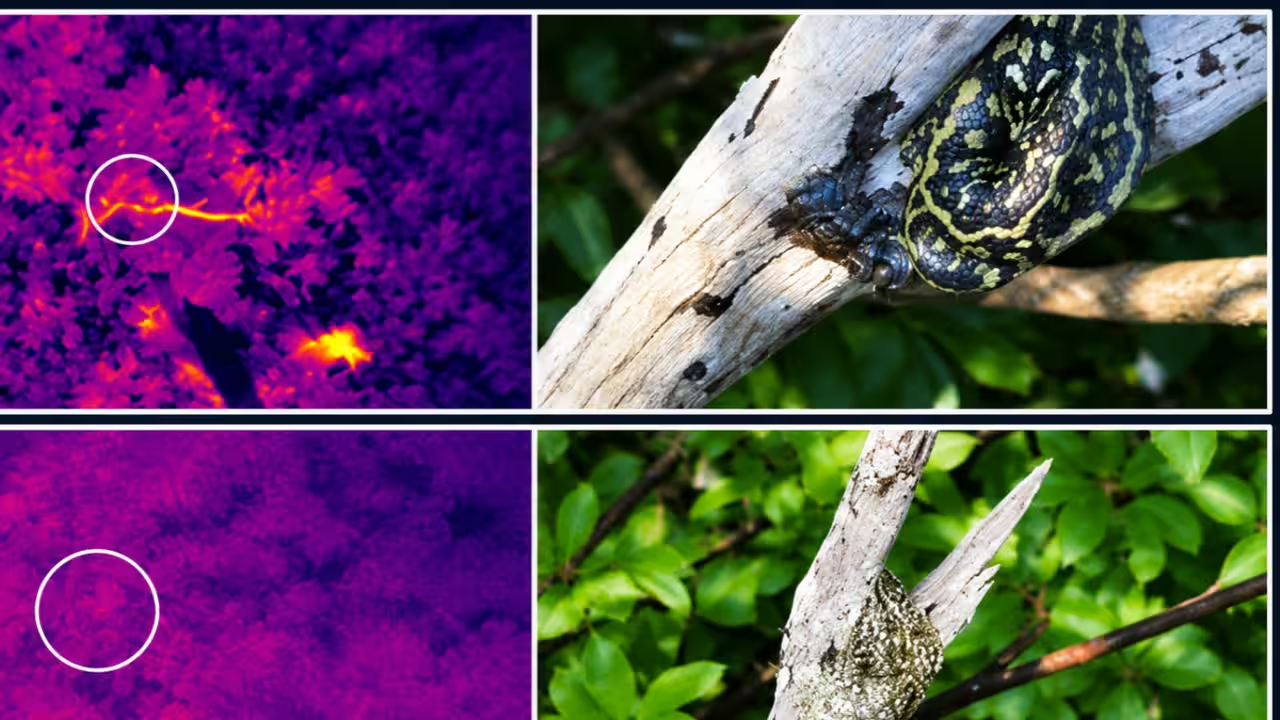
Scientists have successfully employed thermal-imaging drones to detect snakes concealed within the high canopies of Australian forests, marking a significant advancement in wildlife observation. This research, published in the journal Australian Zoologist on August 13, 2026, highlights the potential of aerial thermal technology to locate reptiles that are often challenging to spot through traditional ground-based methods. The study recorded sightings of carpet pythons and green tree snakes across three distinct forest ecosystems in eastern Australia.

The researchers utilised drones equipped with infrared cameras to detect temperature variations between the snakes and their surrounding vegetation. This novel approach not only facilitates the identification of arboreal reptiles but also opens avenues for studying their behaviour, habitat utilisation, and distribution in forest environments that are typically difficult for researchers to access.

Survey Locations and Findings

The study, titled “Thermal Drone Detection of Cryptic Arboreal Snakes Across Rainforest and Sclerophyll Canopies in Eastern Australia,” encompassed tropical rainforest, subtropical rainforest, and sclerophyll forest settings. The research team documented sightings of two species: carpet pythons (Morelia spilota) and green tree snakes (Dendrelaphis punctulatus). The surveys were conducted in Queensland and New South Wales.

In Queensland, drones were deployed over a 30-hectare rainforest area in the Atherton Tablelands, where researchers conducted three hours of afternoon surveys. The canopy heights varied from 20 to 30 metres, with some trees reaching up to 40 metres. The drones successfully detected snakes from distances ranging between 15 and 90 metres. In New South Wales, nocturnal surveys conducted from 2022 to 2025 recorded carpet pythons resting in elevated positions within the forest canopies.

The technology’s effectiveness lies in its ability to detect infrared radiation, allowing researchers to identify temperature differences between the snakes and their environment. Although locating ectothermic snakes presents challenges, larger carpet pythons were found to appear warmer than the surrounding foliage due to their thermal inertia, which enabled researchers to distinguish their thermal signatures against the forest backdrop.

Observations and Environmental Influences

During the Queensland surveys, researchers identified 11 carpet pythons and one green tree snake. They recognised five individual carpet pythons and one green tree snake by distinctive body patterns and GPS coordinates. Notably, one carpet python was found resting within a staghorn fern, while others were observed on canopy leaves and branches, illustrating the diverse elevated habitats they occupy.

The New South Wales surveys yielded significant observations, including carpet pythons resting at the tops of trees and inside tree hollows. On September 30, 2025, two carpet pythons were detected inside a hollow of a living scribbly gum eucalyptus tree, approximately six metres above ground. Their intertwined bodies were partially visible, showcasing the complexities of their arboreal lifestyle.

Environmental conditions were found to significantly affect the drones’ ability to detect snakes. Temperature differences between the reptiles and surrounding vegetation fluctuated throughout the day, impacting the visibility of their thermal signatures. In certain observations, a carpet python lacked a discernible thermal signature in the early morning but appeared warmer later in the day, indicating that solar heating and vegetation cooling could enhance detection opportunities.

Future Implications for Reptile Conservation

The researchers concluded that thermal drones could serve as a vital tool for studying elusive reptiles that are difficult to locate through conventional surveys. Many arboreal species inhabit elevated vegetation and tree hollows, making population monitoring a challenge. The study also pointed to the potential application of this technology for monitoring the pale-headed snake, a species classified as Vulnerable in New South Wales.

By enabling researchers to inspect elevated habitats, this technology could contribute significantly to the conservation of various reptile species. Future research is encouraged to explore how factors such as snake size, canopy density, survey altitude, and weather conditions impact detection success. Enhancements in thermal sensors and machine-learning systems may further improve the identification of smaller reptiles.

Long or Short, get news the way you like. No ads. No redirections. Download Newspin and Stay Alert, The CSR Journal Mobile app, for fast, crisp, clean updates!

App Store – https://apps.apple.com/in/app/newspin/id6746449540

Google Play Store – https://play.google.com/store/apps/details?id=com.inventifweb.newspin&pcampaignid=web_share

Latest News

Popular Videos