


Amit Shah Highlights Unity Among Indian Languages At Hindi Diwas Event
The CSR Journal Magazine

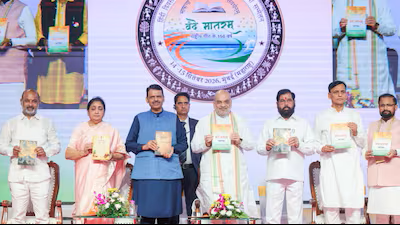
During Hindi Diwas 2026 and the 6th All India Official Language Conference held in Mumbai, Union Home Minister Amit Shah underscored the significance of linguistic diversity in India. He urged for an enhanced interconnectivity among the nation’s many languages, arguing that Hindi should not be perceived as a rival to other languages but rather as a unifying force. Shah elaborated on various initiatives by the Department of Official Language, mentioning the growth of the Hindi Shabd-Sindhu dictionary and the application of artificial intelligence in language-related tasks.

Shah pointed out that India’s languages have coexisted and influenced each other for centuries. He shared his personal experience as a Gujarati speaker, noting that his ability to communicate in Hindi facilitated his work at the national level. Drawing on historical examples, he cited the efforts of Acharya Vinoba Bhave, who used Hindi to disseminate the concepts of Bhoodan and Gramdan, illustrating the language’s extensive reach.

Shah called for unity among the country’s languages, stating, “While there may be many dialects, India’s voice must remain one.” He expressed his commitment to promoting harmony and collaboration within the linguistic landscape of the country.

Expansion Of Hindi Shabd-Sindhu Dictionary

Amit Shah announced the considerable growth of the Hindi Shabd-Sindhu dictionary, indicating its expansion from 51,000 words to approximately 8 lakh words. He stated that over 50,000 terms from regional languages have been added, enhancing Hindi’s flexibility and inclusivity. The new additions include words from Tamil, Telugu, Marathi, Gujarati, Bengali, and Odia, which reflect the rich linguistic heritage of India.

Shah expressed optimism that the Hindi Shabd-Sindhu could become the largest dictionary globally by the year 2029. He believes this expansion will facilitate better communication across diverse linguistic groups within India.

Additionally, Shah reiterated the significance of learning in one’s mother tongue. He asserted that children who are educated in their native languages are likely to develop critical thinking and analytical skills more effectively. He urged for the incorporation of another Indian language alongside the mother tongue to strengthen national unity and promote cultural connections.

Technological Innovations Supporting Language Development

At the event, Amit Shah highlighted government initiatives to leverage technology for the advancement of Indian languages. He elaborated on the AI-based Kanthasth 2.0 platform, which boasts a database of over five crore sentences, now accessible to international users. He also mentioned various projects such as LILA Rajbhasha and LILA Pravah that aim to facilitate the learning and translation of Indian languages.

According to Shah, more than five lakh employees of the Government of India have received training in the Official Language. Furthermore, Hindi courses are being offered at several universities abroad. This initiative is part of broader efforts to enhance the visibility and relevance of Indian languages in global academic contexts.

In a bid to make Indian languages more prominent in governance and science, he noted that entrance examinations like JEE and NEET are now being conducted in 13 languages. Shah described these efforts as essential to expanding the use and acceptance of Indian languages across various sectors.

Recognition Of Cultural Contributions And Initiatives

During the conference, Amit Shah presented the Rajbhasha Kirti and Rajbhasha Gaurav Awards, acknowledging significant contributions to the promotion of Hindi. He released special editions of Rajbhasha Bharati, featuring works focused on India’s culture and literary heritage. He highlighted the importance of Vande Mataram in India’s freedom struggle and cultural identity, noting Prime Minister Narendra Modi’s initiative to have the complete version performed at official events.

Shah also recognised Maharashtra’s multilingual heritage, praising Chhatrapati Shivaji Maharaj for promoting Marathi in administration. He acknowledged the Bhakti movement’s role in enriching Indian culture, stating that Maharashtra exemplifies India’s diversity with languages such as Marathi, Konkani, and Gujarati being recognised and respected.

Concluding his address, Shah reiterated that while India’s languages may have distinct tones, the cultural essence binding them is singular, reinforcing a unified national identity.

Long or Short, get news the way you like. No ads. No redirections. Download Newspin and Stay Alert, The CSR Journal Mobile app, for fast, crisp, clean updates!

App Store –  https://apps.apple.com/in/app/newspin/id6746449540 

Google Play Store – https://play.google.com/store/apps/details?id=com.inventifweb.newspin&pcampaignid=web_share

Latest News

Popular Videos
