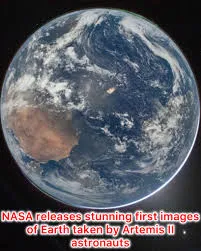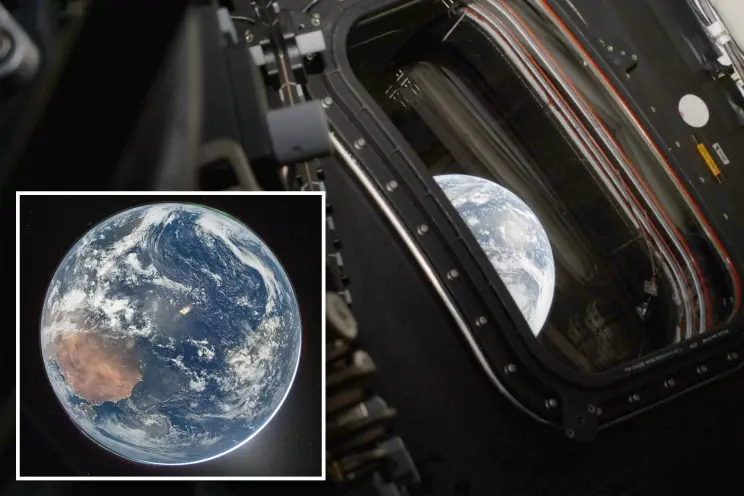

The Artemis 2 mission has yielded its first images of Earth, showcasing the planet from the vantage point of the four astronauts en route to the Moon. These visuals, taken from the Orion spacecraft, depict Earth in high detail, signifying the return of human photography from such significant distances after more than five decades.
Among the collection of images, one remarkable photograph illustrates Earth as a delicate crescent, glowing amidst the vastness of space. The photograph, captured by a camera mounted on one of Orion’s solar array wings, reveals the planet partially illuminated, resembling a silver crescent moon against the backdrop of the cosmos.
Another notable image was taken through the spacecraft’s window, providing a stunning high-resolution view of the swirling blues of the Pacific Ocean, interspersed with white clouds. This image serves as a reminder of the planet the astronauts departed from just days earlier, evoking sentiments of home.

Purpose of Capturing Earth Images
Although the mission primarily targets the Moon, these early photographs are critical for testing the advanced imaging technology on board. The capability to send high-quality, large-scale images over vast distances presents a significant challenge for deep space exploration.
By transmitting these pictures back to Earth, NASA is validating the spacecraft’s communication systems, ensuring they can manage the substantial data loads anticipated during future lunar landing missions. This verification process is vital for the success of upcoming operations as it assesses the effectiveness of the imaging hardware and long-range data transmission capabilities.
In the context of historic space photography, many space enthusiasts have drawn parallels between these new images and the iconic Earthrise photograph captured during the Apollo 8 mission in 1968. However, while Apollo’s images were taken on film and exhibited graininess, Artemis 2 leverages modern digital sensors that provide unprecedented detail and clarity.