


₹4 Crore T. Rex ‘Dinosaur Skin’ Handbag Set for Auction — Would You Buy It?
The CSR Journal Magazine

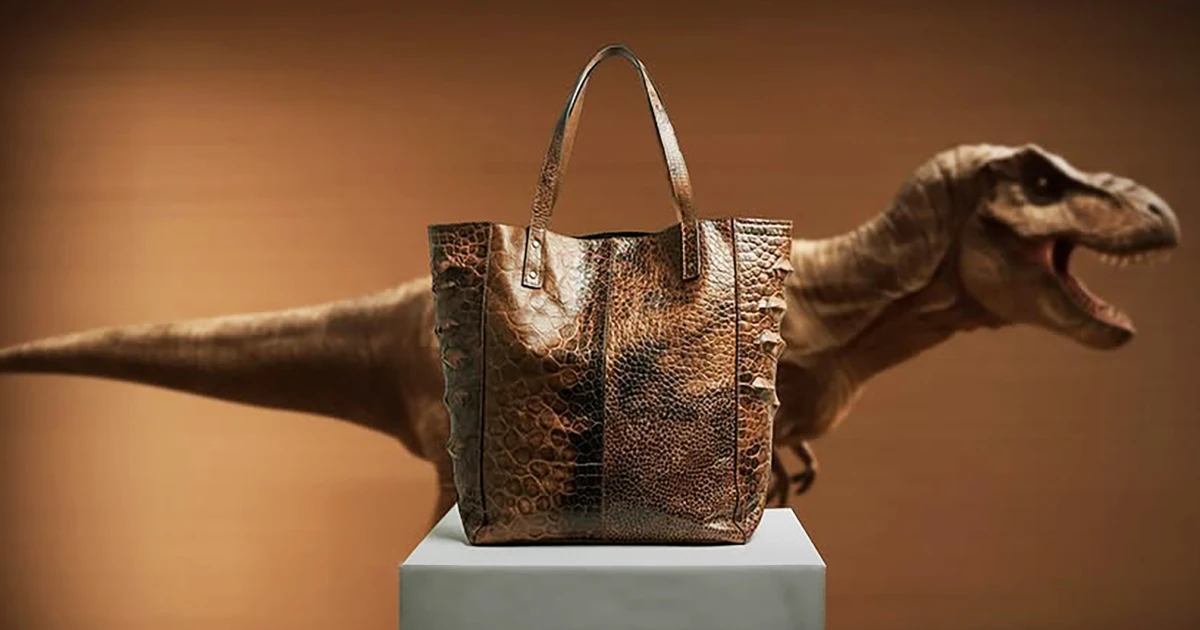
A unique handbag made from lab-grown leather, which allegedly incorporates collagen linked to Tyrannosaurus rex fossils, has recently been unveiled. This groundbreaking product is being showcased at Amsterdam’s Art Zoo museum, where it is displayed on a rock inside a cage, beneath a replica of a T. rex. The teal-coloured bag will remain on display until May 11, before it is scheduled to be auctioned off with a reported starting price exceeding half a million dollars.

Development and Collaboration

The handbag’s creation involves a partnership between genomic engineering company Organoid, creative agency VML, and Lab-Grown Leather Ltd. The material used for the handbag was developed from ancient protein fragments obtained from dinosaur remains, which were inserted into the cells of an unidentified animal to produce collagen that was then transformed into leather. This process faced numerous technical challenges, as noted by Thomas Mitchell, CEO of The Organoid Company, one of the three firms involved in the project.

In a previous collaboration, Organoid and VML succeeded in creating a giant meatball in 2023, combining DNA from a woolly mammoth with sheep cells. Che Connon, CEO of Lab-Grown Leather Ltd., remarked that the connection to T. rex enhances the product’s appeal. He mentioned that the focus is not solely on providing a sustainable alternative to leather but also on advancing technology in material production.

Bas Korsten, global chief creative officer at VML, stated that positioning T. rex leather as an ultra-luxury item underscores the desirability of ethical, lab-grown materials compared to traditional leather options. This statement aligns with a growing trend towards sustainable practices in the fashion industry.

Scepticism from the Scientific Community

Similarly, Thomas R. Holtz Jr., a paleontologist at the University of Maryland, emphasised that any collagen identified in T. rex fossils would primarily originate from bones, rather than skin. Even if there were a precise match of protein, he argued that the structural organisation needed to emulate the characteristics of real leather would be lacking.

In response to these critiques, Mitchell acknowledged that criticism is a natural response to pioneering projects. He expressed appreciation for such scrutiny, viewing it as essential to scientific inquiry. He firmly stated that this initiative might represent the closest anyone has come to recreating something associated with a T. rex, reflecting the challenges faced in the realm of advanced materials and biotechnological applications.

Long or Short, get news the way you like. No ads. No redirections. Download Newspin and Stay Alert, The CSR Journal Mobile app, for fast, crisp, clean updates!

App Store –  https://apps.apple.com/in/app/newspin/id6746449540 

Google Play Store – https://play.google.com/store/apps/details?id=com.inventifweb.newspin&pcampaignid=web_share

Latest News

Popular Videos
