


app-store-logo
play-store-logo
February 24, 2026

Wildflowers Flourish in Death Valley Following Record Rainfall
The CSR Journal Magazine

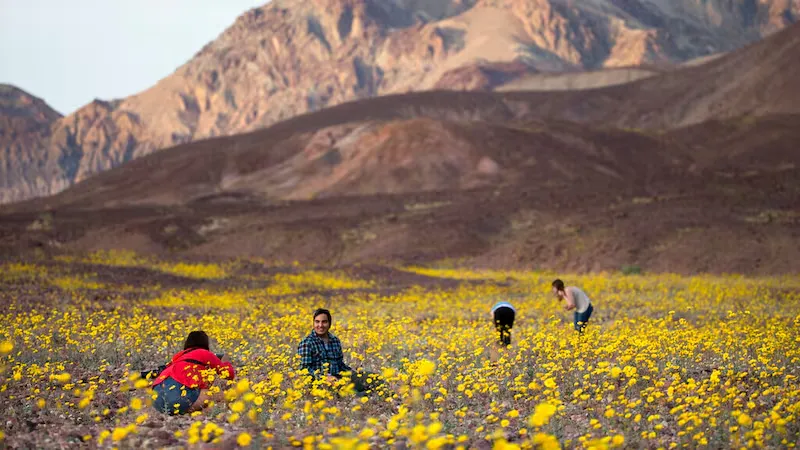
This winter season has proven exceptionally wet in Southern California, with a series of storms bringing significant rainfall to urban areas and even highly arid regions such as Death Valley. As the moisture begins to manifest, vibrant wildflowers are appearing in landscapes that typically seem stark and uninviting. Visitors to Death Valley National Park can observe splashes of yellow, purple, and orange adorning the desert sands. However, experts advise caution regarding the scale of the bloom, suggesting that while it may be impressive, it does not yet qualify as a full-fledged ‘superbloom.’ Several factors, including timing, temperature, and wind patterns, are critical in assessing bloom potential, and rain alone does not capture the entire narrative.

Death Valley’s Promise for a Superbloom

Despite its reputation as one of the hottest and driest places on the planet, Death Valley has experienced approximately double its average seasonal rainfall this year, which would typically encourage a superbloom. Nonetheless, experts emphasize that the timing and consistency of storms are more vital than the overall rainfall amount. For seeds to germinate and thrive, they require moist conditions early in the season followed by consistent rainfall through winter and gentle warmth in spring. Unanticipated heat or strong winds can hinder the fragile plants before they have a chance to flourish.

The Complex Factors Behind a Superbloom

Ecologist Erica Newman from James Madison University notes that the term “superbloom” is often used but typically refers to events that happen once every decade, influenced by a complex combination of conditions. In addition to rainfall, soil quality, air temperature, and specific germination cues play essential roles. According to her, strong winds can harm young plants, limiting their spread across the sprawling landscapes commonly associated with superblooms. Furthermore, the ongoing impacts of climate change introduce additional unpredictability, altering seasonal patterns that have historically supported plant life.

Geographical Features of Death Valley

Death Valley encompasses a vast structural basin mainly located in Inyo County, California. It is recognized as North America’s lowest, hottest, and driest area, extending approximately 140 miles from north to south, with varying widths between 5 and 15 miles. The valley is bordered by mountain ranges, specifically the Panamint Range to the west and the Black, Funeral, and Grapevine mountains of the Amargosa Range to the east. It lies near the shifting boundaries between the Great Basin and the Mojave Desert.

Current Blooming Conditions and Visitor Expectations

Unlike most seasons when wildflowers quickly wilt, this year’s bloom appears to be notably different. According to park officials, low-elevation regions are already showcasing blossoms and may continue to do so into mid-to-late March. Routes like Badwater Road and Highway 190 reportedly provide some of the best early views. The unpredictable nature of flowering is often part of the attraction, as higher elevations may not fully bloom until late spring or early summer. This staggered blooming schedule encourages visitors to return in hopes of witnessing the desert in its prime.

Comparison to Previous Blooms

Many observers still draw comparisons to the remarkable bloom of 2016, which transformed extensive desert areas into vibrant landscapes visible from afar, leading to an influx of visitors. Interestingly, the rainfall in the lead-up to that extraordinary event was not historically significant. The timing of early storms, followed by favorable spring conditions, paved the way for that spectacular display. While this year’s bloom may feel more pronounced in select locales, the widespread coverage that characterizes a true superbloom has yet to fully emerge. Visitors are already capturing images of poppies, desert gold, and small purple blossoms breaking through the sandy terrain.

Long or Short, get news the way you like. No ads. No redirections. Download Newspin and Stay Alert, The CSR Journal Mobile app, for fast, crisp, clean updates!

App Store –  https://apps.apple.com/in/app/newspin/id6746449540 

Google Play Store – https://play.google.com/store/apps/details?id=com.inventifweb.newspin&pcampaignid=web_share

Latest News

Popular Videos
