Why Does India Celebrate Clearing an UPSC Exam More Than Creating a Business?
The CSR Journal Magazine

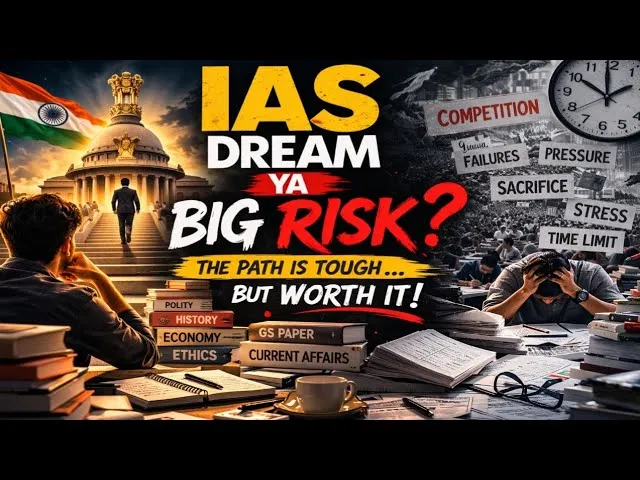
It is 5:30 in the morning in Mukherjee Nagar, Delhi. The tea stalls have just lit their first flames. Young men and women, most of them in their mid-20s, a few nudging 30, file into coaching institutes with ring-binders under their arms and dark circles under their eyes. This ritual has repeated itself every morning for years. Some of these students have been here for 3 years. Some for five. One man, whom we’ll call Rajesh, has been appearing for the UPSC Civil Services Examination since 2019. He is 31 now. He was an engineering graduate from a decent NIT. He had offers from mid-sized IT firms. He declined them all. The bureaucracy, he told his parents, is where a man of intelligence belongs.

Rajesh is not a cautionary tale in his own telling. He is a hero, a protagonist in a story that Indian society has been collectively writing for decades. The UPSC Civil Services Examination is not merely a job selection test in this country. It is mythology. It is a rite of passage. It is, for an astonishing number of educated Indians, the singular definition of success.

But here is the number that no coaching center advertises on its billboard, and no Bollywood film holds up to the light: In 2023, the UPSC received approximately 11.6 lakh (1.16 million) applications for the Civil Services Examination. The number of vacancies? 1,105. That is a selection rate of roughly 0.09%. You are statistically more likely to be struck by lightning twice in your lifetime in India than to clear the UPSC on a given attempt.

And yet, the dream does not shrink. It expands.

India has a population of approximately 1.44 billion people. The working-age population, those between 15 and 64, is roughly 68% of that, or nearly 980 million people. The entire Indian Administrative Service (IAS), the crown jewel of the UPSC system, has a sanctioned strength of only about 6,500 officers. The Indian Police Service (IPS) has roughly 3,300 officers. All Group A Central Services combined — the full harvest of every UPSC exam ever conducted — accounts for barely 90,000 to 1,00,000 active officers serving a nation of 1.44 billion. That is one gazetted civil servant for every 14,000 citizens.

Now consider this: according to data from the UPSC Annual Report 2022-23, the total number of candidates who appeared in the preliminary stage of the Civil Services Examination was approximately 5.78 lakh in 2022. Of these, around 13,000 made it to the mains. About 2,500 qualified for the personality test (interview). And 933 were finally recommended. The rest — nearly 5.77 lakh candidates — went home. Most of them had spent between one and six years preparing. Many had sacrificed lucrative careers, business opportunities, marriages delayed, and mental health quietly eroded.

A 2021 survey by the career platform Shine.com found that nearly 60% of UPSC aspirants spend more than three years preparing for the exam. A 2022 report by the Observer Research Foundation noted that the average age of a first-time UPSC qualifier is approximately 26-27 years, meaning they began preparing at 21-22, straight out of college. They gave up the most economically productive and skill-building years of their early adulthood to a single-target gamble with a 0.09% payout.

But the real tragedy is not in the numbers alone. It is in what those numbers represent: a nation’s best-educated youth, opting out of creation and opting into competition for control.

Ask a UPSC aspirant why they want to become an IAS officer. The answers come in a familiar chorus: “I want to serve the nation.” “I want to bring change at the grassroots level.” “I want to make policy that helps the poor.” These are beautiful answers. They are also, in many cases, a socially acceptable veneer over a less noble instinct — the instinct to be the person who tells others what to do, and to never be told what to do yourself.

This is not a character indictment of every UPSC aspirant. It is an observation about the structural incentives the system creates. A District Magistrate in India has extraordinary powers. They can detain citizens, override local governments, commandeer resources, and exercise authority that would be unthinkable for a civil servant at the equivalent level in any developed democracy. In a country where class hierarchies and caste structures have historically valorised power over people, the IAS officer represents the apex of state-sanctioned dominance — not accountability.

Dr. Shiv Visvanathan, a sociologist and political commentator, has long argued that the Indian civil service system is not merely administrative — it is an architecture of expropriation dressed in the language of welfare. The collector does not just collect revenue; they collect deference, authority, and a kind of civic fealty that no private-sector job can offer. In a country where an entrepreneur risks everything and a doctor serves for decades before earning respect, the IAS officer is handed power on day one of posting. No wonder the dream is addictive.

A 2019 survey by LocalCircles found that over 72% of young Indians in Tier-2 and Tier-3 cities considered a government job, particularly the IAS, as the most desirable career outcome. Meanwhile, according to NASSCOM data from 2023, India produces approximately 14 lakh engineering graduates annually, but fewer than 9% pursue entrepreneurship or tech start-ups within two years of graduation. The rest scramble for government jobs, PSU positions, or UPSC coaching classes. India has one of the lowest rates of graduate entrepreneurship among major economies — a direct consequence of a culture that prizes the safety of the state over the risk of creation.

The opportunity cost is staggering. Imagine redirecting even one-third of the cognitive energy, study hours, and financial resources poured annually into UPSC preparation into skill training, entrepreneurship incubation, or technical innovation. India spends an estimated Rs. 15,000 crores annually on UPSC coaching — a private industry that has grown 20% year-on-year since 2015, according to a 2023 report by IBEF (India Brand Equity Foundation). This is money spent not to produce anything, but to win a lottery that 99.91% of participants will lose.

Films like Jai Ho (2014), Newton (2017), and the blockbuster television drama Aspirants (TVF, 2021) have constructed a very specific image of the civil servant: a lone idealist, armed with integrity and intellect, battling corrupt politicians and broken systems, ultimately bringing justice to the people. In Aspirants, the protagonist is not just a student — he is a martyr in slow motion, his sacrifice rendered noble and his eventual failure made poetic. Millions of young Indians watched Aspirants and wept. Then they enrolled in coaching centers.

The reality, documented by actual IAS officers in their memoirs, interviews, and whistle-blower accounts, is categorically different.

Sanjiv Chaturvedi, a 2002 batch IFS officer who won the Ramon Magsaysay Award in 2015 for exposing corruption in AIIMS, spent most of his early career not fighting systemic corruption heroically — he spent it fighting transfer orders, suspension notices, and vigilance inquiries filed against him by politicians whose interests he threatened. He is the exception. And even he nearly broke.

Ashok Khemka, a 1991 batch IAS officer from Haryana, holds the distinction of being transferred 55 times in 30 years of service — a number so absurd it would be comedic if it were not a human life. Khemka has repeatedly spoken on record about how the IAS system strips officers of autonomy and places them squarely at the mercy of political masters who often have neither the education nor the intention to govern well.

This is the central contradiction that Bollywood refuses to film: the IAS officer is not a knight in shining armour. In the vast majority of cases, they are a highly educated, well-compensated executor of instructions handed down by politicians who may have never finished college. India’s Parliament has a significant proportion of members with criminal cases pending against them — according to the Association for Democratic Reforms (ADR) report on the 2024 General Elections, 46% of newly elected Lok Sabha MPs had declared criminal cases, including serious charges. These are the people who set policy priorities. These are the people the “brilliant” IAS officer ultimately answers to.

A 2020 study by the Centre for Policy Research found that IAS officers in most states spend an average of less than 18 months in any given posting before being transferred. Policy continuity is impossible. Institutional memory evaporates. The system is not designed for governance — it is designed for political compliance. And the young dreamer in Mukherjee Nagar who wants to “change the system from within” will, in most cases, find that the system changes them first.

Kota is famous for its engineering and medical coaching factories. What is less discussed is the human cost — the suicides, the depression, the broken families. UPSC preparation hubs like Mukherjee Nagar in Delhi, Rajinder Nagar, and Allahabad are developing their own quiet epidemic of a similar kind.

A 2022 report by iCall, a mental health initiative of TISS (Tata Institute of Social Sciences), found that UPSC aspirants reported significantly elevated levels of anxiety, depression, and social isolation compared to the general population. The average aspirant exists in a state of suspended life — they are neither employed nor students in a traditional sense. They delay marriage. They avoid financial planning. They exist in a liminal state of perpetual hope and perpetual preparation; a condition clinicians have begun to call “aspirant syndrome”.

Social media has made it worse. Instagram and YouTube are populated with the success stories of toppers — rank 1, rank 3, rank 12 — who are photographed with their proud families and celebrated with the fanfare normally reserved for Olympic medallists. What the algorithm does not amplify is the person who attempted the exam six times, aged out of the eligibility window at 32, and returned home to a small town with no marketable skills, six years of lost income, and a family that mortgaged itself to fund the dream.

The UPSC system in its current form does not merely fail most of its aspirants. It extracts years from their lives, returns nothing in exchange for the vast majority, and sends them back into a labor market for which they are, by this point, significantly underprepared.

India is in the middle of a demographic dividend window that economists argue will close by 2040. The country has the world’s largest youth population — approximately 600 million people under the age of 25. For this dividend to pay off, these young people need to be economically productive, skilled, and entrepreneurially active.

Instead, a troubling portion of India’s educated youth is locked in a holding pattern. The Economic Survey 2022-23 noted that India’s labor force participation rate remains one of the lowest in Asia, particularly among educated urban youth. A significant part of this is explained by the growing population of “exam-waiting” youth — young people deliberately withholding themselves from the labor market while they prepare for government examinations, UPSC being the most prestigious.

The World Economic Forum’s Future of Jobs Report 2023 ranked India as one of the country’s most urgently needing reskilling investment, particularly in technology, green energy, and advanced manufacturing. Meanwhile, India’s National Skill Development Corporation (NSDC) has consistently struggled to meet its skilling targets — in part because the most motivated and educationally capable youth are not seeking skills. They are seeking the Prelims question paper from 2018.

China, India’s most direct peer in terms of population size and development trajectory, made a decisive pivot in the 1990s and 2000s toward valorising technical education, manufacturing entrepreneurship, and applied innovation. The result: China produces more patents annually than the US and Europe combined. India, with a comparable population and a far higher proportion of English-educated graduates, produces a fraction of the patents — and a disproportionate number of UPSC toppers.

None of this is to say that India does not need a civil service or that the UPSC should be abolished. It is to say, urgently and without diplomatic softening, that the current system is broken in ways that are actively harming the nation — and that reform is not optional, it is existential.

The Second Administrative Reforms Commission (ARC), which submitted its reports between 2005 and 2009, made recommendations that were, in many cases, prescient and comprehensive. Most of them were never implemented. The Baswan Committee (2016) and the Alagh Committee (2001) also proposed significant changes to the UPSC examination pattern and civil service structure. Their reports gather digital dust on government servers.

What does meaningful reform look like?

First, lateral entry must be normalized and accelerated. The current model of hiring specialists from outside the IAS at joint secretary level — introduced cautiously since 2018 — must be expanded dramatically. A nation managing AI policy, climate adaptation, and complex financial systems cannot afford to have its key ministries led exclusively by generalists trained in medieval history and philosophy.

Second, fixed tenures must be constitutionally mandated. An IAS officer transferred 55 times — like Ashok Khemka — is not an anomaly; he is a warning. The system must insulate officers from political transfers through independent posting boards, with tenures of minimum three years in each posting. Without stability, there is no policy delivery.

Third, the examination itself must be redesigned. The current system tests encyclopedic knowledge of a vast, eclectic syllabus — from Mughal history to quantum physics to international relations — that has almost no direct correlation with the competencies required to govern effectively in the 21st century. Countries like Singapore, South Korea, and the UK have modernized their civil service recruitment to test situational judgment, ethical decision-making, leadership under ambiguity, and data literacy. India tests who can write the most about the Chola dynasty.

Fourth, UPSC preparation culture must be decoupled from societal prestige. This is the hardest reform because it is cultural, not administrative. It requires India’s families, its media, its schools, and yes, its film industry, to collectively reexamine what they choose to celebrate. When an entrepreneur who builds a business that employs 200 people is less celebrated in his community than the boy who cleared Prelims, something has gone profoundly wrong in our collective value system.

Finally — and this is perhaps the most politically difficult — India must confront the uncomfortable truth that the UPSC system, as currently structured, is one of the most elaborate and well-disguised systems of elite rent-seeking in the democratic world. A tiny number of people gain, through a single examination, enormous lifelong power, job security, social status, and state resources. The exam is presented as meritocracy. But meritocracy that ignores the wildly unequal access to coaching, education, and preparation resources — where a student from a Dalit family in rural Bihar competes on the same paper as a Delhi University graduate whose parents spent Rs. 5 lakh on coaching — is not meritocracy. It is the illusion of meritocracy, which is more insidious than open elitism.

Let us return to Rajesh. He is 31. His seventh attempt at the Preliminary examination is six months away. He has not given up. His father, a retired schoolteacher in Rajasthan, still tells neighbors that his son is preparing for IAS. The neighbors nod respectfully. The dream sustains everyone in the family.

What does Rajesh owe the system? Nothing. He has given it everything. What does the system owe Rajesh? An honest answer about his odds — which no UPSC advertisement, no coaching center, and no motivational YouTube channel will ever provide. What does India owe Rajesh? A way out that is not also a way down. A society that does not brand the unsuccessful UPSC aspirant a failure, but rather a person who was let down by a structure that extracted from him without any guarantee of return.

There are an estimated 20 to 30 lakh active UPSC aspirants in India at any given point — many of them repeat aspirants in various stages of preparation. If even a fraction of them were redirected, through honest social signaling and better opportunity structures, toward entrepreneurship, vocational excellence, technology, or social enterprise, the effect on India’s GDP, innovation index, and employment metrics would be transformative.

The UPSC dream is not wrong because ambition is wrong. It is not wrong because government service is unworthy. It is wrong — or at least, dangerously distorted — because it has been made into something it was never designed to be: the only respectable destination for India’s educated, the only credible proof that a young person is truly intelligent, truly serious, truly deserving of national regard.

A nation of 1.44 billion cannot be governed from a civil service of 1,105 annual recruits. It must be built by the millions who do not get in. And for those millions to build it, they must first stop believing that not getting in means they have failed.

The morning tea stalls in Mukherjee Nagar will light their flames again tomorrow. Rajesh will be there, ring-binder under his arm. Across the country, lakhs of young people will open their books to the same chapters they have read forty times before. And the system — the examination, the coaching industry, the political establishment that benefits from a compliant bureaucracy, and the culture that worships the rank-holder — will look on without urgency, without apology, and without change.

That, more than any question in any UPSC paper, is the problem India urgently needs to solve.

Views of the author are personal and do not necessarily represent the website’s views.

Dr. Jaimine Vaishnav is a faculty of geopolitics and world economy and other liberal arts subjects, a researcher with publications in SCI and ABDC journals, and an author of 6 books specializing in informal economies, mass media, and street entrepreneurship. With over a decade of experience as an academic and options trader, he is keen on bridging the grassroots business practices with global economic thought. His work emphasizes resilience, innovation, and human action in everyday human life. He can be contacted on jaiminism@hotmail.co.in for further communication.

Long or Short, get news the way you like. No ads. No redirections. Download Newspin and Stay Alert, The CSR Journal Mobile app, for fast, crisp, clean updates!

App Store – https://apps.apple.com/in/app/newspin/id6746449540

Google Play Store – https://play.google.com/store/apps/details?id=com.inventifweb.newspin&pcampaignid=web_share

Latest News

Popular Videos