


app-store-logo
play-store-logo
February 17, 2026

Which Continent Has the Most Countries?
The CSR Journal Magazine

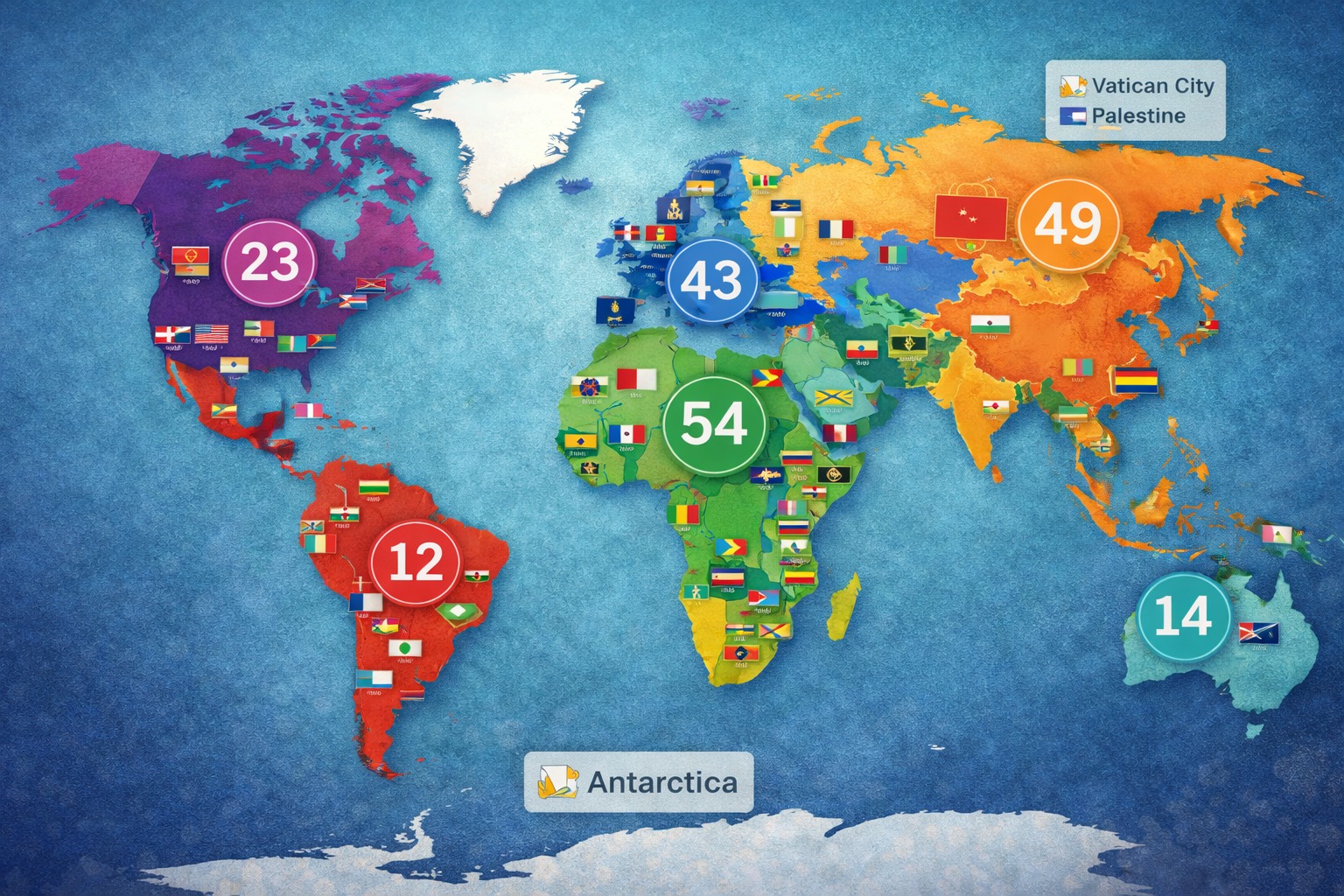
The current global landscape consists of 195 recognized countries, encompassing 193 member states of the United Nations and two observer entities, Vatican City and Palestine. However, these countries are not equally distributed across the continents. Certain regions boast numerous nations, while others are limited to just a few. Data from international sources reveals that Africa holds the record for the most countries, totaling 54, whereas South America has the fewest, with only 12. This uneven distribution is rooted in historical events, colonization, geographical factors, and political transformations.

Africa Leads in Country Counts

Africa stands out with over a quarter of the world’s nations. The continent occupies around 20% of the Earth’s total land area and features a diverse array of both large and small countries. Major countries include Algeria and the Democratic Republic of Congo, which rank among the largest by land size, while smaller island nations like Seychelles and São Tomé and Príncipe also call Africa home. The high number of countries in Africa can be attributed to its colonial past, where the independence movements of the 20th century resulted in the formation of multiple sovereign states.

Asia’s Strong Presence

Ranking second in the world, Asia comprises 49 countries. It is also the most densely populated continent, with nearly 60% of the global populace residing there. Asia encompasses some of the largest nations such as Russia, China, and India, alongside smaller countries like Singapore and the Maldives, which occupy minimal land areas. The continent’s diversity is a reflection of thousands of years of civilizations, migrations, and complex political advancements.

European and North American Contexts

Europe consists of 43 countries, many of which were established following significant wars and political upheavals in the 19th and 20th centuries. Ukraine holds the title of the largest country in Europe by land area, followed closely by France. North America comprises 23 nations, which include countries from Central America and the Caribbean, featuring both larger states and smaller island nations.

Oceania and South America’s Lower Counts

The regions of Oceania and South America have the fewest countries, with Oceania hosting 14 nations and South America comprising just 12. South America’s lower number is largely due to its colonial history, where extensive territories were consolidated into single nations following independence. Antarctica stands apart, as it has no countries; instead, it is governed by an international treaty and lacks any permanent population.

The Implications of Country Distribution

The distribution of countries across each continent is not arbitrary; it is shaped by a long history of exploration, colonization, independence movements, and political change. Although borders may alter over time, the current global map narrates the story of how human societies have organized and structured themselves throughout history. From Africa’s 54 nations to South America’s 12, the world continues to be a complex mosaic influenced by both geography and historical events.

Long or Short, get news the way you like. No ads. No redirections. Download Newspin and Stay Alert, The CSR Journal Mobile app, for fast, crisp, clean updates!

Latest News

Popular Videos
