


Uttar Pradesh Minister Revives Demand to Divide State Into Four Regions
The CSR Journal Magazine

The recent call by Uttar Pradesh Minister Om Prakash Rajbhar to split the state into four parts has rekindled a long-standing discussion that dates back to a 1955 proposal by Dr B.R. Ambedkar. Rajbhar stated during a rally in Ambedkarnagar that Prime Minister Narendra Modi allegedly assured him that the partition would occur following the caste census. He also claimed that the first Chief Minister of the proposed Purvanchal state would be from his Rajbhar community.

This notion is not new; it echoes Ambedkar’s vision for smaller, more manageable administrative units. In November 2011, the Bahujan Samaj Party, led by Mayawati, attempted to push a similar resolution in the Uttar Pradesh Assembly. However, that initiative did not receive approval from the central government and has since remained inactive.

Rajbhar’s party, the Suheldev Bharatiya Samaj Party (SBSP), is currently in alliance with the Bharatiya Janata Party (BJP), and the renewed push for division appears strategically timed with the upcoming Assembly elections in 2027. The emphasis on caste could significantly influence voter demographics.

Details of the Proposed Split

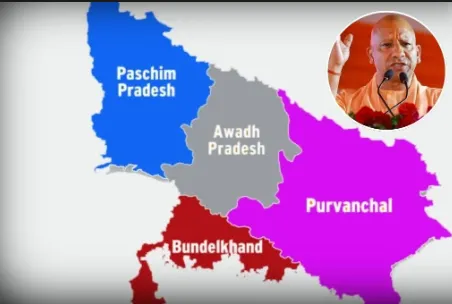
The proposal advocates dividing Uttar Pradesh into four distinct regions: Purvanchal (Eastern UP), Paschim Pradesh or Harit Pradesh (Western UP), Bundelkhand (Southern UP), and Awadh Pradesh or Madhyanchal (Central UP). These regions have been recurrently identified in past discussions regarding state reorganisation.

While Rajbhar’s revival of this demand has generated significant interest, there is currently no legislative bill being considered in Parliament, nor has there been any official decision from the central government. The previous resolution from 2011 remains unexamined and dormant, making the likelihood of immediate action quite remote.

Rajbhar’s recent claims regarding a private conversation with the Prime Minister have not been independently verified. The current political landscape suggests that such proposals remain heavily dependent on political will and voter sentiment as the election period approaches.

Constitutional Procedure for State Reorganisation

The process for creating new states in India is outlined in Article 3 of the Constitution, which grants Parliament the authority to make changes, with a requirement for a presidential recommendation to introduce a reorganisation bill. The procedure involves seeking the opinion of the Uttar Pradesh Assembly before Parliament votes on the bill.

Even if the state Assembly provides its views, the ultimate decision resides with Parliament, which is not compelled to follow the state Assembly’s recommendations. A simple majority in both Houses is necessary for the bill to pass, which differs significantly from the higher threshold required for constitutional amendments.

Legal experts interpret Article 3’s provisions as encompassing the ability to form, enlarge, reduce, or rename states, a flexibility that underlines India’s unitary nature. However, practical considerations related to revenue allocation, bureaucratic organisation, and infrastructural changes would substantially complicate the division of Uttar Pradesh.

Implications of the Proposed New States

If the split were to occur, each new state would be governed by its own Chief Minister, Governor, Council of Ministers, and Assembly. Rajbhar’s emphasis on a Chief Minister from Purvanchal resonates politically, highlighting the regional aspirations tied to this proposal.

The potential advantages and challenges presented by the new states suggest a complex trade-off. For example, Paschim Pradesh could benefit from its industrial base and proximity to the National Capital Region but would also take with it a significant portion of the state’s tax revenue. Conversely, regions like Bundelkhand may gain a dedicated political voice but face ongoing developmental challenges.

A division of Uttar Pradesh would alter its political influence at the national level. While smaller states may allow for more targeted governance and shorter administrative response times, the costs associated with establishing new state capitals and bureaucracies could be substantial, creating significant logistical challenges for the region. The debate over the reorganisation continues amidst uncertainties about its feasibility.

Long or Short, get news the way you like. No ads. No redirections. Download Newspin and Stay Alert, The CSR Journal Mobile app, for fast, crisp, clean updates!

App Store –  https://apps.apple.com/in/app/newspin/id6746449540 

Google Play Store – https://play.google.com/store/apps/details?id=com.inventifweb.newspin&pcampaignid=web_share

Latest News

Popular Videos
