


US Warns Pakistan Missile Advances May Reach Intercontinental Range
The CSR Journal Magazine

Following years of speculation regarding its missile capabilities, Pakistan is now under increased scrutiny from the United States. During testimony before the Senate, US intelligence chief Tulsi Gabbard alerted lawmakers about Pakistan’s development of advanced long-range ballistic missiles, which she claimed could potentially reach the United States.

Gabbard warned that if developments continue on this trajectory, Pakistan could soon possess an intercontinental ballistic missile (ICBM). This assertion has raised alarms within US security circles, particularly as it coincides with heightened regional tensions stemming from incidents in May 2025. The situation also poses concerns for India, which has historically viewed Pakistan’s missile advancements as a strategic threat.

US Threat Assessment Highlights Pakistan’s Nuclear Threat

According to the 2026 US threat assessment report, Pakistan is categorized alongside countries like China, Russia, North Korea, and Iran as one of the most significant nuclear threats to the United States. Despite an apparent thaw in diplomatic relations with the Trump administration, the inclusion of Pakistan in this report emphasizes Washington’s skepticism regarding Islamabad’s progress in missile technology.

Notably, Pakistan has not publicly disclosed any comprehensive strategy regarding the use of its nuclear arsenal, often relying on nuclear rhetoric as a deterrent measure against India.

Details on Pakistan’s Missile Development

While the US report does not specify the particular missile systems under development, it highlights concerns regarding Pakistan’s potential ICBM capabilities. Currently, Pakistan has not conducted any tests of ICBMs. However, the US government has penalized four Pakistani companies associated with missile development.

An ICBM is characterized by its capability to carry nuclear warheads across intercontinental distances, generally exceeding 5,500 kilometers. To reach the US mainland, a system with a range beyond that currently requires significant advancements in propulsion and design. Presently, only a limited number of nations, including Russia, France, China, and the UK, possess ICBMs with such capabilities.

Signs of Advancing Missile Technology

A US assessment indicates that Pakistan is working on larger rocket motors essential for ICBM development. Recent satellite imagery analyzed by the International Institute for Strategic Studies revealed the construction of a sizable solid rocket motor test facility at the National Defence Complex in Attock between 2021 and 2023. This development aligns with previous warnings from US administrations regarding Pakistan’s increasingly sophisticated missile technology.

Historical Context of US Warnings

Concerns regarding Pakistan’s missile capabilities are not new. Previous US officials have cautioned about Islamabad’s potential to develop long-range ballistic missiles, suggesting that advancements were several years away. Under the Biden administration, in 2024, sanctions were imposed on a Pakistani firm and several Chinese companies for allegedly providing technology relevant to Islamabad’s ballistic missile program. The US believes the Beijing Research Institute of Automation for Machine Building Industry might be collaborating with Pakistan in these advancements.

Current Status of Pakistan’s Missile Arsenal

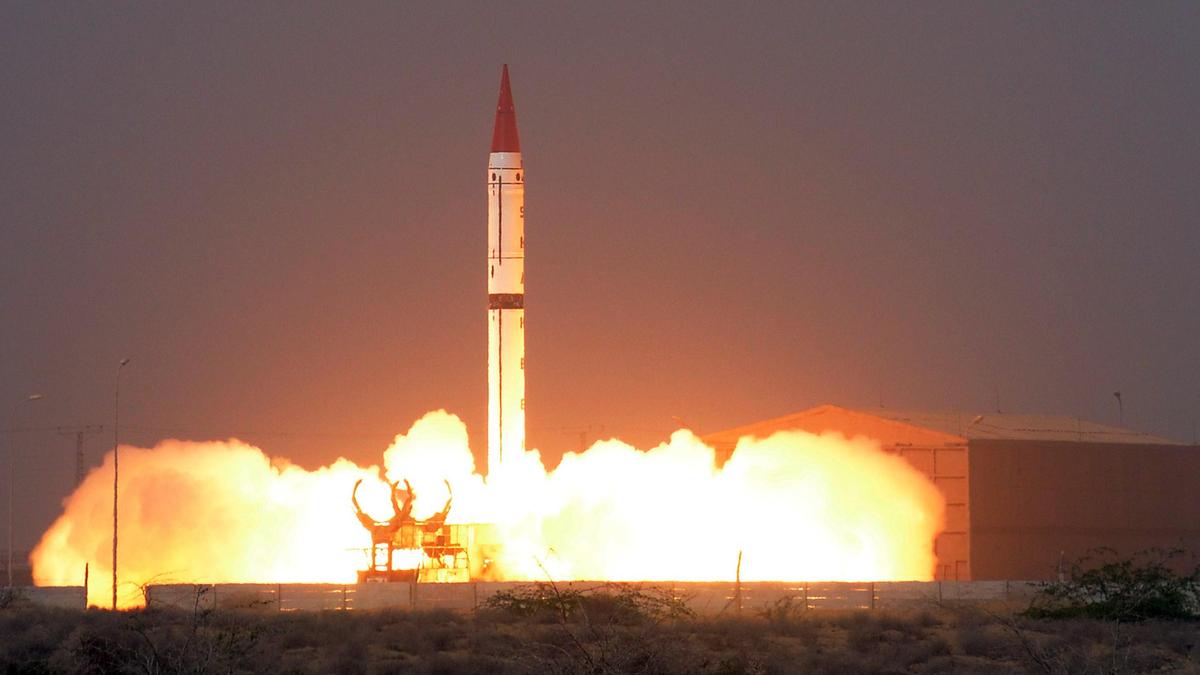
As of now, Pakistan primarily possesses short-range and medium-range ballistic missiles, with the most notable being the Shaheen III missile, which has a range of 2,750 kilometers and can accommodate both conventional and nuclear payloads.

Another important system is the Ababeel missile, featuring Multiple Independently Targetable Reentry Vehicle technology, enabling it to carry multiple warheads to different targets simultaneously. If Pakistan successfully develops an ICBM, it would constitute a significant shift in its military capabilities, suggesting a potential widening of its focus beyond regional adversaries, bringing the United States into the strategic equation.

Long or Short, get news the way you like. No ads. No redirections. Download Newspin and Stay Alert, The CSR Journal Mobile app, for fast, crisp, clean updates!

App Store –  https://apps.apple.com/in/app/newspin/id6746449540 

Google Play Store – https://play.google.com/store/apps/details?id=com.inventifweb.newspin&pcampaignid=web_share

Latest News

Popular Videos
