


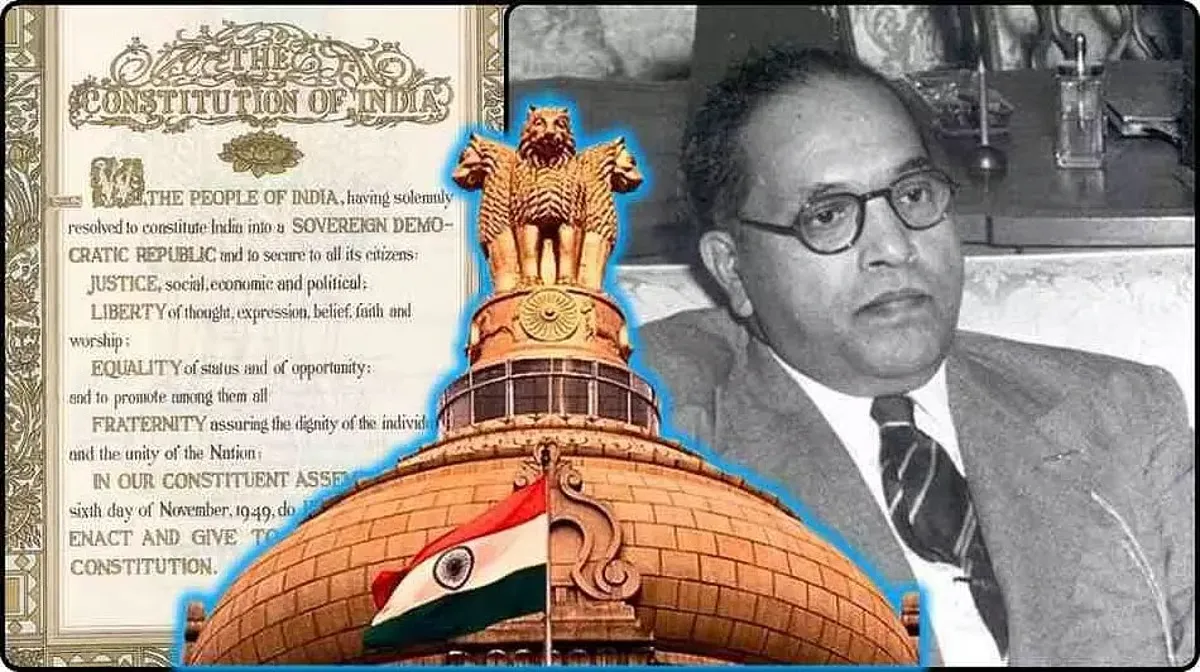

There are anniversaries that demand more than commemoration. The 135th birth anniversary of Bhimrao Ramji Ambedkar is one of them. Across India today, his image will be carried in processions, his name will be chanted in rallies, his statues will be garlanded in blue and white. Politicians who have never opened The Annihilation of Caste will invoke him with great passion. And then, tomorrow, a sanitation worker will descend into a sewer without safety gear somewhere in Maharashtra or Tamil Nadu, and the newspapers will either not notice or carry a four-line brief.
That gap — between the reverence accorded to Ambedkar the symbol and the indifference shown to the crisis he devoted his life to solving — is perhaps the most honest measure of how far India has, and has not, come.
This is not an obituary. It is a reckoning.
“For in India, Bhakti or what may be called the path of devotion or hero- worship, plays a part in its politics unequalled in magnitude by the part it plays in the politics of any other country in the world. Bhakti in religion may be a road to the salvation of the soul. But in politics, Bhakti or hero-worship is a sure road to degradation and to eventual dictatorship.” – Dr Ambedkar
Born on April 14, 1891, in Mhow (now Dr. Ambedkar Nagar, Madhya Pradesh), Ambedkar was the 14th child of Ramji Sakpal, a Subedar Major in the British Indian Army, and Bhimabai. The family belonged to the Mahar community, classified as “untouchable” — a designation that meant not merely low social status but legally and socially enforced degradation at every turn. He could not drink from the same well. He sat on a gunny sack on the classroom floor. A barber refused to cut his hair. Railway station clerks would not let him touch the reservation register.
His response was not resignation but a ferocity of intellectual purpose that seems almost improbable in retrospect. Supported by the Maharaja of Baroda and his own exceptional ability, Ambedkar went to Columbia University in New York where he studied under the philosopher John Dewey, then to the London School of Economics where he earned a DSc in Economics, and then to Gray’s Inn where he qualified as a barrister. When he returned to India in the 1920s, he was arguably the most credentialed Indian of his generation — a fact that the caste system absorbed without a tremor, because credentials, in its logic, were never the point.
He brought back from those years abroad something even more important than degrees: the conviction that oppression must be named with precision, argued with evidence, and confronted without apology. That approach would shape everything he wrote and every battle he fought.
Ambedkar’s political life was conducted on multiple fronts simultaneously, which is part of what made him so exhausting to his contemporaries and so essential to ours.
In March 1927, he led the historic march to the Chavadar Tank in Mahad, Maharashtra — a public tank from which Dalits were barred. He described it not as a demand for water but as a demand for personhood. The upper castes responded with violence, and afterwards ritually “purified” the tank to remove the contamination of Dalit presence. Later that same year, Ambedkar publicly burned a copy of Manusmriti, the ancient Brahminical legal text that had codified caste hierarchy and the subordination of women for millennia. It was a symbolic act with few precedents in modern Indian history — the public repudiation of a scripture’s moral authority.
Through the 1930s and 1940s, Ambedkar’s contests were constitutional and parliamentary. He represented the depressed classes at the Round Table Conferences in London, pressing the British for political safeguards. When the 1932 Communal Award granted Dalits separate electorates — a mechanism that would have created genuinely independent Dalit political constituencies — Mahatma Gandhi responded by fasting unto death. Gandhi’s position was that separate electorates would fracture Hindu society. Ambedkar’s was that Dalits were not Hindu society’s problem to solve, but free people entitled to their own political representation. Under immense moral pressure, with Gandhi’s life in the balance, Ambedkar signed the Poona Pact — conceding separate electorates in exchange for increased reserved seats in joint electorates. He described it as a capitulation he never forgave himself for, a moment when political necessity overrode constitutional principle. Historians continue to debate whether any other outcome was realistically possible.
As the Chairman of the Constitution Drafting Committee, his crowning achievement was also his most publicly misunderstood one. The Constitution he produced — which came into effect on January 26, 1950 — abolished untouchability under Article 17, guaranteed fundamental rights, and created the framework for reservations in education and public employment. But Ambedkar was clear-eyed about its limits. At the Constitution’s adoption, he famously warned Parliament: “On the 26th of January 1950, we are going to enter into a life of contradictions. In politics we will have equality and in social and economic life we will have inequality.” He was not celebrating. He was issuing a warning.
His resignation from the Cabinet in 1951 — over the blocking of the Hindu Code Bill — passed with little political consequence at the time, though its significance has grown with the decades. The Bill would have given Hindu women the right to divorce, to inherit property equally, and to choose their own spouses. Its defeat revealed how little the formal equality of the Constitution meant when confronted with the social conservatism of the men who controlled the legislature.
Ambedkar was among the most prolific political thinkers India produced in the twentieth century, though the mainstream literary establishment was slow to recognise this. His bibliography spans economics, constitutional law, sociology, history, and religious philosophy — and much of it reads, seven decades later, with the sharpness of a contemporary text.
The Annihilation of Caste (1936) is now considered a foundational document of anti-caste thought — but it began as a speech he was invited to deliver at the Jat-Pat Todak Mandal conference in Lahore and was then uninvited from because of what it said. The conference organisers, who wanted caste reform, could not stomach his conclusion that caste could not be reformed at all. The problem, he argued, was theological: caste was commanded by scripture, and until the Hindu reformer found the courage to stand up and say that those scriptures were wrong, all social reform would remain cosmetic.
“You cannot build anything on the foundation of caste,” he wrote. “You cannot build up a nation, you cannot build up a morality.” When B.R. Ambedkar and Gandhi exchanged published responses to the text — Gandhi defending the varna system, Ambedkar dissecting the defence — it produced one of the most substantive debates in modern Indian intellectual history. Arundhati Roy’s annotated edition, published in 2014, brought the text to a new generation and sparked a new round of argument, which was itself a tribute to its enduring relevance.
Who Were the Shudras? (1946) and The Untouchables: Who Were They and Why They Became Untouchables (1948) were historical investigations into the origins of the caste hierarchy, challenging both Brahminical orthodoxy and some nationalist historical accounts. Pakistan or the Partition of India (1940) was a sociological and political analysis of Muslim separatism — thorough, often uncomfortable, later misappropriated by communalists who stripped it of its analytical context and read it as a brief against Islam.
His final works — Buddha or Karl Marx (1956), The Buddha and His Dhamma (published posthumously in 1957), and the unfinished Riddles in Hinduism — reveal a thinker engaged in a civilisational project whose scope death prevented him from completing. Riddles in Hinduism, in particular, reads as a systematic philosophical demolition — funny in places, savage in others — that was judged so incendiary it remained suppressed from the official collected works for decades.
Ambedkar’s critiques of both Hinduism and Islam have been so frequently cherry-picked for political purposes that it is worth restating what made them distinctive: he judged every religious system by how it treated its most vulnerable members. His standard was humanistic and consistent, even when his conclusions were unsparing.
His critique of Hinduism was the deeper and more sustained one. He argued that the caste system was not a social aberration within an otherwise egalitarian religion — it was the religion’s structural core, legitimised by the Vedas, the Dharmashastras, and the unbroken authority of the priestly class. Unlike reformers who sought a “purified” Hinduism, Ambedkar concluded that such purification was philosophically incoherent — the texts themselves were the problem. His argument was that a Brahmin, however personally enlightened, operated within a system that accorded him divine sanction, and that this was a problem no amount of private sentiment could dissolve.
His critique of Islam was considerably narrower and more measured but equally clear-eyed. He acknowledged that Islamic theology was formally egalitarian — no caste system, a universal brotherhood in faith. But he observed that caste-like stratification existed in practice among South Asian Muslims: the hierarchy between Ashrafs (those of claimed Arab, Persian, or Turkic lineage) and Ajlafs (local converts) was a persistent social reality. He raised pointed concerns about the legal position of Muslim women — particularly regarding the ease of triple talaq for men and the near-impossibility of obtaining khula for women — and about the extent to which Islamic democracy was genuinely universal or bounded by faith.
What is important, and often lost, is that Ambedkar never used his critique of Islam to rehabilitate Hinduism, nor did he use his critique of Hinduism to excuse the failures of Islamic society. He was not playing the communal game. He was applying the same humanistic measuring rod twice and recording what he found. That consistency is precisely why selective quotation from his work is so intellectually dishonest.
On October 14, 1956, in Nagpur, Ambedkar converted to Buddhism alongside an estimated 365,000 to 600,000 of his followers in a single day — one of the largest mass conversions in recorded history. A second ceremony at Chandrapur three days later brought over 300,000 more. He was 64 years old, diabetic, and had perhaps 6 weeks to live. He knew this. He converted anyway.
He rejected the Theravada and Mahayana traditions of Buddhism, calling his version Navayana — the New Vehicle — a form of engaged Buddhism distinct from established schools. In The Buddha and His Dhamma, his scripture for the new movement, he stripped away elements he found metaphysically indefensible — karma as cosmic retribution, rebirth as a mechanism of divine justice — and centred Buddhism on its ethical and social content: prajna (wisdom), karuna (compassion), the rejection of hierarchy, and the supremacy of reason over revelation.
Martin Fuchs describes Ambedkar’s effort as an attempt to seek a “post-religious religion” driven by the “reasonable principle of sociality” — not spiritual doctrines or philosophical speculation, but a lived ethics of equality. Others, including scholars citing Blackburn, have noted that Ambedkar’s reinterpretation was historically selective — that the original Buddhism he claimed to be recovering was itself constructed. These are legitimate scholarly objections. But they somewhat miss the point. Ambedkar was not writing a history of Buddhism. He was building a philosophy of liberation from within the Buddhist tradition, using it as a vehicle for what he could not achieve through politics alone.
Almost 90% of Navayana Buddhists live in Maharashtra today, and the Dalit Buddhist movement continues to function as both a religious and socio-political movement. The question of what this movement holds for India’s future is genuinely open. As a counter-cultural institution-builder — running schools, cultural centres, networks of mutual aid — the Ambedkarite Buddhist community in Maharashtra and beyond has created structures of solidarity that exist outside both the Hindu mainstream and the state apparatus. Whether Navayana Buddhism can develop into a broader civilisational current — articulating a humanism and an ethics that speaks beyond Dalit identity to a wider Indian audience — remains the central unanswered question of Ambedkar’s spiritual legacy. The 2011 Census recorded approximately 8.4 million Buddhists in India, the vast majority of them Ambedkarite converts concentrated in Maharashtra. The number of people who identify culturally with the movement is considerably larger.
The Arithmetic of Atrocity
The numbers, assembled honestly, are not the kind that permit comfortable reading.
According to the NCRB’s Crime in India report for 2022, a total of 57,582 cases were registered for crimes against Scheduled Castes — an increase of 13.1% over 2021’s figure of 50,900 cases. The crime rate rose from 25.3 per lakh in 2021 to 28.6 per lakh in 2022. To put this in proportional terms: according to NCRB data, one crime is committed against a Dalit every 18 minutes, 13 Dalits are murdered every week, and 27 atrocities against Dalits occur every day.
The trend line is unambiguous. An analysis by the National Coalition for Strengthening SCs and STs (PoA) Act found that crimes against Dalit people rose by 177.6% and crimes against tribal communities rose 111.2% between 1991 and 2021. This is not a problem that has been getting better with time. It is a problem that has been getting, in statistical terms, measurably worse.
Between 2018 and 2022, the Indian government told Parliament that over 1.9 lakh cases of crimes against Dalits were recorded. Uttar Pradesh alone reported 49,613 cases in that period, followed by Rajasthan with 8,752 cases and Madhya Pradesh with 7,733 cases in 2022 alone.
Particularly troubling is the pattern around gender. Crimes against Dalit women and girls constituted 15.32% — nearly 63,000 incidents — of total crimes against Dalits between 2014 and 2022. In that same period, there was an 89.9% increase in rape cases against Dalit women and minor girls. The acquittal rate at special courts for crimes against Dalit women stands at approximately 60.5%, suggesting that even when cases reach court, conviction is far from guaranteed.
The conviction rate in crimes against Scheduled Castes shows a disturbing pattern: it spiked in election years — 42.4% in 2020, 36% in 2021, 34% in 2022 — while the absolute number of cases registered steadily climbed from 42,793 in 2018 to 57,582 in 2022. One cannot read this data without noticing the political seasonality of enforcement: justice, it appears, performs best when votes are being counted.
There is also the problem of what is not counted. Human Rights Watch has consistently noted that Dalits often do not report crimes due to fear, social pressure, and lack of faith in police. In a review of 113 anti-Dalit atrocity cases, the Citizens for Justice and Peace found that 9 involved direct police violence against victims, 6 saw no action taken at all, and only 92 resulted in any kind of formal response — of which 4 were merely procedural rather than substantive.
The socioeconomic picture compounds the picture of structural exclusion. The literacy rate among Dalits stands at 73.5%, against a national average of 80.9%. The poverty rate among Dalits is 31.1%, compared to a national average of 21.2%. The average wage of Dalit workers was 17% lower than that of non-Dalit workers, according to a 2012 National Sample Survey Office study. Most starkly: land ownership among Dalits is only 2.2%, against a national average of 17.9%. Land, in rural India, is not merely an economic asset. It is social standing, credit-worthiness, and political leverage. The near-total exclusion of Dalits from land ownership is, therefore, not one deprivation among many — it is the structural foundation of most of the others.
The Sewer Question
No single metric captures the distance between the constitutional promise and the lived reality more graphically than the persistence of manual scavenging — the practice of cleaning human waste by hand, which has been illegal in India since 1993.
The government’s own figures, presented in the Rajya Sabha in July 2024, acknowledge that 377 people died while hazardously cleaning sewers and septic tanks between 2019 and 2023. In the same breath, the Ministry of Social Justice stated that there is “no report of practice of manual scavenging currently in the country” — a formulation that the Safai Karmachari Andolan (SKA), the foremost civil society organisation working on this issue, has described as categorically false.
According to the National Commission for Safai Karamcharis, 1,313 sewer and septic tank deaths have been reported between 1993 and 2025, with 63 deaths in 2023 and 52 in 2024 alone — meaning that on average, 41 lives are extinguished every year in pursuit of an activity that is nominally banned.
Even as the government denies that manual scavenging is caste-based, close to 92% of the Sewer and Septic Tank Workers profiled under its own NAMASTE programme belong to Scheduled Caste, Scheduled Tribe, or Other Backward Class communities. The Ministry’s position — that this is an occupation-based rather than a caste-based practice — would be intellectually difficult to sustain even if the data did not exist. That it persists in the face of the data says something important about the relationship between official discourse and uncomfortable facts.
This is what Ambedkar meant when he wrote about structural violence. It does not always look like a mob. Sometimes it looks like a government form that classifies an activity as non-existent while its practitioners continue dying.
The Marriage Question
Ambedkar identified the willingness to share food and daughters across caste lines — what he called roti-beti vyavahar — as the true and unfakeable test of caste dissolution. On this measure, India in 2026 is not doing well.
The most recent National Family Health Survey (NFHS-5, 2019-21) found that 86% of respondents had married someone of a similar caste. The practice of inter-caste marriage in females has nearly doubled over the decades, from 7% for cohorts married before 1970 to 13.3% for the 2019-21 cohort — a real change, but still a minority phenomenon.
The National Council of Applied Economic Research puts inter-caste marriages nationally at around 5%, while the 2011 census figure was 5.8%. The variation across states is dramatic: Mizoram records approximately 55% inter-caste marriages, while Madhya Pradesh records only 1%. Regional patterns reveal that the problem is not geographic fate — it is social will. States that have invested in education, urbanisation, and the weakening of caste-based social structures show higher rates. States where caste panchayats remain powerful, where land distribution remains deeply unequal, and where Dalit political mobilisation has been absorbed or co-opted, show lower ones.
The consequences of crossing this line can be lethal. Khap panchayats across North India continue to issue orders against so-called “honour killings” of couples who marry across caste lines. Those who dare inter-caste marriage in violation of social norms have faced violence, social boycott, family boycott, and death. The Indian state, to its credit, has a legal structure that protects and in some cases incentivises inter-caste marriages. The Indian state, to its detriment, has an implementation machinery that has proven consistently unable or unwilling to enforce that protection against the organised authority of caste councils.
One deeply counterintuitive finding from the data deserves particular attention: the 2017 Indian Statistical Institute study found that inter-caste marriages are actually more frequent in rural areas (5.2%) than urban areas (4.9%), and more common among poorer people (5.9%) than richer ones (4.0%). The implication — that education and economic mobility do not straightforwardly produce inter-caste marriage, and may in some contexts reinforce caste endogamy as a status-protection mechanism — is one that policymakers and social reformers would do well to sit with rather than dismiss.
What Has Been Achieved, and How to Count It
It would be both inaccurate and unfair to say that Ambedkar’s project has produced nothing. It has produced an extraordinary amount — though the question of whether it has produced enough is a different one.
The Constitution he drafted remains one of the most progressive founding documents of any democracy. Article 17 abolishes untouchability. Articles 14 through 18 guarantee equality before law, equal protection, and prohibit discrimination on grounds of religion, race, caste, sex, or place of birth. Reservations in education, legislatures, and public employment have created a Dalit middle class of real size and political consequence — something that did not exist in 1947. Dalit politicians have held some of the highest offices in the country, including the Presidency.
The Dalit literary movement, particularly in Maharashtra but also in Tamil Nadu and Andhra Pradesh, has produced writing of genuine power — fiction, poetry, autobiography — that has brought the interior experience of caste oppression into the mainstream consciousness in ways that no policy paper can. The writings of Namdeo Dhasal, Baby Kamble, and Bama belong not just to Dalit literature but to Indian literature.
And yet. The Supreme Court’s 2018 dilution of the SC/ST Prevention of Atrocities Act — subsequently reversed by Parliament — showed how fragile constitutional protections can be when confronted by political and judicial resistance. The caste census, long demanded by Dalit and OBC organisations as a prerequisite for evidence-based policy, remains politically contested. The representation of Dalits in the private sector — where reservations do not apply — is vanishingly small. Dalits account for only 6.5% of the formal sector workforce, and only 6.6% hold professional or managerial positions, against a national average of 15.6%.
The deeper problem is one Ambedkar diagnosed himself: political democracy and social democracy are two different things, and one does not automatically produce the other. India has made remarkable strides in the former. Its performance on the latter remains, seven and a half decades after independence, a source of serious concern.
Criticisms: Of the Man and His Inheritors
Ambedkar belongs to no one, and the effort to claim him wholly — to make him a saint of a particular political tradition — is itself a form of betrayal.
His historical methodology has attracted scholarly criticism. His reading of ancient India as a straightforward story of Brahminical oppression compressed a complex civilisational history into a polemical framework that served his political purposes but was not always historically precise. His relationship with Dalit communities outside Maharashtra was limited, and his understanding of the caste dynamics of southern India — where the algebra of oppression is different — was sometimes incomplete.
His handling of the Poona Pact continues to be debated within Dalit political thought. A significant strand of scholarship argues that separate electorates, had they been maintained, would have produced genuinely independent Dalit political representation rather than the dependent position of the reserved-seat politician, who must court dominant-caste voters in a general electorate. Others argue that Ambedkar had no realistic choice and that the counterfactual is unknowable. The debate is not resolved, and it matters because the question of Dalit political strategy — integration or separatism, coalition or independence — has never been more urgent.
The most important criticism, however, is directed not at Ambedkar but at what has been done in his name. Ambedkarism, as a lived political tradition, has often struggled to translate his intellectual ambitions into institutional practice. Of 19 Scheduled Caste candidates who won parliamentary seats in the 2024 general elections, 17 won from seats reserved for Scheduled Castes, meaning only 2 Dalit candidates won from unreserved constituencies in UP — a measure of how constrained Dalit political participation remains. His portrait hangs in Parliament while the laws he authored are imperfectly implemented. His name is invoked by political parties across the spectrum, including those whose policies he would have found abhorrent. This is the peculiar fate of revolutionary thinkers in democratic societies: they become currency, tradeable by people who have never been genuinely poor.
The Question Ambedkar Never Stopped Asking
Ambedkar’s greatest intellectual legacy may be methodological rather than doctrinal. He modelled what it looks like to bring the full resources of reason, evidence, and moral seriousness to the question of human dignity — not as an abstract philosophical exercise but as an urgent political necessity. He showed that the most radical act available to an oppressed person is not violence but thought: rigorous, documented, published, argued.
The country he helped build has honoured him with a national holiday and a thousand statues. Whether it has honoured him with the substantive equality he spent his life pursuing is a question each generation must answer for itself — not by looking at the statues but by looking at the data.
The data, at this moment, suggests that the revolution is unfinished. The literacy gap persists. The land gap persists. The wage gap persists. The violence persists. The sewer deaths persist, and the government files them under a different name. The marriages across caste lines remain, for most Indians, a social transgression rather than a social aspiration. The caste census has not happened. The private sector remains largely untouched by any reservation policy. The acquittal rate at special courts for crimes against Dalit women approaches 60%.
And yet: there are more Dalit students in universities than at any previous point in Indian history. There is a Dalit literary culture of extraordinary vitality. There is a generation of Ambedkarite scholars, lawyers, journalists, and activists who read him closely and argue with him fiercely. The movement lives. It is contested. That is the sign of a living tradition.
Ambedkar died on December 6, 1956 — six weeks after his conversion, in the early hours of the morning, with manuscripts on his desk. He had been working until the end. That, perhaps more than any of his achievements, is the image worth carrying into the year ahead: not the garlands, not the motorcades, not the invocations by politicians who have read none of his books — but the desk, the lamp, and the unfinished sentence.
Sources cited in this article:
-
National Crime Records Bureau, Crime in India (2022 Report)
-
National Family Health Survey (NFHS-5), 2019–21
-
National Coalition for Strengthening SCs and STs (PoA) Act (NCSPA) analysis
-
Safai Karmachari Andolan (SKA) data on sewer deaths
-
National Commission for Safai Karamcharis (NCSK) parliamentary data
-
Round Table India, Socio-economic Overview of Dalits in India
-
Citizens for Justice and Peace (CJP), Everyday Atrocity (2025)
-
Global Forum of Communities Discriminated on Work and Descent, 2023
-
Indian Statistical Institute inter-caste marriage study (2017)
-
National Council of Applied Economic Research inter-caste marriage study (2016)
-
Research: Can Inter-Caste Marriages Reduce Economic Inequalities in Child Nutrition in India? (NFHS analysis, 2025)
-
Ministry of Social Justice and Empowerment, Lok Sabha replies (2023–24)
-
B.R. Ambedkar: The Annihilation of Caste (1936), The Buddha and His Dhamma (1957), Riddles in Hinduism (posthumous), Pakistan or the Partition of India (1940)
 Dr. Jaimine Vaishnav is a faculty of geopolitics and world economy and other liberal arts subjects, a researcher with publications in SCI and ABDC journals, and an author of 6 books specializing in informal economies, mass media, and street entrepreneurship. With over a decade of experience as an academic and options trader, he is keen on bridging the grassroots business practices with global economic thought. His work emphasizes resilience, innovation, and human action in everyday human life. He can be contacted on jaiminism@hotmail.co.in for further communication.