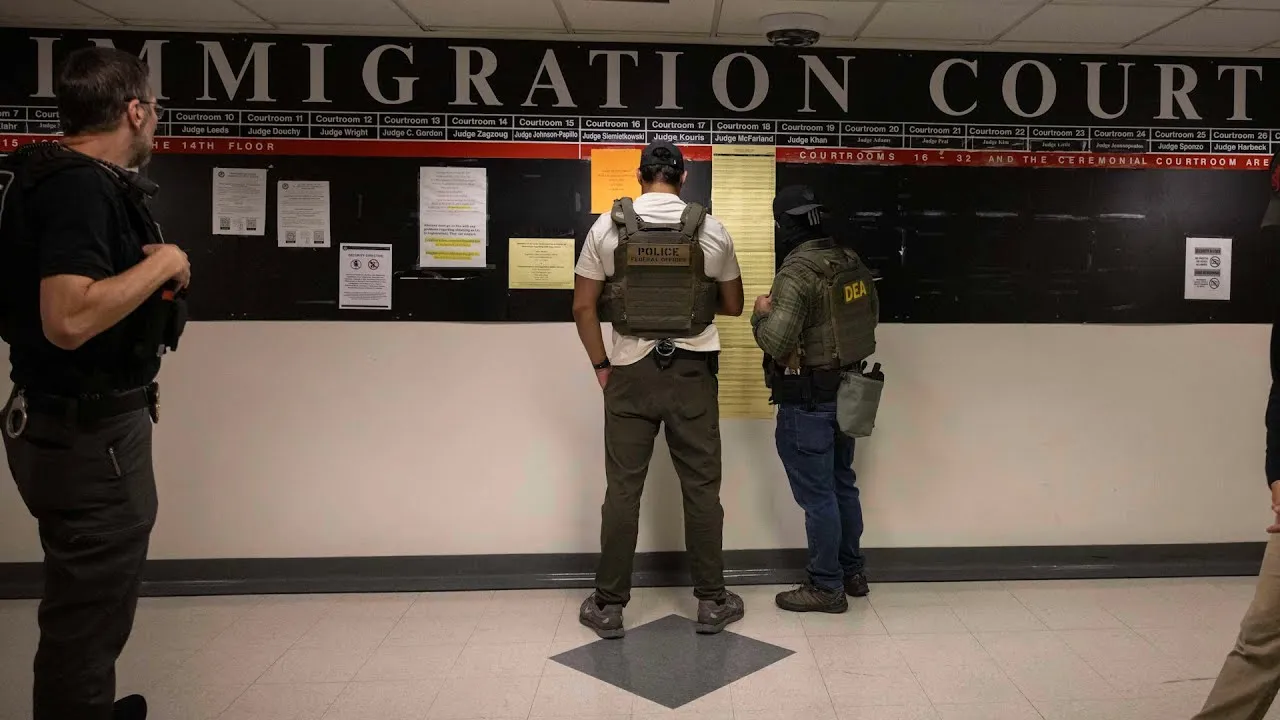
The U.S. Department of Justice (DOJ) has announced the appointment of 33 new immigration judges, many of whom possess military backgrounds. This decision is regarded by some experts as potentially more significant than the standard actions taken by Immigration and Customs Enforcement (ICE) regarding immigration enforcement.
Among those commenting on the appointments is Varad Mehta, an Indian-origin historian, who highlighted a forthcoming regulation in conjunction with the new judges. On social media, he noted that the Trump administration is set to publish a fast-track regulation that aims to shorten the timeframe for appealing an immigration judge’s decision to just 10 days and simplify the process for the appeals board to dismiss cases. Mehta remarked on the implications of these changes, suggesting they might have a more profound impact than the actions of ICE.
The new judges were officially sworn in on Thursday, building upon the hiring of 36 immigration judges in October, which included 25 temporary appointees. These judges will be assigned to immigration courts in numerous states, encompassing Arizona, California, Colorado, Florida, Georgia, Illinois, Louisiana, Maryland, Massachusetts, Nebraska, New York, Texas, Utah, Virginia, and Washington.
A spokesperson for the DOJ defended the appointments, asserting that the initiative aims to restore credibility and impartiality to the immigration courts, which they claim were undermined during the previous administration. The spokesperson expressed pride in welcoming the new judges, framing their mission as a commitment to protecting national security and public safety.
Notably, half of the newly appointed permanent judges have military experience, while all temporary judges, who are permitted to serve for durations of up to six months, also come from defense backgrounds. This decision aligns with previous announcements from the Pentagon, which had indicated that military and civilian lawyers would temporarily assume the role of immigration judges under the leadership of Defense Secretary Pete Hegseth.
The recent appointments follow significant personnel changes within the immigration court system, as more than 100 judges have been dismissed or have resigned since President Donald Trump took office for a second term. The American Immigration Lawyers Association has raised alarms concerning the implications of these changes, highlighting that the reduction in judges could impede the ability to address the mounting backlog of cases in immigration courts. Statistics indicate that approximately 3.2 million cases were pending as of December 31, a situation analyzed by Mobile Pathways, a nonprofit focused on immigration court data.
Additionally, the Trump administration has amended regulations governing the detention of migrants, resulting in many individuals who could previously secure release on bond now remaining in detention. This shift follows a ruling by the Board of Immigration Appeals in September, which altered the interpretation of a significant law, drawing criticism from various federal judges.
Varad Mehta, the historian providing commentary on these developments, is known for his research into how historical narratives are constructed and perceived. His work primarily focuses on the eighteenth century and the Enlightenment, exploring themes related to modernity, history, and political thought. Mehta also investigates intellectual history and the representation of history in contemporary media.