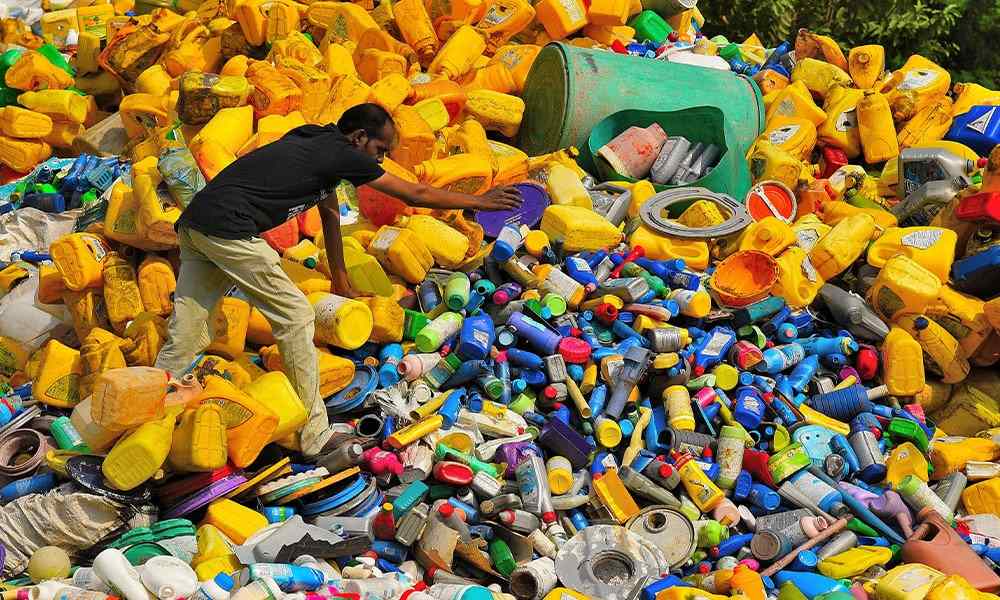

India faces a severe plastic waste crisis, generating millions of tonnes yearly, with much left uncollected, clogging drains, polluting rivers/oceans, harming wildlife, and leaching toxins due to poor infrastructure, enforcement, and habits, despite initiatives like Swachh Bharat and bans, requiring better segregation, tech, and circular economy models.
India produces around 9.3-9.4 million tonnes of plastic waste annually, contributing significantly to global pollution. While collection rates are around 81%, a large portion (around 40%) remains uncollected or mismanaged, with low actual recycling rates (around 9-13%). Average Indian plastic use is around 11 kg/year, rising with urbanization, but richer states use much more.
Plastic waste leads to severe impact such as clogged drains, polluted rivers, choked landfills, and soil/water contamination. Over 100,000 marine animals die yearly from plastic ingestion or entanglement. Toxic chemicals leach into soil and water, impacting ecosystems and potentially human health.
Major Challenges in plastic waste management in India include lack of proper waste segregation and management facilities, ineffective implementation of existing plastic bans, deep-rooted littering habits and reluctance to adopt new methods. A large, unrecorded informal recycling sector complicates data and formal management.
Government of India has been trying to combat this through campaigns like Swachh Bharat Abhiyan which aims to instill responsibility. States like Sikkim and Himachal Pradesh have implemented bans and awareness programs. Extended Producer Responsibility (EPR) is being implemented to manage plastic waste.
CSR tackling plastic waste in India
Corporate Social Responsibility (CSR) in India tackles plastic waste through a multi-pronged approach that includes Extended Producer Responsibility (EPR) compliance, innovative recycling and upcycling, community engagement, and awareness campaigns. These initiatives align with government programs like the Swachh Bharat Mission to move towards a circular economy. Through diverse efforts, CSR plays a vital role in transforming India’s approach to plastic waste, shifting it from a disposal-focused model to a sustainable, circular economy model that benefits both the environment and local communities.
Extended Producer Responsibility (EPR) mandates that producers, importers, and brand owners are responsible for the end-of-life management of their plastic packaging. Companies like Hindustan Unilever (HUL) and Coca-Cola India have implemented large-scale collection and recycling programs to meet their EPR targets, often partnering with NGOs and waste management companies to create efficient supply chains for plastic recovery.
CSR funds are used to set up essential waste management infrastructure, including Material Recovery Facilities (MRFs), segregation units, and recycling hubs, often in urban local bodies and rural areas. Businesses invest in technologies that turn plastic waste into valuable resources.
Plastic waste is shredded and mixed with bitumen to build stronger, longer-lasting roads; India has already built over 100,000 km of plastic roads using this method. It is also converted into durable chipboards, an eco-friendly alternative to plywood, for use in furniture and temporary shelters.
Collected PET bottles are recycled into polyester staple fiber for textiles and furnishings. Other programs upcycle plastic into items like benches, school desks, and fabric for clothing. Some non-recyclable multi-layered plastics are used as fuel for power plants and cement kilns, reducing reliance on fossil fuels and minimizing landfill burden.
Many initiatives focus on integrating the informal waste-picking sector into the formal economy, providing stable income opportunities, safety training, and fair wages. Programs also involve community members and women’s self-help groups in door-to-door collection, segregation, and upcycling activities, fostering local ownership and behavior change.
Companies run awareness campaigns, workshops in schools and colleges, and cleanliness drives to educate citizens on the importance of source segregation, reducing single-use plastics, and adopting sustainable alternatives.
Let’s take a look into some of the most effective CSR initiatives managing plastic waste in India.
Dabur India’s Plastic Waste Management initiative
In 2023 Dabur India Limited was awarded the Certificate of Appreciation by the Municipal Corporation of Delhi for their efforts towards managing plastic waste in the national capital as part of the company’s Extended Producer Responsibility. The FMCG Company has been working with Waste Management Agencies in Delhi to collect, recycle and process post-consumer plastic waste hence preventing the same from entering the landfills.
Dabur India is a leader in plastic waste management, becoming India’s first “Plastic Waste Positive” FMCG company by collecting and recycling more plastic than it generates, achieving this through Extended Producer Responsibility (EPR) since 2018, engaging local communities, ragpickers, and recyclers, and focusing on source segregation awareness for a circular economy.
In FY 2022-23, Dabur collected and processed 35,000 metric tons (MT) of plastic waste, surpassing its own plastic usage, a feat it achieved earlier in 2021-22 as “Plastic Waste Neutral” (around 27,000 MT). They collect diverse plastic types, including PET, HDPE, multi-layered plastics (MLP), and beverage cartons, from end-users in over 150 cities.
The year 2021-22 saw Dabur emerge as the first Indian FMCG company to become Plastic Waste Neutral by collecting, processing and recycling nearly 27,000 MT of post-consumer plastic waste from all over India. This fiscal, we have set ourselves the target of collecting, processing and recycling nearly 35,000 MT of post-consumer plastic waste. Till December-end, we have already crossed the 30,000 mark and are well on course to achieve our target of collecting, processing and recycling 35,000 MT by March 2023.
Dabur also runs awareness programs on waste segregation at the source, supports schools with waste bins, and involves local ragpickers (waste collectors) to improve their livelihoods. Collected waste is sent to recyclers, Waste-to-Energy (WtE) plants, and cement kilns for co-processing. The initiative started in 2017-18 under India’s PWM Rules, with Dabur registered with Central and State Pollution Control Boards (CPCB).
Bisleri’s CSR initiative ‘Bottles for Change’
Bisleri manages plastic waste in India through its CSR initiative ‘Bottles for Change’ focusing on creating a circular economy by collecting, segregating, and recycling used PET bottles, turning them into new products (like T-shirts, furniture, paver blocks) and raising awareness in schools, corporates, and communities, partnering with local bodies and SHGs for Material Recovery Centers and implementing projects like “Bench of Dreams” from caps, aiming for plastic neutrality.
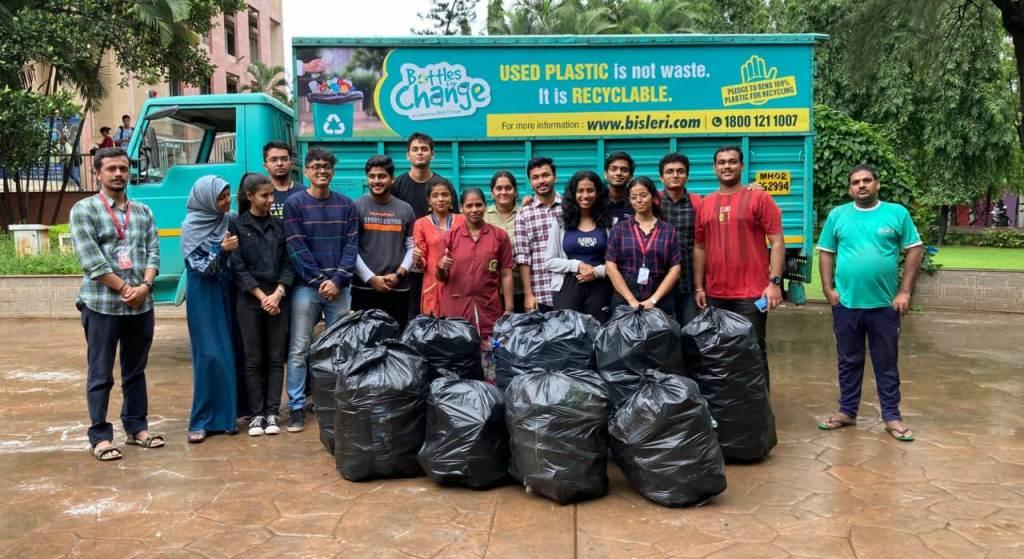
The core initiative involves encouraging consumers, schools, offices to segregate plastic at the source (cleaning and crushing bottles). The company collaborates with Kabadiwalas, aggregators, recyclers, local NGOs, and Municipal Corporations (like MBMC) to streamline collection. They have set up centres run by local Self-Help Groups (SHGs) for efficient processing. They have been converting PET bottles into flakes for T-shirts, bags, furniture; caps into benches, creating value.
Bisleri has launched Plastic Recovery Facilities and Sustainability Inspiration Centers with local bodies like Mira Bhayandar Municipal Corporation (MBMC) in Maharashtra. They have been supporting projects like “Bench of Dreams” and building water harvesting structures such as Project Nayi Umeed.
Tata Power’s Anokha Dhaaga Smart Circularity Programme
Tata Power’s micro-entrepreneurship initiative under the Anokha Dhaaga Smart Circularity programme has transformed over 5,000 kgs of single-use plastic waste into high-quality, recycled fabric products. Spearheaded by women across six centres, the initiative not only addresses the urgent challenge of plastic pollution but also empowers local communities, generating over INR 20 lakhs in fair-trade earnings for women entrepreneurs.

The programme strengthens Tata Power’s commitment to make #SustainableisAttainable. It also integrated denim donations, giving a renewed purpose to pre-loved garments and extending the lifecycle of used clothes.
The project began with a city-wide plastic collection drive across Tata Power’s Trombay plant, residential colonies, and Tata Group and Tata Power offices in Mumbai. Employees and families actively participated, helping divert a significant quantity of plastic waste from landfills. Through a collaboration with ReCircle, a leading circular waste management social enterprise, and their ‘Safai Saathis’ (sanitation workers), the collected waste were converted into RPET (Recycled Polyethylene Terephthalate) fabric.
UNDP and The Coca-Cola Foundation to scale up management of plastic waste in Asia
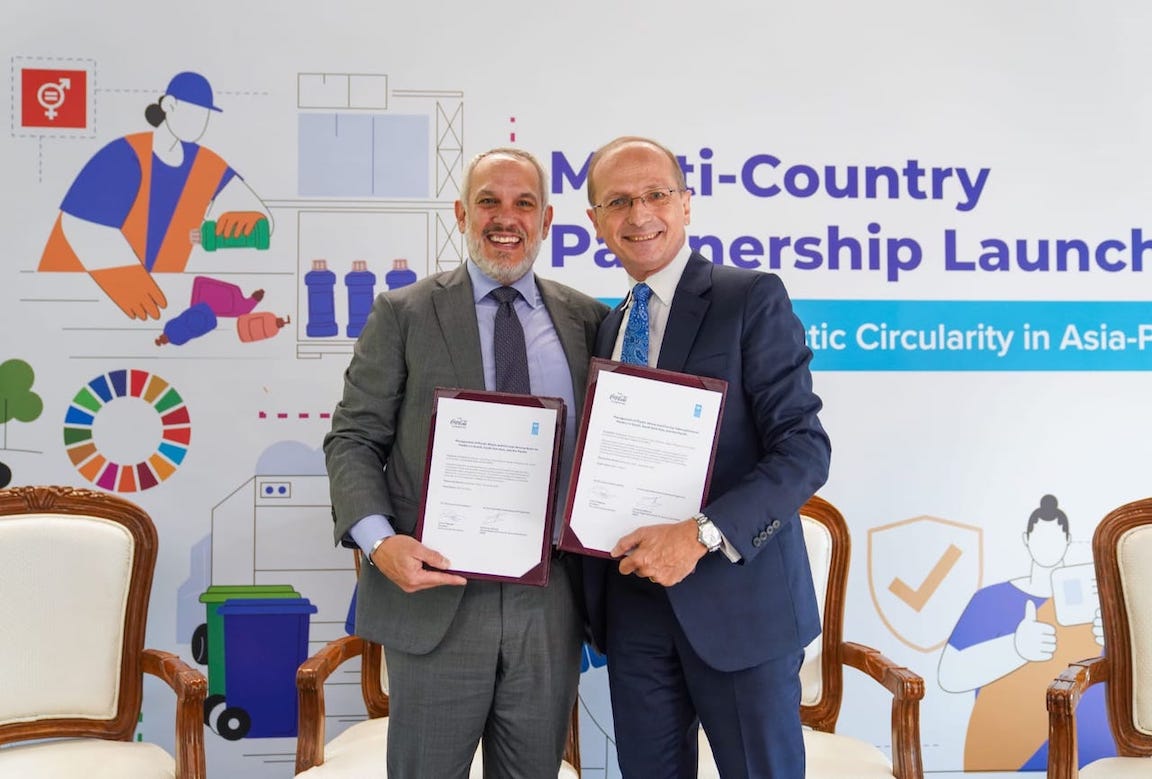
The United Nations Development Programme (UNDP) and The Coca-Cola Foundation (TCCF) have partnered to help address the growing challenge of plastic waste management in Asia, a region that is home to significant environmental opportunities and challenges. Rapid urbanization, increasing demand for single-use plastics, and gaps in waste management infrastructure have contributed to a rising volume of plastic waste, making effective solutions more urgent than ever.
A significant portion of the world’s plastic waste enters the ocean through waterways in the region, posing serious threats to marine ecosystems, human health, and livelihoods. Sixteen of the top twenty polluting rivers in the world are in Asia, and account for more than two thirds -of the global annual volume of plastics flowing into the world’s oceans.
In response to this urgent issue, UNDP and TCCF are scaling up efforts in nine Asian countries—Bangladesh, Bhutan, Cambodia, India, Maldives, Nepal, Philippines, Sri Lanka, and Vietnam—supported by a $15 million grant from TCCF to support UNDP’s initiatives across the region.
The three-year multi-country programme launched in India today, will help improve plastic waste management, promote recycling, reduce plastic leakage into the environment, foster country-based solutions, and facilitate regional collaboration. By adopting and disseminating best practices across the region, the programme aims to inspire policy changes and community-level actions to reduce and help to eliminate disposable plastic and improve the livelihoods of waste workers.
HDFC Mutual Fund’s #NurtureNature 5.0 to Give Plastic Waste a Meaningful Purpose
On the occasion of World Environment Day 2025, HDFC Mutual Fund unveiled the 5th edition of its flagship sustainabilitycampaign, #NurtureNature, in alignment with the United Nations’ theme for 2025 — “Ending Plastic Pollution.”
This year’s campaign carries a meaningful promise of giving plastic waste a purpose. Over the years, HDFC Mutual Fund has supported many environmental causes. Through #NurtureNature, it has helped people participate in this journey by encouraging small, meaningful actions that contribute to a cleaner and more responsible future.”

As part of #NurtureNature 5.0, from June 5 to June 12, 2025, for every new Systematic Investment Plan (SIP) registered digitally in select HDFC Mutual Fund schemes, the schemes will contribute ₹100 toward providing school bags made from recycled plastic waste for children in need.
These school bags do more than recycle plastic, they give discarded plastic a second life, keeping it out of our oceans, landfills and streets, while helping children carry their books, their dignity, and their dreams.
Instant noodle brand to upcycle plastic waste into park equipment in Indian metro cities
Sunfeast YiPPee!, instant noodle and pasta brand from ITC Ltd., runs a campaign – ‘YiPPee! Better World: Create Magic’. As part of this campaign the brand aims to educate, raise awareness, collect and upcycle plastic waste by turning it into park equipment like swings, jungle gyms etc. The campaign is implemented in four major metropolitan cities – Delhi-NCR, Mumbai, Kolkata and Bengaluru.
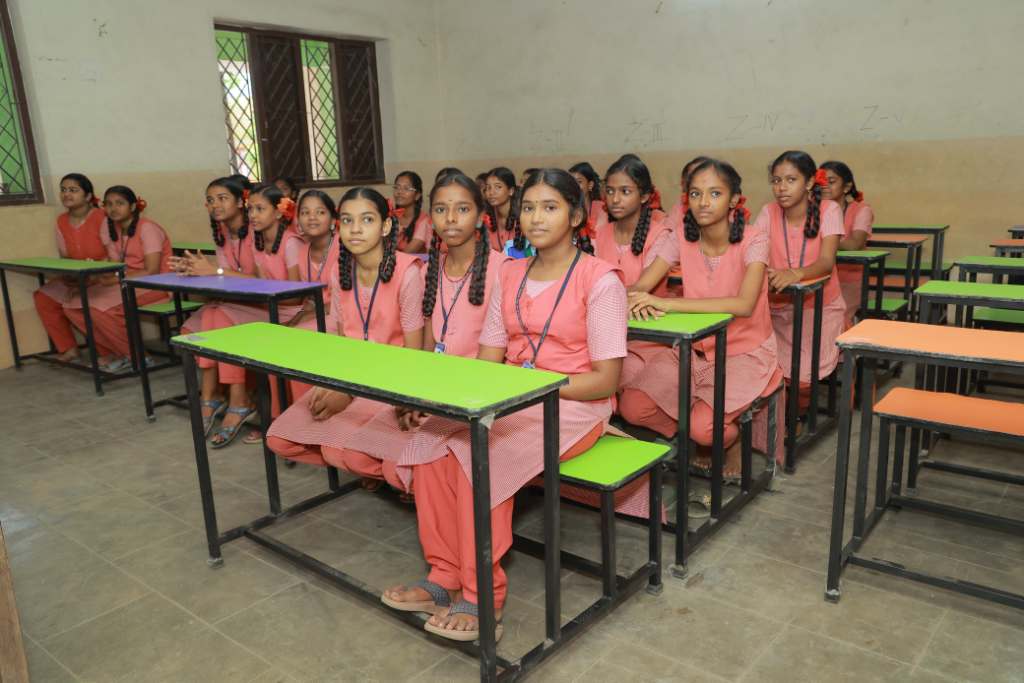
Playground equipment in city parks is essential for recreation, especially for children. The initiative follows a two-pronged approach for maximum impact:
Upcycling Plastic Waste: Converting plastic waste into sturdy, colourful playground equipment – from swings to jungle gyms. The intent is to give a second life to discarded plastic materials, thereby putting it to good use as well as reducing plastic in landfills.
Community Involvement: It involves conducting large-scale awareness, voting and plastic waste collection drives, rallying the larger community to participate in the movement.
Through the ‘YiPPee! Better World Programme’, 2.5 lakh school students across 400 schools in Chennai have been educated on plastic waste management practices. This initiative is designed to bring behavioural change in students across Chennai through on-the-ground awareness programs in schools about plastic waste, its impact on the environment, and strategies to reduce, reuse, and recycle plastic waste. Students were encouraged to collect household plastic waste and to deposit it at designated collection points in schools. The plastic waste collected contributed towards the creation of benches and desks made from recycled plastic. These benches are being deployed in schools that need this infrastructure. One such school is Rani Meyyammai Girls Higher Secondary School in Chennai, where 100 benches and desks made from upcycled plastic waste have been deployed by YiPPee!.
Akshayakalpa Organic’s sustainability initiative ‘Give Back the Milk Pack’
Dairy company Akshayakalpa Organic runs a sustainability initiative, ‘Give Back the Milk Pack’. This innovative initiative encourages consumers to bring back their used milk packets for responsible recycling, sparking a significant revolution in the battle against plastic pollution. The programme runs in major Indian cities like Bengaluru, Hyderabad and Chennai.
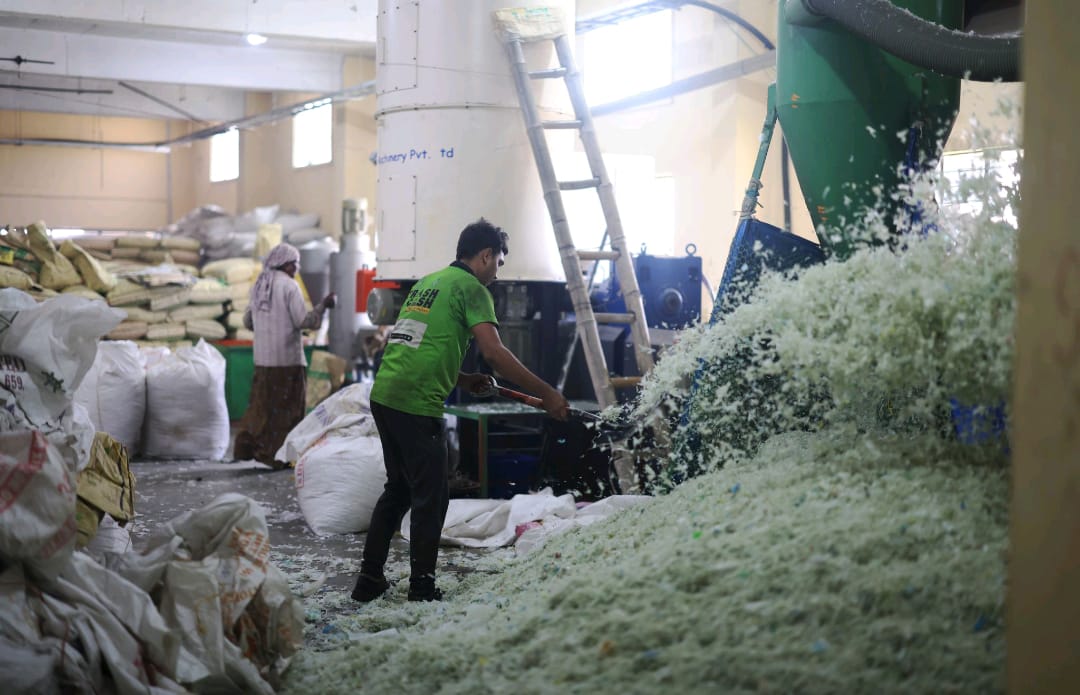
Since the inception of this initiative in 2022, Akshayakalpa Organic has recycled more than 40000 kg of plastic in total across Bengaluru, Chennai and Hyderabad highlighting that when people come together for a common cause, small actions can create a big impact. This recycling program introduced by the brand urges consumers to follow three easy steps — rinse the pack for 30 seconds, hang it to dry, and once it dries then return it by placing it in a delivery bag. The consumers thus also play a pivotal role in creating a sustainable future for their generations to come through this simple process.
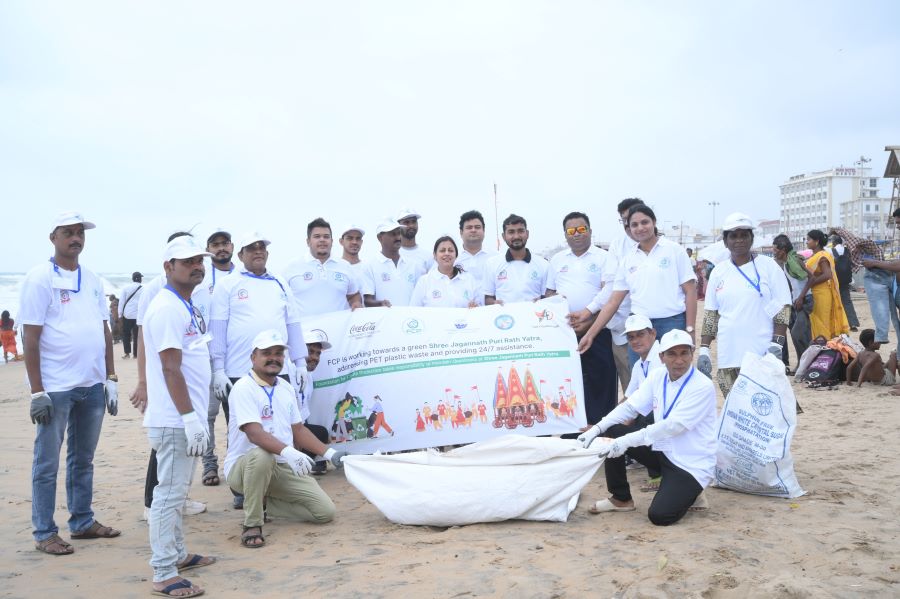
Over 17,000 kgs of used PET bottles collected under CSR at the Puri Ratha Yatra 2024
Hindustan Coca-Cola Beverages one of India’s leading FMCG companies in partnership with the Anandana Coca-Cola India Foundation; State Pollution Control Board, Odisha; Y4D Foundation and supported by Foundation for Climate Protection (FCP), Odisha Development Management Programme (ODMP) and Puri Municipality, has collected over 850,000 used PET bottles, totalling more than 17,000 kgs, at the Puri Ratha Yatra 2024. This year’s festival, which attracted millions of devotees, saw HCCB not only continue its commitment to environmental stewardship but also enhance its efforts to promote recycling and waste management among the festival attendees.