


The World Is Running Out of Helium and It Could Disrupt Modern Life
The CSR Journal Magazine

Recent military actions in the Middle East have led to a significant reduction in Qatar’s liquefied natural gas (LNG) export capacity, jeopardizing approximately 17 percent of its output. This situation poses potential annual revenue losses nearing $20 billion and threatens energy supplies to both Europe and Asia. The ongoing conflicts involving the United States, Israel, and Iran have notably affected key operational facilities, particularly in relation to helium production, drawing attention to this rare and irreplaceable element.

Understanding Helium and Its Characteristics

Helium is a colorless, odorless, and inert gas, recognized as the second lightest element in the universe, following hydrogen. Its chemical stability is crucial for a variety of sensitive industrial applications. One of helium’s defining features is its extremely low boiling point, which allows it to facilitate temperatures essential for advanced technological processes.

Natural Occurrence of Helium

Helium exists naturally on Earth, having formed over billions of years through the radioactive decay of heavier elements like uranium and thorium. It accumulates in pockets within natural gas reservoirs deep underground. However, helium is distinct from other gases; once it is released, its lightness causes it to rise into the atmosphere and escape Earth’s gravitational pull, resulting in a permanent loss to space. This quality renders helium non-recyclable once utilized.

Extraction Methods for Helium

The primary method of helium extraction is from natural gas fields where it exists in minuscule percentages due to underground radioactive decay. Specialized wells drill through cap rock to release this gas mixture, which is then transported to processing facilities. The raw gas undergoes a scrubbing process to eliminate water, carbon dioxide, and hydrocarbons. Following this, a cryogenic distillation process cools the gas to nearly absolute zero, liquefying all components except helium, which remains gaseous. Facilities such as QatarEnergy’s Ras Laffan complex, notable for being the largest helium production site globally, rely on this method to separate and purify helium to high standards. This extraction process is linked to LNG production; a halt in LNG operations equates to a cessation in helium extraction.

Applications of Helium in Modern Life

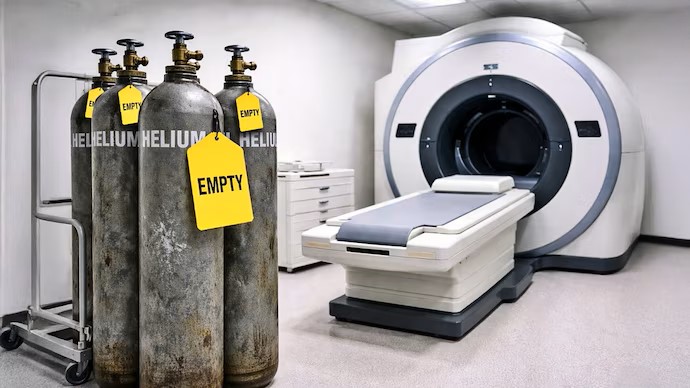
Helium plays a foundational role in several vital sectors, despite its simple structure. In the semiconductor industry, it cools silicon wafers and facilitates chip fabrication, crucial for advanced processors and data centers. In healthcare, liquid helium is essential for cooling superconducting magnets in MRI machines globally. In space and defense, helium pressurizes rocket fuel tanks and prepares propulsion systems for launches. Furthermore, scientific research facilities, including particle accelerators, depend on helium-based cryogenics for optimal functionality. Currently, there are no feasible large-scale alternatives to replace helium in these applications.

Causes Behind Helium Depletion

The world’s helium reserves, concentrated primarily in the United States and Qatar—together responsible for about 30-38 percent of the total output—are diminishing steadily. The shutdown of the US Federal Helium Reserve in 2021 accounted for a loss of approximately 10 percent of production capacity. At the same time, demand is escalating, particularly from MRI machines, which consume 25-30 percent of global helium supplies, while semiconductors take up an additional 20-25 percent. The geopolitical tensions, especially related to the ongoing conflict in West Asia, have further complicated helium production linked to LNG in Qatar, causing a significant disruption in supply. Price surges have been observed, with some markets seeing almost a doubling of prices. This concentrated market raises concerns about vulnerability to future supply disruptions.

Global Dependencies and Future Challenges

Countries like South Korea, which depend heavily on Qatari helium for semiconductor manufacturing, may face severe challenges in the coming months. With limited helium reserves available elsewhere and no industrial-scale extraction method from the atmosphere, the situation underscores a critical reliance on helium across various industrial sectors from healthcare to artificial intelligence, highlighting the precarious nature of our dependence on a resource that is essentially lost once utilized.

Long or Short, get news the way you like. No ads. No redirections. Download Newspin and Stay Alert, The CSR Journal Mobile app, for fast, crisp, clean updates!

App Store –  https://apps.apple.com/in/app/newspin/id6746449540 

Google Play Store – https://play.google.com/store/apps/details?id=com.inventifweb.newspin&pcampaignid=web_share

Latest News

Popular Videos
