app-store-logo
play-store-logo
February 27, 2026

The Robot Dog That Bit Back: Galgotias Was the Headline. The System Is the Story
The CSR Journal Magazine

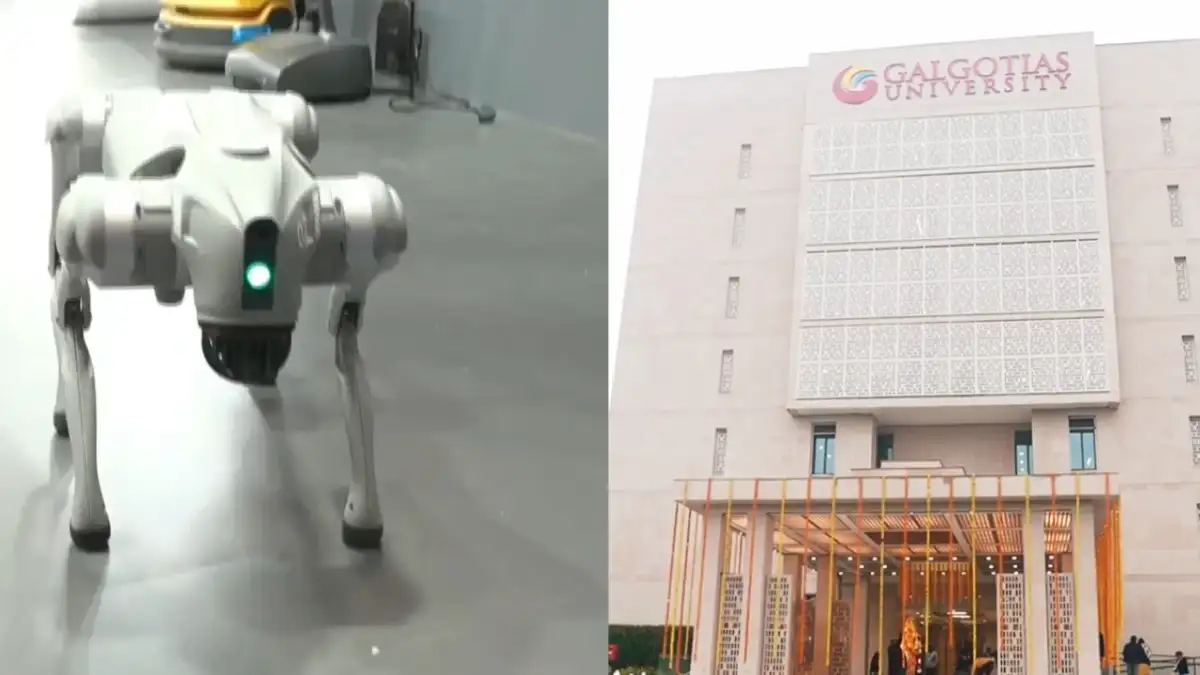
On February 17, 2026, at the India AI Impact Summit in New Delhi — a gathering attended by Prime Minister Narendra Modi, French President Emmanuel Macron, Google CEO Sundar Pichai, OpenAI’s Sam Altman, Microsoft’s Brad Smith, and Anthropic’s Dario Amodei — a Professor of Communication Studies from Galgotias University walked up to a state broadcaster’s camera and introduced the world to “Orion.” This, she told DD News, was a robotic dog developed by the ‘Centre of Excellence’ at Galgotias University.

Within hours, the internet identified it as the Unitree Go2, a commercially available product from a Chinese robotics firm, retailing at roughly $1,600. The clip went viral. Side-by-side comparisons circulated. The university was ordered to vacate its pavilion mid-summit. International headlines followed. In full view of global technology leaders, India’s moment of showcased innovation had become something else entirely. Then came the official apology.

“She was not aware of the technical origins of the product,” Galgotias University’s press release stated, “and in her enthusiasm at being on camera, gave factually incorrect information.” It also noted, for good measure, that she “was not authorised to talk to the media.”

Let us sit with that for a moment.

A university sends a professor of communications — of all the academic specialisations one might choose — to represent it at the nation’s most consequential technology summit. She stands at the stall. She speaks on camera. The segment airs on national television. And then, when the internet catches the institution with its hands in the cookie jar, the institution’s official response is that she was not authorised to speak and did not know what she was talking about.

One is entitled to ask: if that is true, why was she there?

The professor in question, Neha Singh, later told PTI that she had “misspoken” in the excitement of the moment and clarified that she had never meant to claim the university had manufactured the robot. It is entirely possible that she genuinely did not know. Which raises a more damaging question for the institution: who did?

Someone placed that robot dog on the display table. Someone named it “Orion.” Someone briefed the representatives who would stand beside it at a national government summit. Was that briefing silent on the fact that it was a $1,600 product anyone could order online? Was the professor handed a script and a smile and pointed toward a camera with no further instruction? And if so, what does that say about the chain of decision-making within the institution?

The organisational psychology term for this pattern is well-established. The “Glass Cliff” — first identified by British researchers Michelle Ryan and Alexander Haslam — describes the tendency to place women, and members of other underrepresented groups, in positions of highest visibility precisely at the moments of highest institutional risk. In the Galgotias episode, the person positioned at the frontline was a communication faculty member, not a researcher from the Centre of Excellence, not the dean of engineering, not a member of the management. When the crisis arrived, she was described, in the institution’s own words, as uninformed and unauthorised. This is not an isolated failure of one person’s preparation. This is a window into how a certain kind of institution operates: performance at the front, insulation at the top.

A Communication Professor Talking About AI: What’s Wrong With That?

There is a subtler issue here, one that deserves more attention than it has received. Why is it remarkable, or even newsworthy, that a communications professor was at an AI summit?

It should not be. Artificial intelligence is not a technology story alone. It is a communications story, a sociological story, an ethical story, a policy story. Some of the most incisive work being done on AI globally comes from scholars trained in philosophy, linguistics, media studies, and the humanities. Interdisciplinary inquiry is not a weakness. It is, in fact, precisely what the discipline of AI demands if it is to be deployed responsibly.

The mockery directed at the professor’s presence — the suggestion that a “comms” person had no business being at a technology event — tells us something about how narrowly India’s educational establishment, and its amplifiers in media, conceive of knowledge. We are comfortable with the engineer who builds without being asked whether the building is necessary. We are uncomfortable with the humanist who insists on the question.

The National Education Policy 2020 — celebrated as the most ambitious reform of India’s education architecture in 3 decades — specifically advocates for multidisciplinary learning. It promises flexibility across disciplines, encourages liberal education, and envisions graduates who think across domains. Yet when a university deploys that principle at a public event, the reflex response from the commentariat is to ridicule the choice of spokesperson.

The problem at Galgotias was not that a communications professor spoke about technology. The problem is that she was placed there to present something she had apparently not been adequately briefed on. Those are entirely different failures. One is an institutional failure of preparation. The other is a structural failure of how we imagine disciplinary authority. Both deserve examination. Only one is being examined.

The Tip of a Very Large Iceberg

Here is the question that has not been asked loudly enough: how did a private university secure a prominent exhibition pavilion at a summit that India was using to signal its technological credibility to the world? What was the vetting process? Who approved the applications? What documentation was submitted?

The Samajwadi Party’s MLA raised these questions in the Uttar Pradesh state assembly, and they are the correct questions. But they are also the opening line of a much longer inquiry.

If India were to deploy a genuinely independent, external audit of its higher education institutions — not the self-reported metrics that feed the current accreditation system, but an arms-length examination of patent filings, research publications, faculty compensation records, and institutional finances — the Galgotias episode would be, at most, a footnote.

Consider the landscape: the total number of universities in India has nearly doubled from 764 in 2014 to 1,338 in 2025, but many exist only on paper, operating from temporary campuses with poor infrastructure and dismal faculty-student ratios. This proliferation was not accompanied by commensurate investment in faculty development, library infrastructure, laboratory equipment, or research ecosystems. What it was accompanied by, in many cases, was a race for accreditation scores — scores that, as the country now knows, were not always earned.

On February 1, 2025, the Central Bureau of Investigation (CBI) arrested the chairman and 6 members of a National Assessment and Accreditation Council (NAAC) inspection committee in a corruption case that shook the higher education establishment. The CBI conducted raids across 20 locations in India, including Chennai, Bangalore, and New Delhi, recovering ₹37 lakhs in cash, gold, mobile phones, and laptops. The bribes were allegedly given by office bearers of a Guntur-based educational foundation which operates KL University.

Among those arrested was Samarendra Nath Saha, who is also the vice-chancellor of Ramchandra Chandravansi University, and a professor from Jawaharlal Nehru University. The charge was straightforward: an A++ accreditation, the highest a university can receive in India, had allegedly been sold for cash, gold, and laptops.

This was not a peripheral case. NAAC accreditation determines a university’s eligibility for UGC funding, its standing in national rankings, its ability to attract students and faculty, and its credibility with employers. If the accreditation can be bought, then the entire architecture of quality assurance in Indian higher education is compromised. Every high-ranking institution that was assessed by a compromised committee must now ask itself an uncomfortable question. Every student who chose a university based on its NAAC grade deserves an answer.

NAAC has since announced a shift from physical inspections to a digital system for accreditation, in line with the Radhakrishnan Committee’s recommendations to the Ministry of Education. Whether a digital system merely digitises the same vulnerabilities, or genuinely restructures incentives, remains to be seen.

The Publish-or-Perish Trap

The accreditation scandal is one thread. The research output scandal is another.

Indian universities are under enormous pressure to demonstrate research productivity. Publications, patent filings, and citations feed into rankings and regulatory assessments. The result is a system that has created powerful financial incentives for misconduct. In 2020-22, India saw a 2.5x increase in retractions largely due to misconduct. Predatory journals remain a major threat, with India contributing significantly to fake publications.

The University Grants Commission introduced the UGC-CARE list in 2018 to identify legitimate journals and discourage predatory publishing. But in October 2024, the commission scrapped this list, arguing that it over-centralised decisions and neglected regional language journals. Instead, India’s higher education institutions were asked to design their own mechanisms to assess journal quality. Critics argue that this opens further pathways for predatory journals to flourish.

Studies have found that roughly 27% of predatory journal publishers are based in India, and approximately 35% of authors in such journals are affiliated with Indian institutions. More than 300 publishers in India manage predatory journals — operations that exist not to advance knowledge but to extract publication fees ranging from $30 to $1,800 per article, in exchange for the appearance of scholarly output.

When a university’s promotion criteria require publications, and legitimate publications are difficult to achieve, the path of least resistance is the path to a predatory journal. The institution gets a number to report. The academic gets a line on their CV. The knowledge ecosystem gets noise. Everyone wins except the student who is being taught by someone whose academic record is partly fiction, and the employer who hires a graduate from a university whose research pedigree is, at least in part, manufactured.

Patent filings follow a similar logic. The pressure to show innovation, to have something tangible for rankings and for exhibition stalls at government summits, has created a market for patent applications that are filed not to protect genuine inventions but to generate a metric. Whether an independent audit of Indian university patent portfolios would survive rigorous international examination is a question the system has been careful not to ask.

It is instructive that Galgotias University appeared in this story at all — because it had been appearing in a very different kind of story for several years prior. The institution has, in recent reporting, been counted among India’s most prolific patent filers. In 2022-23, it ranked among the top 3 academic patent applicants in the country, filing 1,089 patent applications — more than many of the IITs combined. In 2024, it crossed the 1,500 mark in annual filings.

These numbers, presented in isolation, look impressive. They appear in rankings. They feed into NIRF scores. They are cited in promotional materials.

Now for the other number.

Between 2020 and 2025, Galgotias University filed 2,233 patents. The number granted: 2. That is a grant rate of 0.1 percent.

This is not an outlier. Lovely Professional University (LPU), which routinely tops patent filing charts, filed 7,096 patents over the same period and received 164 grants — a rate of 2.3 percent. Chandigarh University filed 5,318 patents and received 45 grants, a rate of 0.8 percent. Shobhit Institute filed 961 patents and received 0 grants.

Compare this with the institutions that have spent decades building genuine research cultures. All IITs collectively achieved a grant rate of 42.8% over the same period. IISc Bengaluru achieved 46.5 percent. The NITs, often overlooked in this conversation, achieved 41 percent.

India’s total patent filings increased from 58,503 in 2020-21 to 1,10,375 in 2024-25, nearly doubling in 4 years, with educational institutions driving a 61.7% surge. Yet only a small fraction of those filings result in grants, and a vanishingly small fraction result in commercially transferred technologies.

The commercialisation gap is where the contrast becomes starkest. IIT Madras, which filed 417 patents in 2024-25, has in the last 5 years transferred technologies through licensing deals worth Rs 28 crore to industry partners including a 5G RAN sub-system technology licensed to the Tata Group. Its Technology Transfer Office generates approximately Rs 2.5 crore annually in licensing revenue, with 30 or more IP deals executed in 2024-25 alone.

No comparable commercialisation data appears to exist for the institutions filing thousands of patents a year.

Why does this matter? Because the National Institutional Ranking Framework (NIRF) provides double weightage to granted patents compared to published ones, and NAAC accreditation also considers research and patents. 

The incentive is not to innovate. The incentive is to file. Filing is cheap, administratively manageable, and legible to ranking committees. Getting a patent granted requires the invention to survive examination. Getting it commercialised requires someone in the world to find it valuable enough to use.

The ranking system, in its current architecture, does not differentiate meaningfully between an institution that filed 5,000 patents and received 40 grants, and one that filed 400 patents and received 170 grants and transferred five technologies to industry. The result is a system where volume becomes strategy, and strategy becomes performance, and performance replaces the thing it was designed to measure.

Achal Agarwal, Founder of India Research Watch (IRW) and named by Nature magazine as one of the world’s top science advocates in 2025, puts it plainly: “For Indian institutions, the reason for filing patents is not just economic, but largely the rankings and the ratings system.”

The robot dog at the AI summit was a physical metaphor for something that has been happening in spreadsheets for years. A product is acquired. A name is placed on it. It is displayed. Credit is claimed. The system that should verify the claim does not, because the system is designed to count, not to interrogate.

What NEP 2020 Promised, and What the Ground Reality Delivered

The National Education Policy (NEP 2020) is, by any reading, an ambitious document. It envisions a fundamental restructuring of Indian schooling and higher education — multidisciplinary learning, critical thinking, reduced emphasis on rote examination, integration of vocational and academic streams, autonomy for institutions of demonstrated quality, and an aspiration to raise public spending on education to six percent of GDP.

The aspiration has not been met. India currently spends approximately 4.6% of GDP on education, significantly below the NEP’s own target and below the global average for comparable economies. The UGC has not had a full-time head since early 2025. A reformed accreditation system, born in the aftermath of scandal, is still in transition. The multidisciplinary learning agenda, while formally adopted, has encountered an institutional culture that does not know how to reward, assess, or even take seriously the scholar who crosses departmental lines.

The deeper problem is that NEP 2020 was written as though institutions were ready to be reformed. Many are not. A policy that hands greater autonomy to universities assumes that the universities in question have the governance structures, the financial probity, and the academic culture to use autonomy well. In institutions where management operates as a real-estate venture with an educational licence, where faculty salaries are suppressed far below the statutory minimum, where promotions are tied to political loyalty rather than academic merit, and where the governing boards are constituted of the promoter’s family members, autonomy is not a gift to scholars. It is a gift to proprietors.

The Exodus That Numbers Confirm

There is a verdict on Indian higher education that does not appear in any regulatory report, any NAAC grade, or any government ranking exercise. It appears in passport data.

India hosted 46,878 inbound international students in 2021-22 while sending over 11.59 lakh students abroad — a number that climbed to 13.36 lakh by 2024, highlighting a persistent and widening imbalance in student mobility. As the NITI Aayog report on the internationalisation of Indian higher education stated plainly, the current trend has contributed significantly to brain drain.

In 2024, for every one international student who came to India, about 28 Indian students went abroad for higher education. The ratio is not a gentle lean. It is a rout.

Indian students’ overseas spending on tuition and living expenses could reach Rs 6.2 lakh crore by 2025, nearly 2% of India’s GDP. These expenses are projected to account for almost 75% of India’s total trade deficit in FY 2024-25. Outbound remittances for education under the Reserve Bank of India’s Liberalised Remittance Scheme rose nearly 2,000 percent between 2014 and 2024, increasing from Rs 975 crore to Rs 29,000 crore.

A country that is building Bharat Mandapam to host global technology summits is simultaneously watching its young people vote with their feet — and their families’ savings — in favour of universities in Canada, the United States, the United Kingdom, Germany, and, in growing numbers, Latvia, Ireland, and other European nations where Indian students now constitute a significant share of international enrolments.

Since 2011, over 1.6 million individuals have relinquished Indian citizenship. This is not an abstract statistical trend. These are researchers, engineers, physicians, entrepreneurs, and academics who concluded that the Indian system — its institutions, its incentives, its infrastructure, its governance — was not where they wished to build their working lives.

The same AI summit that was supposed to demonstrate India’s technological readiness saw a university exhibit a Chinese product as domestic innovation. The same higher education system that produces 24,000 PhD graduates annually paid $14.3 billion in intellectual property royalties abroad in 2024, while earning only $1.5 billion. India consumes more knowledge than it creates, and the most commercially significant knowledge it sends overseas in the bodies of its graduates, who then create it on someone else’s balance sheet.

The Accountability Deficit

All of this — the Galgotias episode, the NAAC bribery case, the predatory publication ecosystem, the patent inflation, the brain drain — is connected by a single thread: the absence of credible, independent, external accountability in Indian higher education.

The current regulatory architecture — the UGC, NAAC, AICTE, and the various state regulatory bodies — is built on a model of institutional self-reporting, periodic inspection, and accreditation. That model has failed in ways that are no longer deniable. The NAAC’s own inspection chairman was arrested for taking bribes. The UGC’s journal quality list was discontinued partly because it had been colonised by the very predatory publishers it was supposed to exclude. A university that presented a commercially available robot as its own invention had been awarded sufficient regulatory standing to attend a government summit.

What would genuine accountability look like? It would begin with a requirement that all higher education institutions publish audited financial statements — not regulatory filings designed by the institution’s accountants, but independently audited accounts accessible to the public, showing what fees are collected, where the money goes, what is paid in salaries, and what is returned to promoters or affiliated entities. It would include an independent review of a statistically significant sample of published research, to assess whether the publications are in credible journals and whether the research reported is genuine. It would include physical inspection of facilities against stated claims. It would include anonymous faculty surveys on pay, working conditions, and institutional governance.

None of this is administratively impossible. Some of it is already mandated in theory. Almost none of it is enforced in practice.

India spent decades building a higher education system premised on the idea that the credential — the degree, the accreditation grade, the publication count, the patent filing — was the thing. The credential could be manufactured. The credential could be purchased. The credential could be performed.

The credential that cannot be manufactured, purchased, or performed is what a robotics expert would call genuine capability. It is what a student needs when she graduates. It is what an employer is actually looking for. It is what India needs if its AI ambitions are to be more than an exhibition stall.

A Moment That Deserves More Than Outrage

The professor who stood beside that robot dog in New Delhi deserved better from her institution. The institution, it would appear, knew exactly what it was doing when it decided she should stand there — and exactly what it was doing when it decided, afterward, that she had been acting without authorisation.

The students who enrolled at institutions like Galgotias, and at the 100s of other universities that have proliferated across India over the past decade, deserve better from the system that granted those institutions the legitimacy to accept their fees. The public, which trusted the accreditation architecture, deserves to know how many other A++ grades and “Centres of Excellence” were similarly constructed.

And the country that gathered the world’s technology leadership in New Delhi — that hosted the CEOs of Google, OpenAI, Microsoft, and Anthropic under one roof — deserves an honest conversation about whether its higher education system is capable of producing the talent, research, and genuine innovation that its ambitions require.

The robot dog has been returned to its stall. The exhibition pavilion has been vacated. The apology has been issued.

The questions it raised have barely been asked.

Views of the author are personal and do not necessarily represent the website’s views.

Dr. Jaimine Vaishnav is a faculty of geopolitics and world economy and other liberal arts subjects, a researcher with publications in SCI and ABDC journals, and an author of 6 books specializing in informal economies, mass media, and street entrepreneurship. With over a decade of experience as an academic and options trader, he is keen on bridging the grassroots business practices with global economic thought. His work emphasizes resilience, innovation, and human action in everyday human life. He can be contacted on jaiminism@hotmail.co.in for further communication.

Long or Short, get news the way you like. No ads. No redirections. Download Newspin and Stay Alert, The CSR Journal Mobile app, for fast, crisp, clean updates!

App Store – https://apps.apple.com/in/app/newspin/id6746449540

Google Play Store – https://play.google.com/store/apps/details?id=com.inventifweb.newspin&pcampaignid=web_share

Latest News

Popular Videos