


app-store-logo
play-store-logo
March 16, 2026

Rare Collision of Two Planets Captured in Telescope Data Offers Insights into Moon’s Formation
The CSR Journal Magazine

Anastasios Tzanidakis, a doctoral candidate at the University of Washington, recently uncovered a significant astronomical event while analyzing old telescope data. During his examination of archived records from 2020, Tzanidakis found unusual behavior from Gaia20ehk, a stable star located approximately 11,000 light-years away. Instead of maintaining consistent brightness, the star exhibited erratic flickering patterns that raised questions about its stability.

Understanding the Star’s Flickering

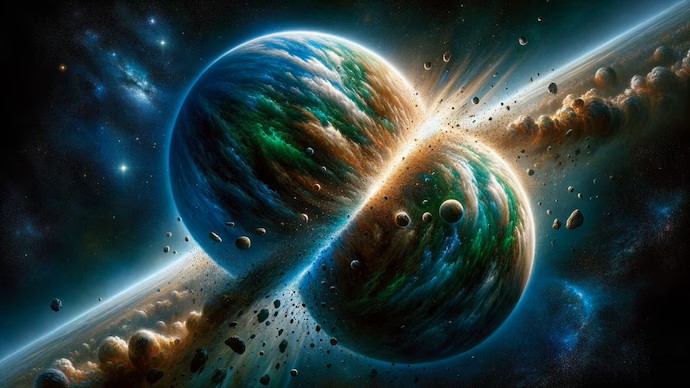
The fluctuations in brightness were not inherent to Gaia20ehk itself, but rather caused by large amounts of dust and rocky debris passing between the star and Earth. The debris is believed to have originated from a cataclysmic collision between two planets. Tzanidakis noted that the star’s light output was initially stable, but began to show significant dips around 2016, culminating in pronounced flickering by 2021.

Transition to Infrared Observations

To delve deeper into the phenomenon, researchers analyzed infrared data, which revealed a spike in light intensity as the visible light diminished. Tzanidakis explained that this change indicates the presence of hot material obstructing the star’s light, consistent with the extreme temperatures generated by a destructive planetary collision. The initial gradual declines in brightness likely stemmed from the planets slowly moving closer together, culminating in their final impact.

Comparison to Earth and Moon Formation

This recent planetary collision mirrors the event believed to have formed the Earth-Moon system approximately 4.5 billion years ago. The debris surrounding Gaia20ehk orbits at a distance comparable to that between the Earth and the Sun, suggesting that it might eventually cool and solidify into structures similar to the Earth and its Moon. Senior study author James Davenport, an assistant research professor of astronomy at UW, emphasized the fundamental significance of understanding the rarity of such events in the context of astrobiology.

Importance of the Moon in Earth’s Habitability

Davenport highlighted that the Moon plays a crucial role in making Earth a habitable planet. It helps shield the Earth from asteroid impacts, influences ocean tides, and may even contribute to tectonic activity. The new findings enhance our understanding of the conditions that lead to life-sustaining planetary systems in the universe.

Continuing Research in Astronomy

The findings regarding Gaia20ehk have been documented in The Astrophysical Journal Letters. As researchers continue to analyze the data surrounding this event, they aim to shed further light on the processes that shape planetary systems and their potential for harboring life. The observations from Tzanidakis’ research represent a remarkable step forward in our understanding of cosmic phenomena and the histories of celestial bodies.

Long or Short, get news the way you like. No ads. No redirections. Download Newspin and Stay Alert, The CSR Journal Mobile app, for fast, crisp, clean updates!

App Store –  https://apps.apple.com/in/app/newspin/id6746449540 

Google Play Store – https://play.google.com/store/apps/details?id=com.inventifweb.newspin&pcampaignid=web_share

Latest News

Popular Videos
